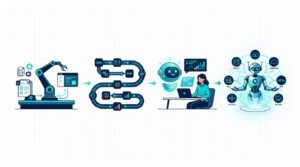


Most large companies are running on software that’s older than the smartphones in their employees’ pockets. These systems were built for a different era, when business moved slower and change happened quarterly, not daily. Now they’re becoming expensive anchors. Companies spend 60 to 80 percent of their IT budgets just keeping old systems running, according to McKinsey research. That leaves almost nothing for actual innovation.
What’s changed isn’t just technology. It’s what companies need technology to do. Businesses now compete on how fast they can spot patterns, predict what customers want, and adapt to market shifts. Legacy systems weren’t designed for this. They were built to process transactions reliably and store data safely, which they still do, but they can’t learn, can’t adapt, and can’t help humans make better decisions in real time.
AI software development companies have become critical partners in fixing this problem. They’re not just coding new features onto old systems. They’re rebuilding how enterprise software works from the ground up, embedding intelligence directly into business operations. After 2020, when supply chains collapsed and customer behavior changed overnight, companies with adaptive systems recovered faster. IEEE research found they cut response times by 40 to 65 percent while making more accurate predictions about what would happen next.
The math on legacy systems has stopped making sense. Direct costs keep rising as the people who know how to maintain old platforms retire. Indirect costs hurt worse: features that take a year to build, integration nightmares, and security holes that vendors stopped patching. Companies are realizing that small fixes won’t work anymore. They need partners who understand both AI and how to transform complex enterprises without breaking what still works.
The Shift From Legacy Architecture to Intelligent Systems
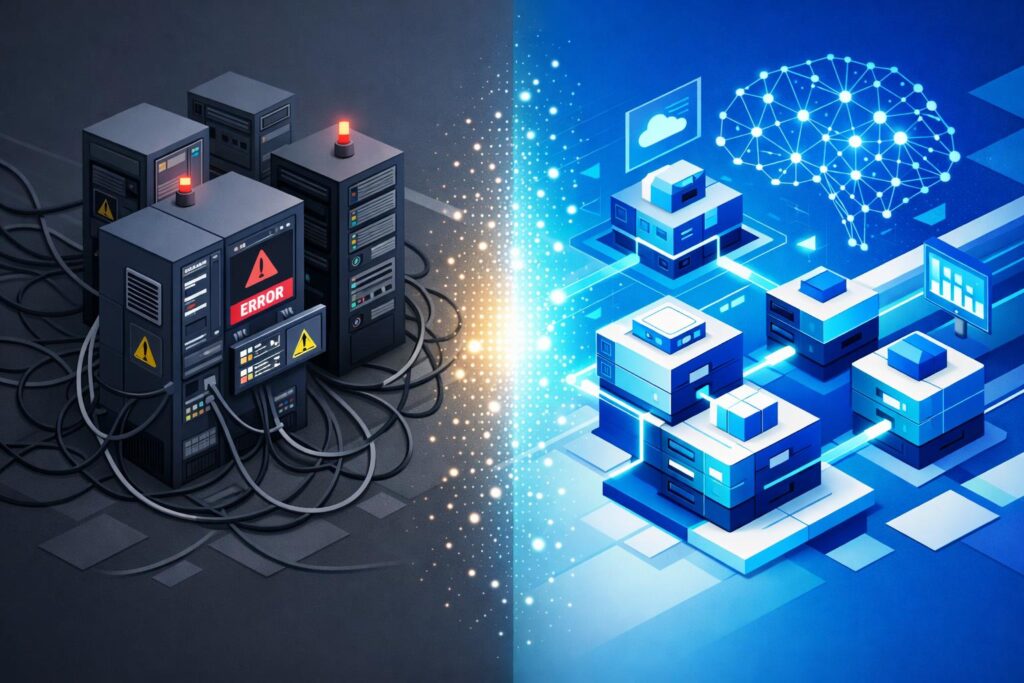
Three forces are pushing companies to modernize faster than ever. First, regulations keep getting more complex. Banks, hospitals, and anyone handling personal data face requirements that old systems simply can’t meet without armies of people doing manual compliance checks. Second, customers now expect every interaction to feel personalized and instant. Third, startups are launching on modern platforms with cost structures 30 to 50 percent lower than established competitors, and they’re taking market share.
Limitations of Legacy Systems
Old systems fail in predictable ways. They’re usually built as single massive applications where everything connects to everything else. Change one thing and you risk breaking ten others. They run on programming languages that fewer people learn each year, creating dependence on a shrinking pool of expensive specialists. Connecting them to modern tools requires building custom bridges that add complexity and new points of failure.
The manual work these systems require adds up fast. Humans validate data that intelligent systems would catch automatically. They handle exceptions that pattern-recognition algorithms would route correctly. They make routine decisions that machine learning models would optimize. This isn’t just inefficient—it’s a talent waste, burning skilled workers on repetitive tasks.
Security problems with legacy systems are getting serious. Most were built before today’s cyber threats existed. Their defenses are outdated. When vendors stop supporting old platforms, security patches stop coming. The system stays vulnerable forever. A healthcare provider learned this in 2023 when attackers exploited a 15-year-old claims system, compromising millions of patient records and triggering over $120 million in penalties.
Banks face some of the worst legacy challenges. Their core platforms from the 1980s and 1990s still process trillions in transactions daily, but they can’t handle real-time payments or sophisticated fraud detection. One European bank needed 400 engineers just for maintenance. New features took 18 months while competitors shipped them in weeks. Worse, the system couldn’t support the API connections that regulators now require for open banking. The bank was locked out of its own market by its own technology.
What Defines Intelligent Software Systems
Intelligent systems work differently at a fundamental level. Instead of following rigid instructions, they learn from what’s actually happening. They spot patterns humans would miss. They predict what’s likely to happen next. They adjust their behavior automatically without anyone rewriting code. When conditions change, they adapt.
These systems process information continuously, not in batches. Traditional systems analyze yesterday’s data to plan tomorrow’s actions. That delay kills competitive advantage. Intelligent platforms react to what’s happening now: a customer showing signs of leaving, a supply chain disruption forming, a fraud pattern emerging. The system sees it, understands it, and responds while it still matters.
The architecture matters. Intelligent systems are built from independent components that talk to each other through clean interfaces. You can upgrade one piece without touching the others. You can test new capabilities safely. You can scale the parts that need it without wasting resources on the parts that don’t. Machine learning isn’t bolted on as an extra feature. It’s woven throughout, fundamental to how the system perceives reality and decides what to do.
How AI Software Development Companies Drive Transformation
AI software development companies bring something different from traditional IT consultants. They understand machine learning infrastructure deeply. They know how to design data architectures that actually work at enterprise scale. Their teams blend data scientists who build models with engineers who make those models run reliably in production and business experts who translate what companies need into what technology should do.
AI-driven System Modernization Strategies
Different situations need different approaches. The table below outlines the primary modernization strategies and when each makes sense:
| Strategy | Approach | Best For | Typical Timeline | Risk Level |
| Refactoring | Restructure existing code while preserving functionality | Systems with sound logic but technical debt | 6-12 months | Low |
| Re-architecting | Fundamental redesign into microservices with embedded AI | Monoliths blocking business innovation | 18-36 months | Medium-High |
| Data-centric modernization | Build data foundations first, then applications | Organizations with poor data quality | 12-24 months | Medium |
| Hybrid approach | Modernize critical paths while maintaining legacy core | Mission-critical systems requiring continuity | 24-48 months | Low-Medium |
| Complete replacement | Build new intelligent platform, migrate in phases | When legacy costs exceed rebuild costs | 24-60 months | High |
Sometimes you can refactor, keeping the core logic but restructuring how it’s implemented to make it faster and more maintainable. This works when the underlying business rules are sound but the code has gotten messy over years of quick fixes.
Other times you need to re-architect completely. Break the monolith into services. Replace proprietary components with open standards. Rebuild with intelligence embedded from the start. This costs more upfront but creates a foundation that can evolve with the business instead of fighting it.
The smartest approach often starts with data rather than applications. Get your data foundation right first:
- Build clean pipelines that move data reliably from source systems to where it’s needed
- Implement quality controls that catch problems early instead of discovering garbage data after you’ve built models on it
- Establish clear ownership so someone’s responsible when things break
- Create governance frameworks that balance access with security
Intelligent systems live or die on data quality. Build AI on messy data and you get expensive mess. Fix the infrastructure first, then build intelligence on a solid foundation.
Integrating AI into Enterprise Workflows
Getting AI working in real business operations requires more than smart algorithms. You need:
- Machine learning pipelines that retrain models automatically as conditions change
- Data governance that balances access with security and compliance
- APIs designed for both humans and intelligent agents to use
- Orchestration systems that coordinate dozens of AI services working together
- Monitoring that catches when models start drifting and making bad predictions
In logistics, companies use ML models to predict delivery times, optimize routes dynamically as traffic changes, and forecast demand across thousands of products. In fintech, intelligent systems detect new fraud patterns emerging in real time, assess credit risk using factors traditional models miss, and personalize product recommendations based on actual behavior rather than demographic guesses. Manufacturing plants deploy computer vision to catch defects human inspectors would overlook and predictive maintenance models that spot equipment failures before they happen.
The integration challenge isn’t purely technical. It’s organizational. Intelligent systems change how work happens:
- Decisions that managers made manually get automated, which threatens people unless you redeploy them to higher-value work
- Processes that required human judgment get handled by algorithms, which means retraining teams
- Roles shift from doing the work to supervising systems that do the work, requiring different skills
- Power dynamics change when data becomes more important than intuition
Companies that ignore these human factors fail even when the technology works perfectly.
AI-enabled Scalability and Performance
Intelligent systems handle growth differently. Traditional systems scale by throwing more hardware at the problem. Intelligent systems predict when load will spike and spin up resources before users notice. They identify bottlenecks automatically and reroute traffic. They optimize resource usage continuously, finding efficiencies humans would never spot.
One retail company deployed ML models to forecast traffic across its e-commerce platform. Instead of maintaining capacity for peak load all the time, the system predicts demand two hours ahead with 95 percent accuracy. Infrastructure scales up before shoppers arrive and scales down when they leave. The company cut cloud costs by 40 percent while improving page load times.
Performance optimization becomes continuous rather than periodic. Traditional systems need humans to analyze metrics, identify problems, and implement fixes. Intelligent systems monitor themselves, detect performance degradation, and adjust configurations automatically. They learn which optimization strategies work in which conditions and apply that knowledge without human intervention.
Key Technologies Powering AI-led System Transformation
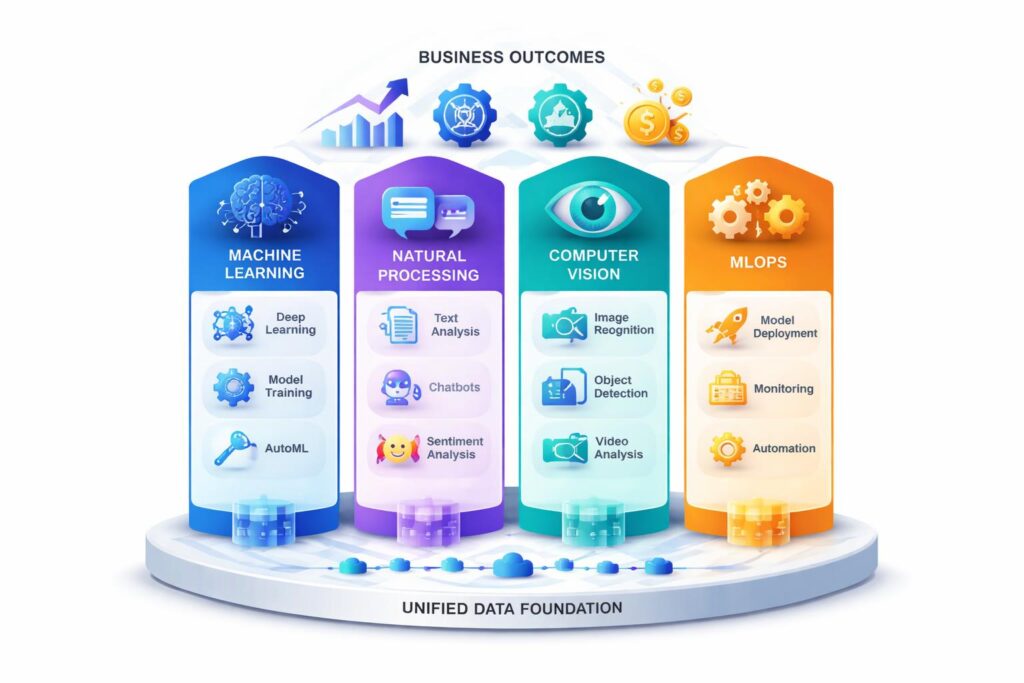
Several core technologies make the shift from legacy to intelligent systems possible. What matters isn’t the technical details but the business capabilities they unlock.
Machine Learning and Predictive Systems
Machine learning finds patterns in data that show what’s likely to happen next. The applications are broad:
- Operations: Predict which processes will hit bottlenecks, which equipment will fail, which resources will run short before it happens
- Finance: Model risk more accurately than traditional formulas by catching edge cases and emerging patterns human analysts miss
- Marketing: Predict which customers are worth keeping, which messages will resonate, which products to recommend based on actual behavior
- Supply chain: Forecast demand at granular levels, optimize inventory placement, predict disruptions before they cascade
The value shows up in better decisions made faster. A logistics company using ML for demand forecasting cut inventory costs by 25 percent while improving product availability. A bank using ML for credit decisions expanded lending to previously unserved segments with default rates actually lower than traditional segments. The models found patterns in non-traditional data that indicated creditworthiness more reliably than FICO scores alone.
Natural Language Processing
NLP technology lets systems understand and generate human language. This unlocks automation in areas previously requiring human judgment. Legal contracts can be analyzed for specific clauses at scale. Customer service inquiries get routed to the right team based on intent, not keywords. Technical documentation becomes searchable by concept rather than exact wording.
One insurance company deployed NLP to process claims documents. Previously, adjusters spent hours reading medical records, police reports, and damage assessments. The NLP system extracts relevant information automatically, flags inconsistencies, and presents adjusters with summary views highlighting what needs human judgment. Claims that took days now take hours. Adjusters handle three times the volume while making fewer mistakes.
Computer Vision and Intelligent Automation
Computer vision gives systems the ability to understand visual information. The applications keep expanding:
- Manufacturing: Cameras with CV models inspect products more consistently than human inspectors, catching microscopic defects
- Retail: CV systems track inventory on shelves in real time, identifying stockouts before sales are lost
- Security: Monitor facilities continuously, detecting anomalies human guards would miss during long shifts
- Healthcare: Analyze medical images to spot conditions radiologists might miss or flag for priority review
- Agriculture: Monitor crop health across thousands of acres, identifying disease or stress before it spreads
A steel mill deployed CV to inspect metal surfaces for microscopic cracks. Defect detection improved from 85 percent with human inspectors to 99.7 percent. The system also identified defect patterns that led engineers to adjust production parameters, reducing defects by 30 percent overall.
MLOps and Continuous Intelligence
MLOps is the discipline of keeping machine learning models working reliably in production. Models degrade over time as the world changes. What worked last quarter might fail this quarter because customer behavior shifted or market conditions evolved. MLOps includes:
- Continuous monitoring of model performance to catch accuracy drops before they cause business problems
- Automated retraining when performance degrades past acceptable thresholds
- Version control so you can roll back problematic deployments quickly
- Testing frameworks that catch issues before models reach production
- Infrastructure for A/B testing different model versions against each other
According to IEEE research, organizations with mature MLOps deploy models to production 10 times faster than those without. More importantly, their models stay accurate longer because monitoring catches drift early and triggers retraining automatically. One financial services firm cut model failure rates from 15 percent to under 2 percent after implementing proper MLOps.
Business Value: Why Enterprises Choose AI-first Software Development
The business case for intelligent systems rests on measurable outcomes, not technology enthusiasm. Organizations that successfully modernize see improvements across multiple dimensions that compound over time.
| Value Dimension | Typical Improvement | Time to Realize |
| Operational cost reduction | 25-40% in targeted processes | 6-18 months |
| Development velocity | 3-5x faster feature delivery | 12-24 months |
| System performance | 40-65% faster response times | 3-12 months |
| Error and defect rates | 60-80% reduction | 6-18 months |
| Security incident response | 70-85% faster detection and containment | 12-24 months |
| Customer satisfaction scores | 15-30 point improvement | 18-36 months |
| Revenue from new capabilities | 10-25% incremental growth | 24-48 months |
Cost Reduction and Operational Efficiency
Direct cost savings come from automation of manual work, optimization of resource usage, and reduction in errors that require expensive fixes. A telecommunications company modernizing its network operations replaced manual provisioning processes with intelligent automation. Provisioning time dropped from two weeks to 15 minutes. The staff that previously handled provisioning moved to network optimization work that generates revenue rather than maintaining operations.
Less obvious but equally valuable are the costs that don’t happen. Intelligent systems catch problems before they cascade. Predictive maintenance prevents equipment failures rather than fixing them. Fraud detection stops losses before money moves. Quality control catches defects before they reach customers. A manufacturer calculated that its CV-based inspection system prevented $12 million in warranty claims over two years while costing $800,000 to deploy and operate.
Energy optimization through intelligent systems delivers substantial savings for companies with large physical footprints. A retail chain deployed ML models to control HVAC systems across 2,000 stores. The models learned optimal temperature and ventilation settings based on occupancy, weather, time of day, and store layout. Energy costs dropped 18 percent while customer comfort scores improved because the system maintained conditions better than fixed schedules.
Security, Compliance, and Risk Management
Intelligent systems excel at detecting anomalies that indicate security threats or compliance issues. They analyze patterns across enormous datasets, spotting behaviors that would never catch human attention until damage was done. A bank deployed ML-based transaction monitoring that examines every payment for fraud indicators. The system catches fraud attempts that rule-based systems miss while reducing false positives that annoy legitimate customers by 60 percent.
Compliance automation becomes viable with NLP and ML working together. Regulatory requirements change constantly. Ensuring thousands of business processes stay compliant requires either armies of compliance staff or intelligent systems that understand requirements and monitor adherence automatically. A healthcare organization deployed automated compliance monitoring across clinical workflows. The system flags potential HIPAA violations in real time, letting staff correct issues before they become reportable breaches. Compliance incidents dropped 75 percent.
Risk management improves when models can analyze far more factors than humans reasonably could. Credit risk, operational risk, market risk, and strategic risk all involve complex interactions among numerous variables. ML models identify risk patterns and correlations that traditional analysis misses. One investment firm credits its ML-enhanced risk models with avoiding losses during a market disruption because the models detected instability signals weeks before human analysts flagged concerns.
Innovation Enablement
Intelligent systems create possibilities that weren’t previously feasible. Product personalization at individual level, service customization that adapts in real time, business models that require prediction accuracy beyond human capability. These weren’t options on legacy platforms.
A media company built a content recommendation engine that analyzes viewing behavior at granular level, predicting what each subscriber wants to watch next with accuracy that drove engagement up 40 percent. This level of personalization would be impossible with traditional systems. The company credits the recommendation engine with reducing subscriber churn by 8 percentage points, worth hundreds of millions in retained revenue.
New revenue streams emerge when companies can offer capabilities their systems couldn’t previously support. A logistics company transformed from moving packages to selling prediction as a service, offering customers ML-powered delivery forecasts and supply chain optimization recommendations. Services revenue now represents 15 percent of total revenue, growing at 40 percent annually while traditional logistics grows at 8 percent.
Challenges Companies Face During AI-led Modernization
Transformation at this scale hits real obstacles. Companies that acknowledge them upfront and plan systematically do better than those assuming smooth sailing.
Data Maturity and Governance Issues
Most organizations discover their data isn’t ready for AI. Common problems include:
- Data scattered across dozens of systems with no consistent format or definitions
- Missing documentation about what fields mean, so nobody knows if “customer_status” means the same thing in different databases
- Quality issues that went ignored because legacy systems tolerated garbage data
- No clear ownership, so when problems surface nobody’s responsible for fixing them
- Privacy and security gaps that become showstoppers when you try to centralize data for ML
One manufacturer spent eight months just getting agreement on data ownership before building a single model. Without governance frameworks defining who owns what, who can access it, how quality gets maintained, and how privacy gets protected, data initiatives stall in endless arguments.
Establishing data maturity takes time and sustained effort. Companies need to catalog what data exists, assess quality, document meaning, establish ownership, implement quality controls, and build pipelines that maintain standards. This work isn’t glamorous but it’s foundational. Organizations that invest in data infrastructure before deploying AI avoid expensive failures and rework.
Integration With Existing Infrastructure
Intelligent systems need to work alongside legacy platforms during transitions that can take years. Integration becomes a major technical challenge. Modern APIs need to connect with mainframes that communicate through batch files. Real-time intelligent systems need data from legacy databases that update nightly. Event-driven architectures need to interact with request-response systems.
The integration layer often becomes as complex as either system it connects. Teams need expertise in both legacy technologies and modern platforms, a rare combination. Integration work consumes far more effort than organizations anticipate. One financial institution estimated integration would require 30 percent of a modernization project. It actually required 55 percent.
Testing integrated environments proves particularly difficult. Behavior emerges from interactions between systems that are hard to predict and reproduce. Bugs hide in edge cases where legacy and modern systems interpret data differently. Organizations need substantial investment in testing infrastructure and expertise to validate that integrated environments work reliably.
Skills Gap and Talent Shortage
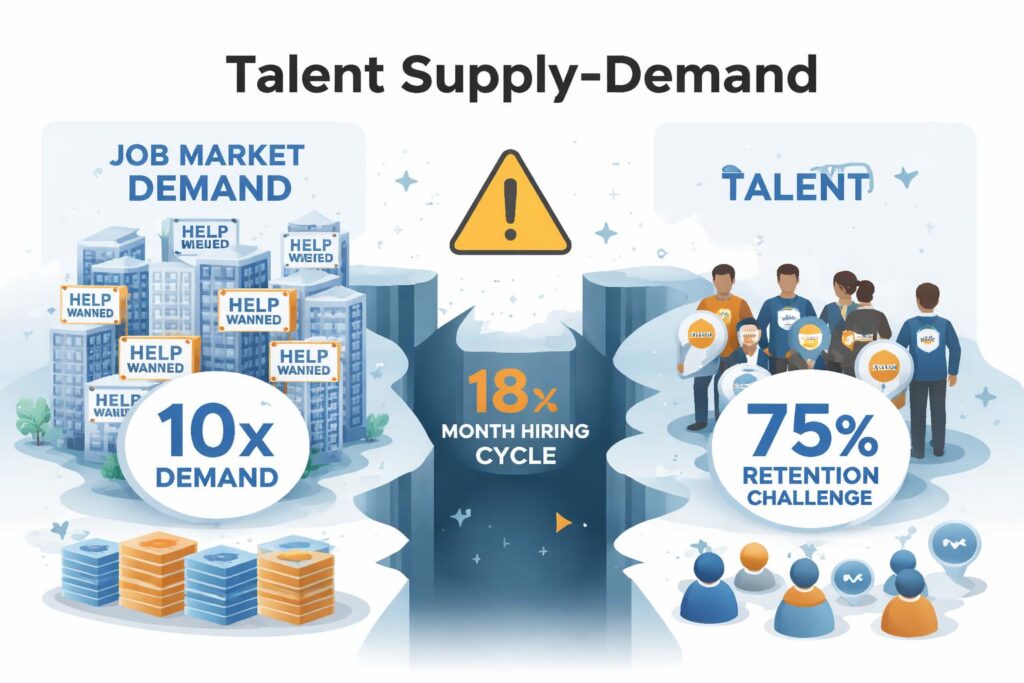
Demand for AI software expertise vastly exceeds supply. The specific challenges:
- Data scientists, ML engineers, and MLOps specialists are scarce and expensive
- Most organizations lack people who understand both their business domain and AI deeply enough to design effective solutions
- Hiring takes months, and you’re competing with tech giants and well-funded startups
- Retention is brutal because every company with money is recruiting anyone with AI on their resume
- Training helps but takes years to build real proficiency
Meanwhile business needs don’t wait for skills to develop. Partnering with AI software development companies addresses this gap by bringing experienced teams that have solved similar problems before. The knowledge transfer during engagements helps build internal capability over time. However, companies still need enough internal expertise to be intelligent buyers, maintain systems after partners leave, and keep evolving capabilities independently.
Ethical, Security and Explainability Concerns
AI systems make decisions affecting people’s lives: loan approvals, hiring recommendations, medical diagnoses, parole decisions. When these are wrong or biased, consequences can be severe. Key concerns include:
- Bias amplification: ML models can perpetuate or amplify biases in training data, leading to discriminatory outcomes
- Explainability requirements: Regulators and customers need to understand why AI made specific decisions, but many models function as black boxes
- Security vulnerabilities: Models can be poisoned through corrupted training data or tricked through adversarial examples
- Privacy leakage: Models can inadvertently reveal information about individuals in training data
- Accountability gaps: When AI makes a bad decision, who’s responsible?
Multiple high-profile cases have shown these aren’t theoretical risks. A hiring tool discriminated against women. A healthcare algorithm gave preferential treatment based on race. A facial recognition system had error rates 10 times higher for certain demographics. Building responsible AI requires frameworks for ethical development, robust testing for bias and fairness, security practices tailored to ML systems, and governance ensuring accountability.
Best Practices for Transitioning From Legacy to Intelligent Systems
Successful transformations follow patterns that reduce risk and accelerate value realization. These practices emerge from experience across multiple industries and company sizes.
Building an AI Roadmap
Transformation starts with clear-eyed assessment of current state and realistic vision for future state. Map existing systems, understanding their interdependencies, technical debt levels, and business criticality. Identify pain points where legacy limitations most constrain business objectives. Prioritize modernization efforts based on business value, technical feasibility, and risk.
The roadmap should sequence initiatives to build momentum through early wins while establishing foundations for later phases. Quick victories that demonstrate value secure continued investment and organizational support. Meanwhile, longer-term foundational work like data infrastructure and governance proceeds in parallel. The roadmap needs flexibility because learning from early phases will change plans for later phases.
Stakeholder alignment matters enormously. Technical teams, business leaders, and frontline users all need to understand why transformation matters, what it will require, and how it affects them. Resistance kills modernization efforts more often than technical challenges do. Investing time in communication, training, and change management pays off through smoother execution and better adoption of new capabilities.
Designing the Data Architecture First
Data architecture determines what’s possible with AI. Start by defining how data will flow through the organization: from source systems through collection, storage, processing, analysis, and activation. Design for quality at every stage. Implement monitoring that catches data problems early. Establish clear ownership and governance.
Build data pipelines that are observable, maintainable, and scalable. Teams should understand what’s happening with data at any moment, diagnose problems quickly when they occur, and scale infrastructure as volumes grow. Modern data platforms built on technologies like Apache Kafka for streaming, cloud data warehouses for analysis, and feature stores for ML enable capabilities impossible with legacy databases and batch processing.
Metadata management often gets overlooked but proves crucial. Teams need to know what data exists, what it means, where it came from, how it’s transformed, who can access it, and what quality issues might exist. Without good metadata, organizations repeatedly rediscover the same data, build incompatible definitions, and waste time debugging issues that proper documentation would prevent.
Choosing the Right AI Software Development Partner
Partner selection significantly impacts outcomes. Look for demonstrated expertise in both AI technologies and enterprise modernization. Review previous projects similar in scale and complexity. Talk to references about how the partner handled challenges, communicated with stakeholders, and transferred knowledge to internal teams.
Technical capability matters but isn’t sufficient. Assess cultural fit and communication style. Partners need to work collaboratively with internal teams, respecting existing knowledge while bringing fresh perspective. They should explain technical concepts clearly to business stakeholders and business requirements clearly to technical teams. Poor communication causes more project failures than technical problems.
Evaluate the partner’s approach to MLOps and production operations. Many firms excel at building models but struggle to deploy them reliably at scale. Production ML requires different expertise than research or prototyping. Ask specific questions about monitoring, retraining, versioning, and incident response. Organizations that skip this diligence often achieve impressive proof-of-concept results that never make it to production successfully.
Real-World Examples of AI System Transformation
Concrete examples illustrate how intelligent systems deliver value across different contexts. These cases represent simplified versions of complex multi-year initiatives but capture the essential dynamics of successful transformations.
Manufacturing: From Equipment Sales to Predictive Services
| Metric | Before Modernization | After Modernization | Change |
| Service revenue as % of total | 15% | 40% | +167% |
| Predictive maintenance accuracy | N/A | 92% | New capability |
| Customer equipment uptime | 87% | 96% | +9 points |
| Time to identify equipment issues | 3-7 days | Real-time | -99% |
| Service margin | 18% | 34% | +89% |
A European manufacturer of industrial equipment faced declining margins as competitors from lower-cost regions gained market share. Their legacy ERP system couldn’t support the service-based business model leadership envisioned. Working with an AI software development company, they rebuilt their platform around predictive maintenance capabilities. Sensors on customer equipment stream data to ML models that predict failures before they occur. The company now sells uptime guarantees backed by prediction accuracy above 92 percent. Service revenue grew from 15 percent to 40 percent of total revenue over four years. More importantly, customers see the company as a strategic partner rather than a commodity equipment supplier.
Financial Services: Advanced Fraud Detection
A Southeast Asian bank struggled with fraud losses exceeding $200 million annually. Their rule-based detection system generated so many false positives that investigators spent most of their time clearing legitimate transactions rather than catching actual fraud. The bank partnered with an AI firm to build an ML-based fraud detection platform. The system analyzes hundreds of features per transaction, learning patterns associated with fraud while minimizing false alarms. Fraud losses dropped 65 percent in the first year. False positive rates fell by 70 percent, improving customer experience significantly. The bank now detects fraud types that their previous system missed entirely, including sophisticated synthetic identity schemes.
A logistics company operating across Latin America faced growing complexity as e-commerce boomed. Their legacy routing and scheduling system couldn’t handle the volume or adapt to changing conditions like traffic, weather, and last-minute order changes. They underwent a comprehensive modernization, rebuilding their operational platform around AI-driven dynamic routing. ML models optimize delivery routes continuously based on real-time conditions. Predictive models forecast demand at granular level, enabling better resource allocation. Computer vision at distribution centers automates package sorting and damage detection. The results came in stages as capabilities deployed. Delivery costs decreased 22 percent. On-time performance improved from 78 percent to 94 percent. Most significantly, the company now handles three times the package volume with only 40 percent more drivers than before modernization.
An energy company managing renewable power generation faced the challenge of variability. Wind and solar output fluctuate with weather while demand varies with time and temperature. Their legacy systems couldn’t balance supply and demand precisely, forcing reliance on expensive reserve capacity and wasting renewable energy during oversupply. They built an intelligent energy management platform with ML models that predict both generation and demand 48 hours ahead with accuracy that enables optimal scheduling. The system decides automatically when to store energy, when to sell to the grid, and when to adjust industrial loads that can shift timing. Renewable energy utilization improved by 28 percent. Grid stability incidents decreased by 85 percent. The system now manages a distributed network of generation sources and storage facilities that would be impossible to optimize manually.
Conclusion
The transition from legacy infrastructure to intelligent systems represents more than a technology upgrade. It’s a fundamental shift in how organizations process information, make decisions, and adapt to change. Companies that delay this transformation increasingly find themselves at competitive disadvantage against rivals operating on modern platforms with embedded intelligence.
AI software development companies have become essential partners in this transition, bringing specialized expertise that most organizations can’t build internally fast enough to match market pace. As demand for intelligent systems accelerates across industries, these specialized firms will play an increasingly central role in shaping how enterprises operate. The question facing business leaders is no longer whether to modernize but how quickly they can execute transformation while managing risk and maintaining operations through the transition.
Organizations ready to move from legacy platforms to AI-native architectures should begin with clear assessment of current capabilities and strategic priorities. Building the right data foundation, securing executive alignment, and partnering with experienced AI software development firms accelerates the journey while reducing the likelihood of expensive missteps. The companies that act decisively now will establish advantages that compound over time as intelligent systems continuously improve and unlock new possibilities.
For executives evaluating modernization initiatives, engaging with specialists who understand both the technical complexity of AI systems and the organizational dynamics of enterprise transformation provides the highest probability of success. The path from legacy to intelligence requires both technical excellence and strategic insight—capabilities that mature AI software development companies bring to every engagement.