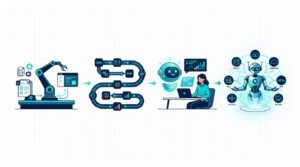


The shift to AI in SaaS platforms is part of a larger trend in the way software companies evolve and remain competitive. With markets maturing and the cost of finding new users growing higher, retention has emerged as the most critical metric for sustainable success. In an era when users can change products at the drop of a hat and expect solutions to be quick and tailored to their wants, the traditional method of retention isn’t going to be effective here. This challenge is solved by AI; better product understanding of user behaviors, predicting user needs, and reducing friction along the user journey.
Conclusion:Artificial intelligence in SaaS products is more than just a shiny new toy. It is, in essence, a pragmatic reaction to rising retention metric pressure across the board. The gap also comes from companies pulling in $1M – $50M+ in ARR find themselves in a bit of a conundrum: they have churn feeding on them like sharks but cannot compete with the resources of enterprise-level players. For these businesses, AI represents an opportunity, as it allows them to offer the same level of personalization and automation that larger platforms currently provide, but at a significantly lower cos
AI as a Competitive Factor for SaaS Growth
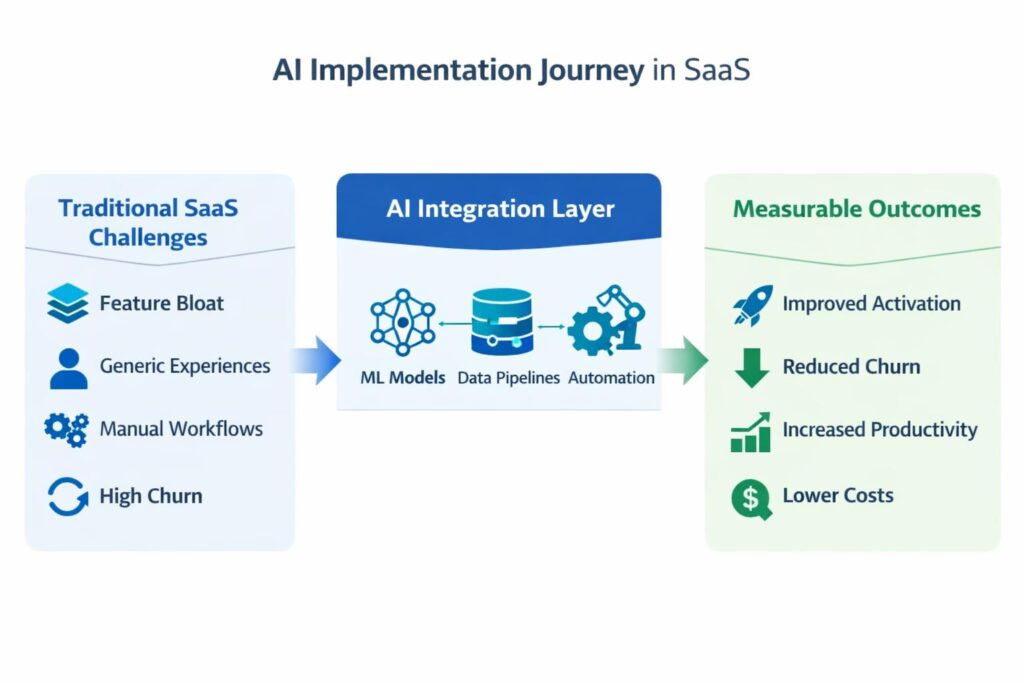
Software markets have changed fundamentally in the past five years. Customer acquisition costs have doubled or tripled in many verticals, according to research tracking SaaS economics trends. Users have dozens of alternatives for almost any function. The average SaaS buyer now evaluates products more carefully and switches more readily when something does not work as expected.
Traditional growth strategies focused on adding features and improving marketing. Those still matter, but they do not solve the retention problem. A product with 100 features means nothing if users only touch five of them. Complex interfaces and generic experiences push people away, even when the underlying capability is strong.
This is where artificial intelligence becomes essential. Machine learning models can track how individuals actually use your product, predict when they might leave, and intervene before that happens. Natural language processing makes interfaces simpler. Recommendation systems surface the features that matter most to each user. Automation removes friction from workflows that used to require multiple manual steps.
“The SaaS companies that will dominate the next decade are those that embed intelligence into every user interaction, making their products feel less like tools and more like collaborative partners.” — Industry analyst report on AI adoption in enterprise software
Research from McKinsey shows that companies integrating AI into core product experiences see measurably better retention metrics. The impact is not marginal. We are talking about differences of 15-30% in annual churn rates, significant increases in feature adoption, and faster time-to-value for new users.
The competitive advantage comes from making your product work harder for each user without requiring them to work harder with your product. That balance is difficult to achieve manually but becomes achievable when AI handles personalization, prediction, and automation at scale.
Why Retention Is the Core Metric in Modern SaaS
Retention determines whether a SaaS business can grow profitably. When customer lifetime value exceeds acquisition cost by a healthy margin, you have a sustainable model. When churn eats away at your user base faster than you can replace it, no amount of marketing spend will fix the underlying problem.
The shift toward retention as the primary metric reflects market maturity. Early SaaS companies could grow by being first to market or by offering basic improvements over legacy software. That advantage has disappeared. Now users expect sophisticated functionality, seamless experiences, and constant improvement. They also expect products to understand their specific needs rather than treating everyone the same way.
Table 1: Impact of Retention on SaaS Business Economics
| Retention Rate | Customer Lifetime (months) | LTV Multiplier | Growth Sustainability |
|---|---|---|---|
| 85% | 6.7 | 1.0x | Unsustainable |
| 90% | 10.0 | 1.5x | Marginal |
| 95% | 20.0 | 3.0x | Healthy |
| 98% | 50.0 | 7.5x | Exceptional |
Interface fatigue is real. People get tired of learning new tools, navigating complex menus, and figuring out which features actually help them. This fatigue lowers switching costs psychologically. If your product requires too much effort relative to the value it provides, users will try something else.
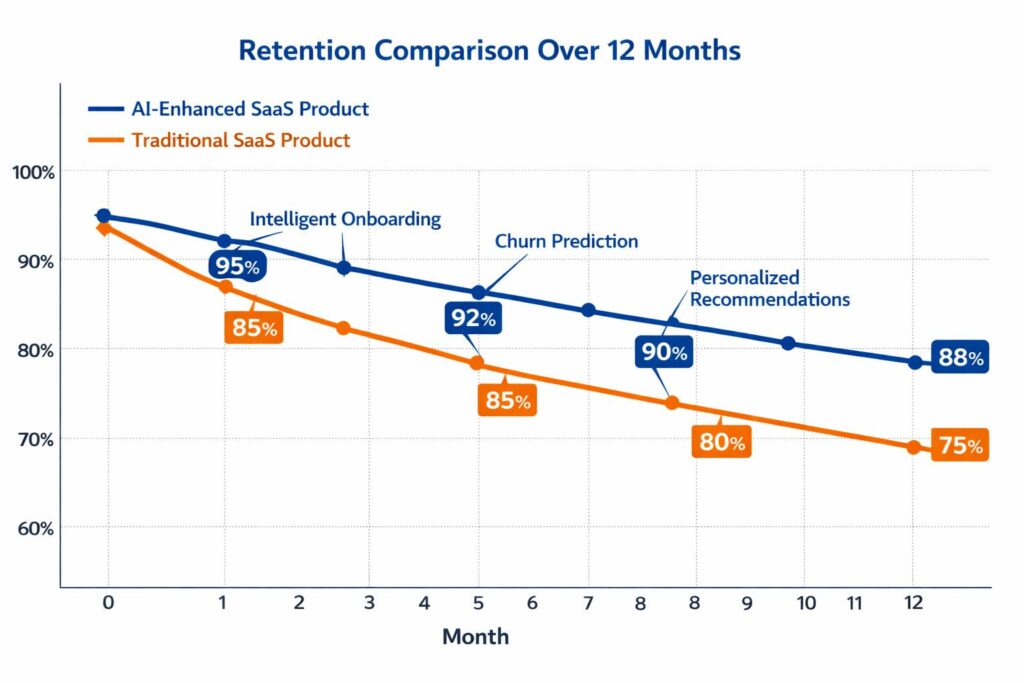
AI directly addresses these dynamics by changing how products engage with users. Activation improves when onboarding adapts to what someone already knows and what they are trying to accomplish. Engagement increases when the platform surfaces relevant functionality without requiring extensive search or training. Lifetime value grows when users discover and adopt advanced features that deepen their reliance on your product.
Key Retention Challenges SaaS Companies Face
Most SaaS products suffer from feature bloat. Teams add capabilities in response to customer requests, competitive pressure, or internal roadmap goals. Over time, this creates interfaces packed with options that overwhelm new users and confuse existing ones. High feature counts look impressive in sales decks but correlate poorly with actual satisfaction or retention.
Advanced functionality often goes unused. Companies invest heavily in building sophisticated tools, then find that only a small percentage of users ever try them. This happens because users do not know the features exist, do not understand how they would help, or face too much friction in actually using them. The result is wasted development effort and unrealized value.
Personalization remains shallow in most products. Users get the same dashboard, the same navigation, the same suggestions regardless of their role, experience level, or goals. Generic experiences fail to resonate. They require every user to figure out which parts of the product matter to them, a process that many people never complete successfully.
Onboarding flows present another common failure point. Traditional approaches walk users through features sequentially, regardless of relevance. Someone who needs one specific capability has to wade through tutorials about everything else first. This creates unnecessary friction at the moment when first impressions matter most. Poor onboarding directly predicts early churn.
How AI Helps Overcome These Barriers
Workflow simplification through AI means analyzing how users actually navigate your product and identifying unnecessary steps. Machine learning models can detect patterns in successful user journeys versus unsuccessful ones, then automatically adjust interfaces to remove obstacles. This happens continuously as usage patterns evolve.
Personalized experiences become feasible at scale when AI systems segment users based on behavior rather than static attributes. Instead of manually creating personas and building separate experiences for each, your product can adapt dynamically. Someone using your platform for financial reporting sees different suggestions and shortcuts than someone using it for team collaboration, even though they are accessing the same underlying system.
Behavioral prediction lets you intervene before problems become critical. Models trained on historical usage data can identify signals that typically precede churn. Maybe users who stop accessing a particular feature within their first 30 days are 60% more likely to cancel. Maybe engagement drops sharply after a specific type of error message. Knowing these patterns means you can reach out proactively or automatically adjust the product experience to prevent disengagement.
Real-time adaptation represents the most significant advantage. Traditional products are static between releases. AI-driven products adjust continuously based on what is working and what is not. If a particular user segment struggles with a specific workflow, the system can simplify it automatically. If another segment rapidly adopts a new feature, the system can promote that feature more aggressively to similar users.
AI Capabilities That Improve SaaS User Efficiency
User efficiency is not just about speed. It encompasses how easily someone can accomplish their goals, how much mental effort is required, and whether the product anticipates needs rather than reacting to explicit requests. AI technologies target each of these dimensions through different mechanisms.
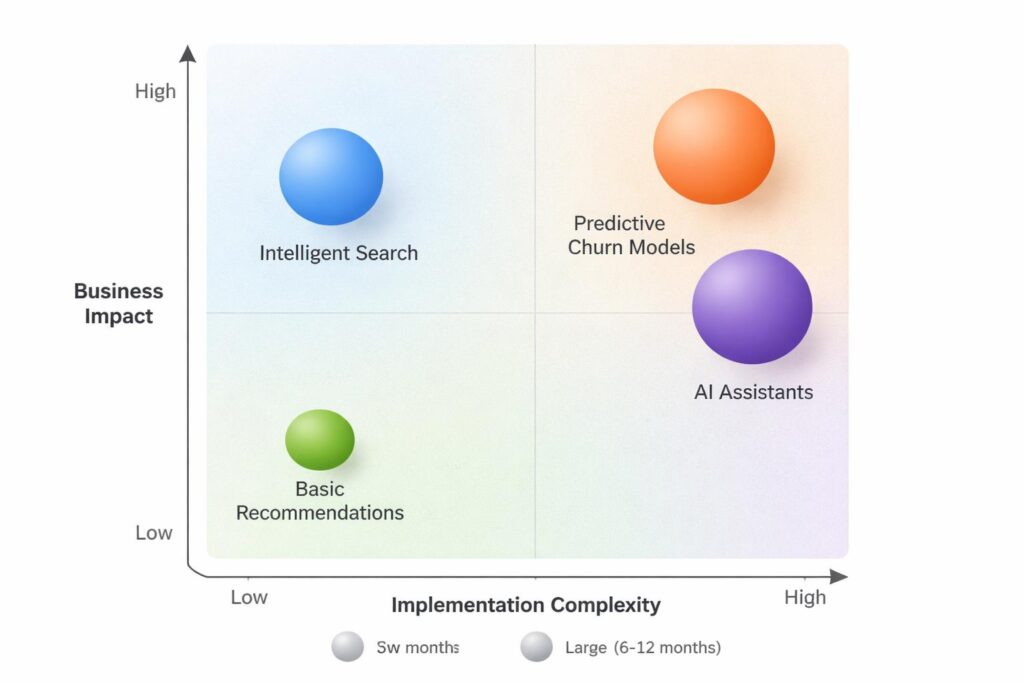
The connection between efficiency and retention is direct. Users stick with products that make them more productive in their actual work. When your platform removes tedious tasks, reduces errors, and helps people make better decisions, it becomes indispensable. That transition from “nice to have” to “cannot live without” is where retention becomes extremely strong.
Intelligent Onboarding and Adaptive Interfaces
First session experiences determine whether users reach activation. Intelligent onboarding means treating each new user as an individual rather than forcing everyone through identical tutorials. AI systems can analyze what someone does in their first minutes with your product and adjust the guidance accordingly.
If a new user immediately navigates to a specific feature, that signals their priority. The system can focus tutorials and tips on that area rather than walking them through unrelated functionality. If someone seems familiar with similar tools based on how quickly they navigate, the system can skip basic explanations and jump to what makes your product unique.
Friction point detection happens through analyzing where users hesitate, backtrack, or abandon tasks. Maybe people consistently get stuck on a particular configuration screen. Maybe a specific button is hard to find. Machine learning models can identify these patterns across thousands of users and flag them for automatic intervention. The system might add contextual help, simplify the interface, or rearrange elements to improve clarity.
Contextual walkthroughs appear exactly when they are useful rather than according to a predetermined schedule. If someone is about to perform a complex action for the first time, the AI can detect this and offer guidance at that moment. This just-in-time approach to education is far more effective than front-loading information that users forget before they need it.
Predictive Analytics for Engagement and Churn Prevention
Churn prediction models analyze thousands of behavioral signals to calculate risk scores for individual users or accounts. These models consider usage frequency, feature adoption, error rates, support ticket history, and many other variables. The output is a probability that someone will cancel within a specific timeframe.
Having churn scores matters only if you act on them. High-risk users might receive proactive outreach from customer success teams, personalized content showing advanced features they have not tried, or automatic adjustments to their experience that reduce friction points identified by the model. The goal is intervention before disengagement becomes terminal.
Key behavioral signals that predict churn with high accuracy:
- Declining login frequency over consecutive weeks indicates disengagement before it becomes critical
- Decreasing session duration compared to the user’s historical baseline often precedes cancellation by 30-45 days
- Abandonment of previously regular workflows suggests the user found alternative solutions
- Increased error rates or failed actions correlate with frustration that drives switching behavior
- Support ticket patterns, particularly unresolved issues or repeat contacts about the same problem
Feature prioritization becomes data-driven when you can predict which capabilities will increase engagement for specific user segments. Instead of guessing what to build next based on the loudest customer requests, you can model the likely impact of different features on retention and lifetime value. This shifts product decisions from opinion-based to evidence-based.
Expansion opportunities also benefit from prediction. Models can identify accounts likely to upgrade based on their usage patterns. Maybe they are hitting limits on their current plan, or maybe they are using advanced features that suggest readiness for premium tiers. Proactive upsell recommendations based on actual behavior convert at much higher rates than generic prompts.
AI Assistants and Task Automation
Reducing clicks means analyzing common workflows and building automation that collapses multiple steps into one. An AI assistant might recognize that a user performs the same sequence of actions every morning and offer to automate it. Or it might detect that someone is manually copying data between sections of your product and create a shortcut that does this automatically.
Document generation represents a major productivity gain in many SaaS contexts. Instead of users manually creating reports, proposals, or analyses by pulling together information from various parts of your platform, AI can generate these documents automatically based on parameters or natural language requests. What used to take 30 minutes now takes 30 seconds.
Decision support comes from AI systems that can analyze data and recommend actions. In a marketing platform, this might mean suggesting which campaigns to prioritize based on predicted ROI. In a project management tool, it might mean flagging tasks likely to cause delays. The AI serves as an intelligent layer that helps users make better choices without requiring them to become data analysts.
Intelligent Search and Natural Language Interfaces
Semantic search understands intent rather than just matching keywords. When someone searches for “campaigns that did not work,” the system comprehends they want underperforming results, even if those exact words do not appear in campaign names or descriptions. This makes finding information much faster and reduces the frustration of failed searches.
Command-based interfaces let users accomplish tasks by typing or speaking what they want rather than clicking through menus. This is particularly powerful for experienced users who know what they need but find graphical navigation slow. An interface where you can type “create project for client X with team Y” and have it happen instantly is dramatically more efficient than the traditional approach.
Platform-wide data search means users can find anything without remembering where it lives in your information architecture. Instead of thinking “I need to go to the reports section, then filter by date, then export,” they just ask for what they want. The AI handles retrieval from wherever the relevant data exists within your system.
AI for SaaS Platforms: Architecture and Technology Foundations
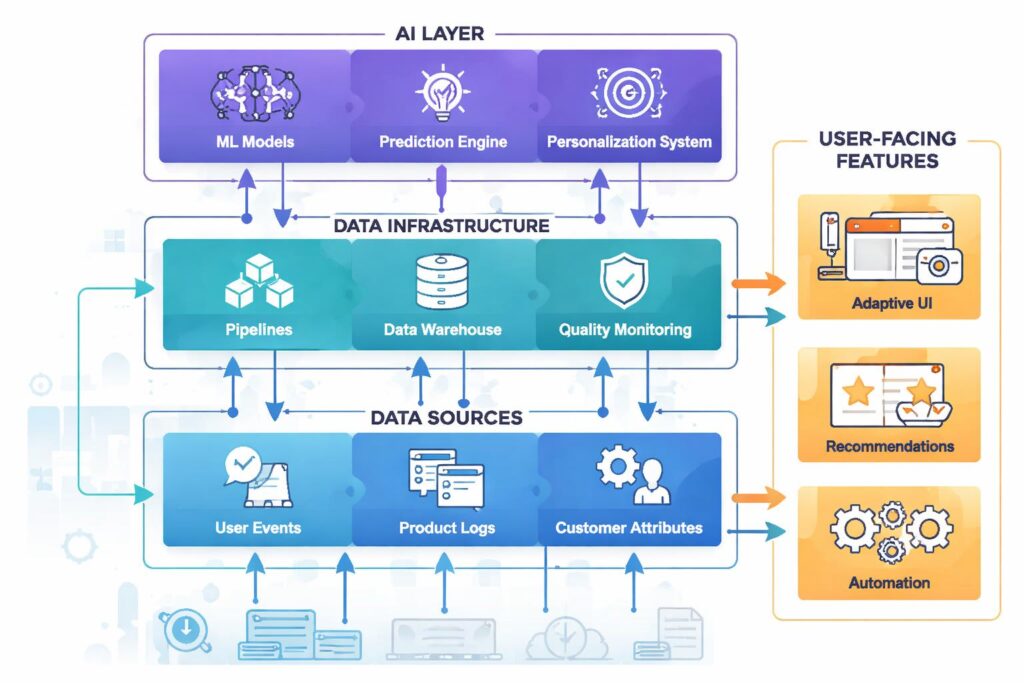
What technical infrastructure does AI require in SaaS products?
Implementing AI successfully demands specific data flows, model management capabilities, and operational systems that support continuous learning. You cannot bolt machine learning onto an existing platform without addressing how data moves through your system, how models get trained and deployed, and how performance stays stable as usage scales.
Why does architecture matter more than rushing features?
A solid foundation lets you iterate quickly, improve models based on production data, and maintain reliability as complexity grows. Poor foundations lead to brittle systems that break under load or drift in accuracy over time. Getting the architecture right initially saves months of rework later.
Data Infrastructure for AI-driven SaaS
Centralized data warehouses or lakes form the starting point. AI models need access to comprehensive user behavior data, product usage logs, customer attributes, and outcome metrics. When this information sits scattered across different databases and tools, creating training datasets becomes a manual nightmare that slows everything down.
Data pipelines handle the movement and transformation of information from source systems into formats suitable for machine learning. These pipelines need to run reliably, handle schema changes gracefully, and maintain data quality through validation checks. Real-time pipelines support features that require immediate AI responses, while batch pipelines work for models that update daily or weekly.
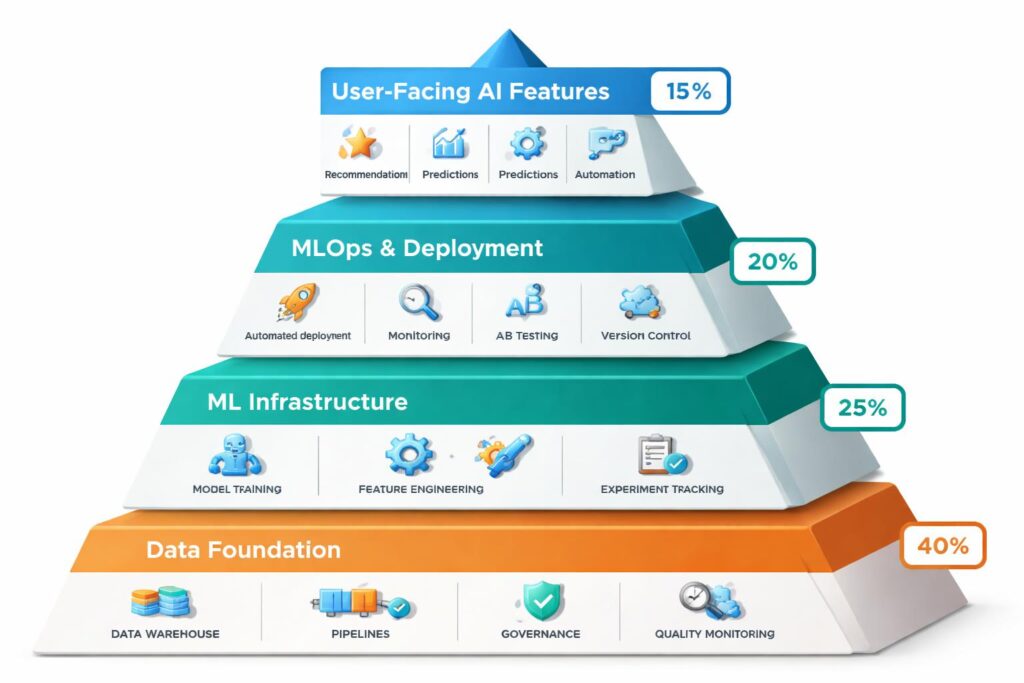
Quality and observability mean monitoring data for completeness, accuracy, and consistency. Machine learning models fail silently when training data degrades. You need automated checks that alert teams when something looks wrong, whether that is missing values, unexpected distributions, or sudden changes in data volume. Good observability also tracks how data flows through your entire system so you can debug problems quickly.
ML Models and Continuous Learning Loops
Behavioral models predict user actions based on historical patterns. These might forecast churn risk, estimate feature adoption likelihood, or anticipate which users will need support. The models train on your actual product data, learning the specific patterns that matter in your context rather than relying on generic assumptions.
Usage forecasting helps with capacity planning and product decisions. If you can predict how demand for different features will grow, you can invest in infrastructure and development accordingly. Forecasting models also support individual user experiences by anticipating what someone might need next and pre-loading or suggesting it.
Adaptive personalization systems continuously adjust to changing user behavior. Someone’s preferences and needs evolve as they become more experienced with your product. Models that personalize interfaces, recommendations, and content need to track these changes and update their understanding of each user over time. This requires feedback loops that capture whether personalization attempts succeeded or failed.
MLOps for Stable AI Delivery
Automation in MLOps covers everything from model training to deployment. Manual processes do not scale when you are managing dozens of models that need regular retraining. Automated pipelines handle data preparation, hyperparameter tuning, validation testing, and pushing models to production without human intervention for routine updates.
Monitoring production models means tracking prediction accuracy, latency, error rates, and feature importance. Models that work well during development can degrade in production for many reasons. Data distributions shift, user behavior changes, or technical issues cause problems. Continuous monitoring catches these issues before they impact users noticeably.
Governance ensures models meet quality, fairness, and compliance standards. This includes version control for models and training data, audit trails showing how decisions were made, and processes for testing models against bias or privacy requirements. Governance matters more as AI becomes more central to your product’s core functionality.
Business Value of AI in SaaS
Traditional SaaS products deliver value through features that users must learn and apply manually. AI-enhanced platforms shift this dynamic by making the product itself an active participant in achieving outcomes. Where conventional systems require users to interpret data and make decisions, intelligent systems provide recommendations and automate actions. Where standard interfaces treat everyone identically, adaptive systems customize experiences based on individual behavior patterns.
The financial impact shows clearly in unit economics. Products without AI rely on customer success teams to drive adoption and prevent churn, creating linear scaling constraints. AI-powered products handle much of this work automatically, allowing teams to support larger customer bases without proportional headcount increases. This operational leverage translates directly to improved margins and faster growth.
Table 2: AI Impact on Core SaaS Metrics
| Metric | Without AI | With AI Implementation | Improvement Range |
|---|---|---|---|
| User Activation Rate | 40-55% | 55-75% | +15-20 percentage points |
| Time to First Value | 8-15 days | 2-5 days | 60-75% reduction |
| Feature Adoption Depth | 3-5 features | 7-12 features | 100-150% increase |
| Annual Churn Rate | 15-25% | 8-15% | 40-60% reduction |
| Support Ticket Volume | Baseline | 30-50% of baseline | 50-70% deflection |
| Customer Success Capacity | 50-75 accounts per CSM | 100-150 accounts per CSM | 100% increase |
Improving Activation and Feature Adoption
Activation rates measure how many new users reach a defined milestone that indicates they have received value from your product. This might be completing key setup steps, using a core feature, or inviting team members. AI improves activation by personalizing onboarding and removing friction from critical early workflows.
Time-to-value decreases when AI systems guide users efficiently toward what matters to them. Instead of exploring your entire product randomly, new users get directed to capabilities relevant to their goals. Companies implementing intelligent onboarding often see 20-40% reductions in time until first meaningful use.
Feature adoption increases when recommendation systems surface capabilities that users would find valuable but have not discovered. Many SaaS products have powerful features that most customers never try simply because they do not know about them or do not understand when to use them. AI-driven suggestions based on behavior patterns address both problems simultaneously.
Adoption depth matters as much as breadth. You want users engaging regularly with features that create strong lock-in effects. AI can identify which features correlate most strongly with long-term retention and actively promote those to users who would benefit from them. This targeted approach outperforms generic feature announcements or in-app notifications that everyone ignores.
Increasing User Productivity
Task completion time drops significantly when AI handles repetitive work. If users spend 20 minutes daily on data entry, reporting, or routine configuration and AI reduces that to 5 minutes, you have created genuine value that users notice immediately. These time savings compound as people use your product more intensively.
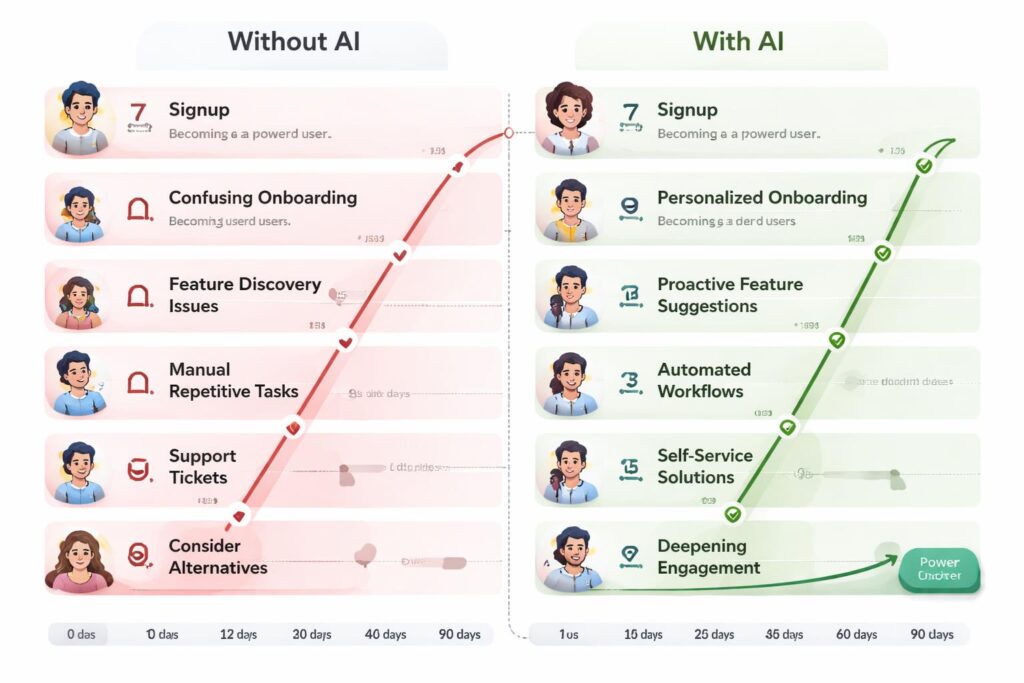
Manual operation reduction means fewer opportunities for human error. When AI automates workflows, you eliminate mistakes from typos, incorrect calculations, or skipped steps. This improves output quality and user confidence in the platform. People trust tools that consistently produce accurate results.
Cognitive load decreases when interfaces adapt to user needs rather than requiring users to remember complex procedures. AI systems that anticipate what someone wants to do next, provide contextual help automatically, or simplify multi-step processes all reduce the mental effort required to work with your product. Lower cognitive load means people can accomplish more without getting exhausted or frustrated.
Reducing Operational Costs
Support automation through AI chatbots or intelligent help systems deflects common questions that would otherwise consume agent time. When users can resolve issues themselves through conversational interfaces that understand their problems and guide them to solutions, support ticket volume decreases substantially. Companies often see 30-50% reductions in low-complexity tickets.
Customer success efficiency improves when teams can focus on accounts that need human attention most. AI handles routine check-ins, flags at-risk accounts automatically, and provides success managers with insights about each customer’s product usage. This lets small teams manage larger customer portfolios without sacrificing relationship quality.
Onboarding cost reduction happens when AI replaces or supplements human-led training sessions. While some customers still benefit from personalized onboarding, many can successfully activate through intelligent product experiences alone. Reducing reliance on manual onboarding frees up resources and improves margins on lower-tier plans.
Challenges SaaS Companies Face When Adopting AI
Implementing AI successfully requires overcoming practical obstacles that stop many initiatives before they deliver results. Understanding these challenges helps set realistic expectations and allocate resources appropriately. The technical challenges around data and infrastructure often surprise teams who underestimate what machine learning requires. Organizational challenges around skills, culture, and change management are equally important.
Data Readiness and Governance
Problem: Insufficient quality data represents the most common blocker. Machine learning models need substantial volumes of clean, labeled examples to learn effectively. Many SaaS companies discover their data is incomplete, inconsistent, or missing critical attributes when they start trying to build models.
Context: Siloed structures make data aggregation difficult. User behavior data lives in product databases, customer attributes exist in CRM systems, financial information sits in billing platforms, and support interactions are tracked separately. Bringing all this together requires integration work that teams often underestimate.
Impact: Historical data gaps mean you cannot always train models on past events. If you want to predict which features drive retention but have not been tracking feature usage historically, you need to start collecting that data and wait before you have enough to build reliable models. This delay frustrates teams expecting quick results.
Integrating AI Into Existing Workflows
Feature conflicts with current interfaces happen when AI-driven capabilities do not fit naturally into established user experiences. Maybe your product has a rigid navigation structure and AI recommendations would work better in a more flexible layout. Retrofitting intelligence into products designed without it creates awkward hybrid experiences.
User expectations can work against AI adoption. If people are accustomed to manual control over every aspect of your product, automated assistance might feel intrusive. Some users resist suggestions or automation even when these would genuinely help them. Managing this resistance requires careful product design and clear communication about how AI features work.
Performance requirements increase when you add real-time AI capabilities. Generating personalized recommendations or running predictions for every page load adds latency if not implemented carefully. Balancing model sophistication with response time constraints often requires technical optimization that takes longer than expected.
AI Talent Gap and Organisational Readiness
Machine learning expertise remains scarce and expensive. Finding engineers who understand both your domain and modern AI techniques is difficult. Even large companies struggle to build strong ML teams. For mid-market SaaS companies, competing for this talent against tech giants is nearly impossible.
Cross-functional collaboration challenges emerge because AI projects span engineering, product, data science, and business teams. These groups often have different priorities, vocabularies, and working styles. Successful AI implementation requires much tighter coordination than traditional feature development.
Experimentation culture matters more for AI than conventional development. Machine learning involves uncertainty and iteration. Models might not work as expected initially. You need to try different approaches and learn from failures. Organizations accustomed to predictable project timelines find this uncomfortable.
Ethical, Privacy and Security Considerations
Compliance requirements around data usage vary significantly by region and industry. GDPR in Europe, CCPA in California, and sector-specific regulations impose constraints on how you can collect, store, and use data for machine learning. Violating these rules creates legal and reputational risks.
Bias in models can lead to unfair or discriminatory outcomes. If your training data reflects historical inequities or if your features inadvertently correlate with protected attributes, models might make biased predictions. This is particularly sensitive when AI influences access to opportunities, pricing, or service quality.
Transparency expectations are increasing. Users want to understand why AI systems made particular recommendations or decisions that affect them. Building explainability into models adds complexity but becomes necessary as scrutiny of automated decision-making grows.
Best Practices for Implementing AI in SaaS
Successful AI implementation follows patterns that reduce risk and accelerate time to value. These practices come from observing what works across many companies and product types. Starting small and expanding gradually beats trying to transform everything at once.
Start With Product Metrics and Retention Goals
Step 1: Baseline assessment. Document your current performance across key metrics. What is your activation rate? How many users adopt advanced features? What does your retention curve look like? Understanding where you start lets you measure improvement accurately.
Step 2: Connect AI to specific metrics. Each AI application should link directly to metrics you want to move. If activation is your biggest concern, focus AI efforts on intelligent onboarding and early friction reduction. If feature adoption is weak, prioritize recommendation systems. This alignment ensures your AI work addresses actual business problems rather than chasing technology for its own sake.
Step 3: Define success criteria upfront. What would constitute a meaningful improvement? A 10% activation increase might justify substantial investment, while a 2% increase might not. Setting these thresholds before starting development prevents moving goalposts and helps with prioritization when multiple AI opportunities compete for resources.
Focus on Data Architecture First
Data governance establishes rules for how information gets collected, stored, accessed, and used. This includes data quality standards, ownership assignments, and processes for requesting new data collection. Good governance prevents the chaos that emerges when everyone creates their own ad-hoc data structures.
Pipeline infrastructure needs to exist before model development begins. You cannot train models effectively without reliable ways to get data from production systems into training environments. Building these pipelines takes time but pays off by making all subsequent AI work much faster.
Metadata management becomes critical as data complexity grows. Understanding what each data field means, where it comes from, and how it has changed over time prevents errors and wasted effort. Teams often discover that fields they thought contained one thing actually contain something different, leading to incorrect model assumptions.
Collaborate With an Experienced AI Partner
Essential partnership elements:
- Technical expertise across multiple AI domains including natural language processing, predictive modeling, recommendation systems, and computer vision where relevant
- Domain knowledge specific to SaaS business models, subscription economics, and the technical constraints of multi-tenant cloud architectures
- Implementation experience with production deployments, not just research prototypes or proof-of-concept demonstrations
- MLOps capabilities to ensure models remain accurate and performant after initial deployment
- Strategic guidance on prioritizing AI investments based on realistic ROI projections and your specific business constraints
Risk minimization comes from working with teams that have implemented AI in production environments before. They know which approaches work reliably versus which seem promising but fail under real-world conditions. This experience helps you avoid expensive mistakes.
Faster MVP development happens when you leverage existing frameworks, tools, and patterns rather than building everything from scratch. Experienced partners bring accelerators that reduce time from concept to working prototype. Getting to a testable implementation quickly lets you validate assumptions and adjust direction based on real results.
Model selection expertise matters because choosing the right approach for each problem requires both theoretical knowledge and practical judgment. Should you use deep learning or simpler methods? How much data is enough? What training techniques apply best? Partners with broad experience can navigate these decisions confidently.
Real SaaS Use Cases of AI Transformation
Concrete examples illustrate how AI addresses specific problems in actual products. These use cases span different industries but share common patterns in how AI creates value.
Marketing Platform Prediction Scoring
Initial Challenge: A marketing automation SaaS company faced poor retention because customers struggled to identify high-quality leads. Their platform collected extensive behavioral data but presented it as raw metrics that required manual interpretation. Most users lacked the analytical skills to use this data effectively. Customer feedback consistently mentioned feeling overwhelmed by numbers without clear guidance on what to do next.
AI Solution Implemented: The company implemented AI-driven lead scoring that automatically ranked prospects based on likelihood to convert. Machine learning models analyzed thousands of behavioral signals across successful and unsuccessful leads to identify predictive patterns. The system surfaced top prospects directly in user dashboards with explanations of why each lead scored highly. Additional features included automated recommendations for optimal contact timing and suggested messaging based on lead characteristics.
Measurable Outcomes: Customer retention improved by 23% in the first year after launch. Users who adopted lead scoring spent 40% more time in the platform and upgraded to higher-tier plans at nearly double the rate of non-adopters. Support ticket volume decreased by 18% as users no longer needed help interpreting their data. The feature transformed the product from a data collection tool into a decision-making system that customers relied on daily.
Fintech KYC Automation
Initial Challenge: A financial services SaaS platform required customers to perform know-your-customer verification for regulatory compliance. Manual KYC processes took 15-20 minutes per verification and required reviewing documents, checking databases, and completing forms. This created friction that hurt user activation. Nearly 35% of new signups abandoned during KYC, never completing account setup. Customer success teams spent significant time walking users through verification requirements.
AI Solution Implemented: AI automation combined document analysis, database lookups, and risk assessment into a streamlined workflow. Natural language processing extracted information from identification documents automatically. Machine learning models flagged high-risk cases for human review while automatically approving low-risk verifications. The system completed most verifications in under 60 seconds while maintaining full regulatory compliance. Users received real-time feedback when documents needed correction rather than discovering issues after submission.
Measurable Outcomes: Activation rates increased by 35% because new users no longer abandoned during onboarding due to lengthy KYC requirements. Verification completion time dropped from 15-20 minutes to under 2 minutes for 78% of cases. Operational costs decreased by 42% as staff previously handling routine verifications shifted to investigating flagged cases and improving system accuracy. Compliance audit results remained strong while user experience improved dramatically. Customer satisfaction scores for the onboarding process increased by 28 percentage points.
HR Analytics and Engagement Intelligence
Initial Challenge: An HR SaaS platform collected employee survey data and basic metrics but provided limited insight into what actually drove engagement or turnover. HR teams received reports full of numbers but struggled to identify actionable patterns or predict which employees might leave. The platform’s value proposition centered on data collection rather than intelligence. Customers frequently requested help interpreting results and deciding what actions to take based on survey findings.
AI Solution Implemented: The company built AI models that analyzed survey responses, productivity metrics, tenure patterns, and organizational data to predict flight risk and identify engagement drivers specific to each company. The system provided recommendations for interventions tailored to different employee segments rather than generic advice. Predictive models learned from each company’s unique patterns rather than relying on industry averages. The interface highlighted which factors most strongly influenced engagement in each organization and suggested specific actions managers could take.
Measurable Outcomes: Customers using the engagement intelligence features reported 18% lower voluntary turnover in the year following implementation compared to pre-implementation baselines. The platform shifted from being a data collection tool to being a strategic system that HR leaders consulted for workforce planning decisions. Customer lifetime value increased by 2.4x as the product became more integral to core HR functions. Net revenue retention climbed above 115% as existing customers expanded usage to more employees and departments. Feature adoption depth doubled as users engaged with predictive analytics alongside traditional reporting.
Conclusion
AI integration into SaaS platforms represents a fundamental shift in how software products create and sustain value. The transition from static, feature-rich products to intelligent, adaptive systems addresses the core retention challenges that define success in saturated markets. Companies that treat AI as a strategic capability rather than a set of isolated features position themselves to compete effectively as user expectations continue rising.
The path from traditional SaaS to AI-native platforms requires investment in data infrastructure, careful selection of high-impact use cases, and commitment to continuous improvement as models learn from production usage. Organizations that move deliberately through this transformation, building solid technical foundations while maintaining focus on measurable business outcomes, achieve substantial advantages in retention metrics and customer lifetime value. This is not about technology for its own sake but about making products so effective and effortless that switching becomes unthinkable.
Ready to transform your SaaS platform with AI capabilities that measurably improve retention and user efficiency? Our team specializes in building intelligent systems that solve real product challenges. We work with companies at your stage to design, implement, and scale AI features that users actually value.