

SaaS software development is changing its fundamental stance. In a digital ecosystem that is growing more competitive, feature richness and cloud-accessibility is no longer considered a moat when it comes to ensuring a competitive advantage. The era of AI-powered automation has come, and the value of a platform is determined not only by what a user can do, but also by how much of it can be done on his/her behalf. This automation is taking a more intelligent turn that is redefining the product lifecycle, including how code is written as well as how the end-users interact with complex interfaces.
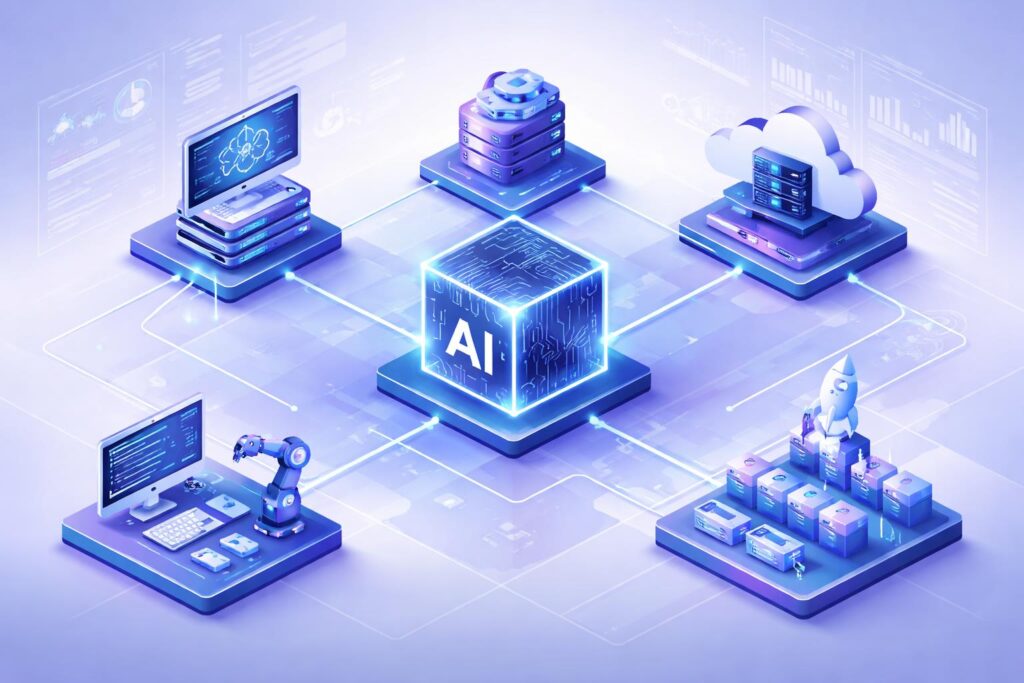
SaaS products of this day have a complexity tax. The friction caused by the sheer scale of platforms (whether it be data, number of users or integration points) can usually lag down both development groups as well as end users. To defeat this, organizations are no longer going through simple rule based scripts but rather going to advanced AI systems. Achieving the agility in the modern market environment and at the same time drastically reducing the operational overhead will become a possibility by implementing machine learning and predictive analytics into the core architecture of the companies.
The incorporation of AI-driven automation is more than an upgrade, this is a strategic requirement. When speed-to-market and retaining users are the chief mediums of exchange in the market, the power to automate cognitive processes, including but not limited to code reviews, anomaly detection and user personalization journeys, places the market leaders and laggards. This paper examines the way this next step of evolution is reorganizing the SaaS sector and maps a roadmap of how leaders can exploit automation as a fundamental building block of their growth initiative.
Why Automation Has Become Critical for SaaS Growth
The SaaS market has gotten to the stage of saturation when the build it and they will come philosophy has been substituted by the brutal efficiency and reliability. Delivery cycles that are taking months to be completed in software delivery are now anticipated to be completed within days or even hours. This is fueled by a change in customer expectations and the commoditisation of features at a very high rate. To the founders of SaaS and CTOs, the key problem is no longer how to create functional software, but how to scale the development of such software and make it fast enough that the human workforce will no longer be capable of maintaining the pace.
A study by McKinsey states that integrating generative AI and automation would bring billions of dollars of value to the global economy as it would dramatically increase workplace productivity. This in the case of SaaS, amounts to automation of high volume, low variability jobs that once consumed costly engineering time. Technical debt is increasing and specialized talent is in demand but not available, which means that automation is the only tool that would allow keeping the velocity of the innovation high without the numbers increasing linearly.
Moreover, the requirement of the reliability, always on, has turned out to be a liability of manual intervention. The enterprise clients of today require 99.99% as well as the response to security vulnerabilities within seconds. AI-based systems would be able to observe the infrastructure in real-time, anticipate system failures and implement patches automatically without the need to be controlled by humans. This movement to self-healing systems is what the next generation of the SaaS is characterized by where intelligent automation is both a buffer and a catalytic agent of growth.
What AI-Powered Automation Means for SaaS
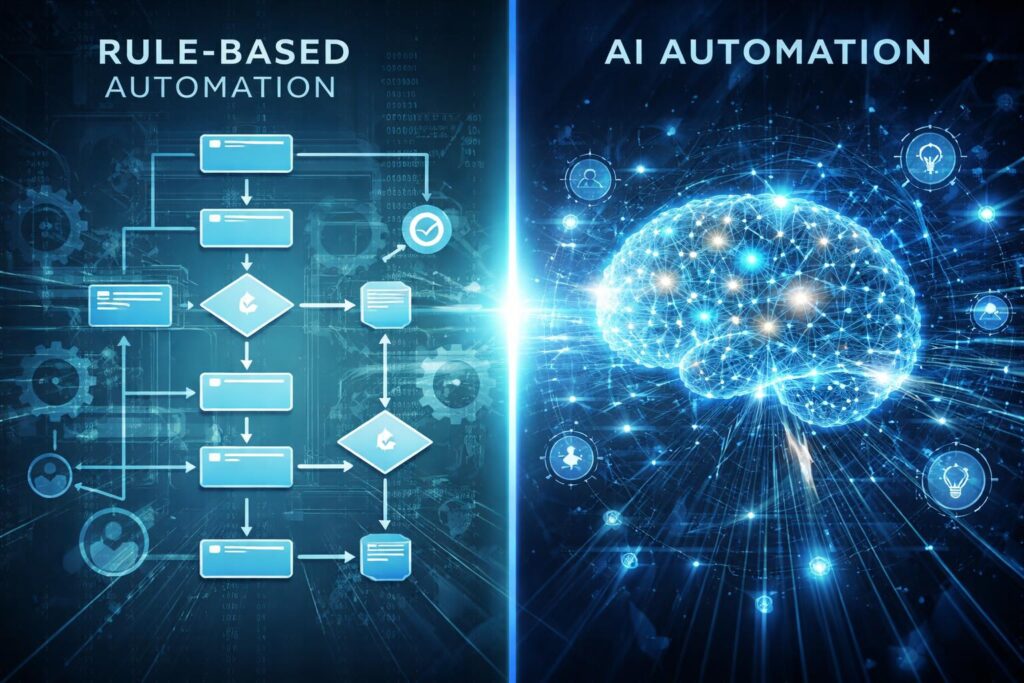
In its simplest definition, AI-based automation is a combination of the conventional programmatic reasoning and the learning abilities of machine learning. Although traditional automation is based on the principle of the if-this-then-that, intelligent automation is informed by the trends of data to take decisions in unexpected conditions.
Traditional Automation to Intelligent Automation
Conventional automation is inflexible. It is also highly skilled in repetitive duties that have definite edges like sending an email when a form is filled. It however fails when confronted with subtlety or variability in data. Intelligent automation applies the Natural Language Processing (NLP), Computer Vision, and Predictive Modeling to deal with ambiguity. This is because in a SaaS setup, the system has the capability to know the intent of the user, classify unstructured data, and streamline its own internal operations based on past performance.
The Rationale of AI-based Automation of SaaS Products
The data explosion in SaaS platforms has outgrown the analysis ability of the human beings. Users do not prefer to be the ones searching through dashboards to gain insight, they want the software to tell them what to do. Moreover, UX is a complicated field these days, as it has to serve a wide variety of audiences spread internationally; an adaptive solution can be offered only by AI. Through AI-based workflow, SaaS providers will be able to support the enterprise level of data growth without interfering with the user experience as they remain smooth and user-friendly.
Core Areas Where AI-Powered Automation Transforms SaaS Products
The use of AI in SaaS goes way beyond the “chatbot” on the side of the screen. It is being integrated into the user experience and the underlining computation.
Automated User Workflows
The first effect is least apparent, which is the diminishing of manual toil on the part of the user. AI has the ability to study the way that a user moves around a platform and recommend shortcuts or streamline multi-step procedures. To illustrate, with a project management SaaS, task assignment, deadline, and even team meeting notes can be summarized automatically through analysis of pattern of team communication, as such taking the administrative load off of the human user.
Personalization and Intelligent Feature Activation
As opposed to a fixed interface, SaaS platforms with AI-based functionality are built on the basis of smart feature flagging. The system determines the features that are the most pertinent to the goals of a given user and shows them, and obscures the extraneous complexity. This extreme personalization will keep the product effective to the power users but easy to the novice that will directly affect the adoption rates and retention in the long run.
Predictive and Adaptive UI
Predictive UI predicts the next action of the user. Real-time clickstream information can be analyzed by the interface to dynamically reorganize elements, putting the next action most likely to be taken in the foreground. This minimizes cognitive load and delivers frictionless experience that is magical to the end-user and establishes a new SaaS design paradigm.
Automation of Customer Support with AI
The modern support automation is not just about the retrieval of FAQ. Now AI agents are capable of doing so-called reasoning tasks troubleshooting technical problems, monitoring billing, and even making minor adjustments to an account without human intervention. This does not only reduce the costs involved in operation but also offers instant resolution to users one of the main motivators of NPS (Net Promoter Score).
AI Automation in the SaaS Development Lifecycle
In the case of the VP of Engineering and the CTO, the most radical changes to occur are occurring in the development pipeline itself. AI within the SaaS development is transforming the software factory into a self-scheduling, self-implementing machine.
AI in QA and Testing
The release cycle has always been held up by testing. AI-based test generators can now be automated, perform visual regression testing to detect UI glitches, and can perform anomaly detection to detect edge cases that a human tester would have missed. This guarantees superior delivery within a fraction of the standard length of time.
Code Generation and Productivity of Developers
The role of the developer is being redefinied with the help of such tools as GitHub Copilot or even a special trained LLM. AI is capable of managing boilerplate code, recommending complex algorithm optimization, and can even help refactor older bodies of code. This is not to displace the developers it just puts them in the role of architects, who then review the AI-generated output, and the amount of good code that the development team can generate will vastly go up.
Probotics Deployment and Release Pipelines
SaaS works on the CI/CD pipeline as a heartbeat. This process is supplemented by AI, providing a sense of risk intelligence. Using the historical deployment information, AI will be able to determine the possibility of a release leading to a regression and automatically pause the pipeline or rollback it. Fast releases with a significantly lower risk profile are possible using this predictive gatekeeping.
Continuous Automation Enabled by MLOps
IEEE states that the incorporation of MLOps (Machine Learning Operations) is the key to ensuring the reliability of AI models in production. Continuous automation implies that as new data is being fed into the SaaS product, the AI models underpinning it are automatically retrained and redeployed. This gives rise to a virtuous cycle in which the product in question becomes smarter each passing day under its use.
Architectural Foundations for AI-Powered Automation
In the case of the VP of Engineering and the CTO, the most radical changes to occur are occurring in the development pipeline itself. AI within the SaaS development is transforming the software factory into a self-scheduling, self-implementing machine.
AI in QA and Testing
The release cycle has always been held up by testing. AI-based test generators can now be automated, perform visual regression testing to detect UI glitches, and can perform anomaly detection to detect edge cases that a human tester would have missed. This guarantees superior delivery within a fraction of the standard length of time.
Code Generation and Productivity of Developers
The role of the developer is being redefinied with the help of such tools as GitHub Copilot or even a special trained LLM. AI is capable of managing boilerplate code, recommending complex algorithm optimization, and can even help refactor older bodies of code. This is not to displace the developers it just puts them in the role of architects, who then review the AI-generated output, and the amount of good code that the development team can generate will vastly go up.
Probotics Deployment and Release Pipelines
SaaS works on the CI/CD pipeline as a heartbeat. This process is supplemented by AI, providing a sense of risk intelligence. Using the historical deployment information, AI will be able to determine the possibility of a release leading to a regression and automatically pause the pipeline or rollback it. Fast releases with a significantly lower risk profile are possible using this predictive gatekeeping.
Continuous Automation Enabled by MLOps
IEEE states that the incorporation of MLOps (Machine Learning Operations) is the key to ensuring the reliability of AI models in production. Continuous automation implies that as new data is being fed into the SaaS product, the AI models underpinning it are automatically retrained and redeployed. This gives rise to a virtuous cycle in which the product in question becomes smarter each passing day under its use.
Business Value of AI-Powered Automation in SaaS
The transition to AI-powered automation is ultimately a business decision driven by the need for superior ROI.
Lower Operational Costs
By automating repetitive engineering and support tasks, companies can decouple their cost structure from their growth. You no longer need to double your support team just because you doubled your user base. This efficiency significantly improves the LTV/CAC (Lifetime Value to Customer Acquisition Cost) ratio.
Faster Time-to-Market
Automation slashes the time between a product idea and its launch. With AI-assisted coding and automated QA, the “feedback loop” is tightened, allowing SaaS companies to experiment, fail fast, and iterate more quickly than competitors relying on manual processes.
Higher Product Reliability
AI doesn’t get tired or overlook details. By automating monitoring and remediation, SaaS platforms can achieve levels of reliability that were previously impossible. Proactive remediation means the system fixes itself at 3:00 AM before a single user notices an issue.
Enhanced User Satisfaction and Retention
When a product “just works” and anticipates user needs, churn drops. AI-driven automation creates a smoother, more intuitive experience that becomes a “sticky” part of the user’s daily workflow.
Challenges of Implementing AI Automation in SaaS
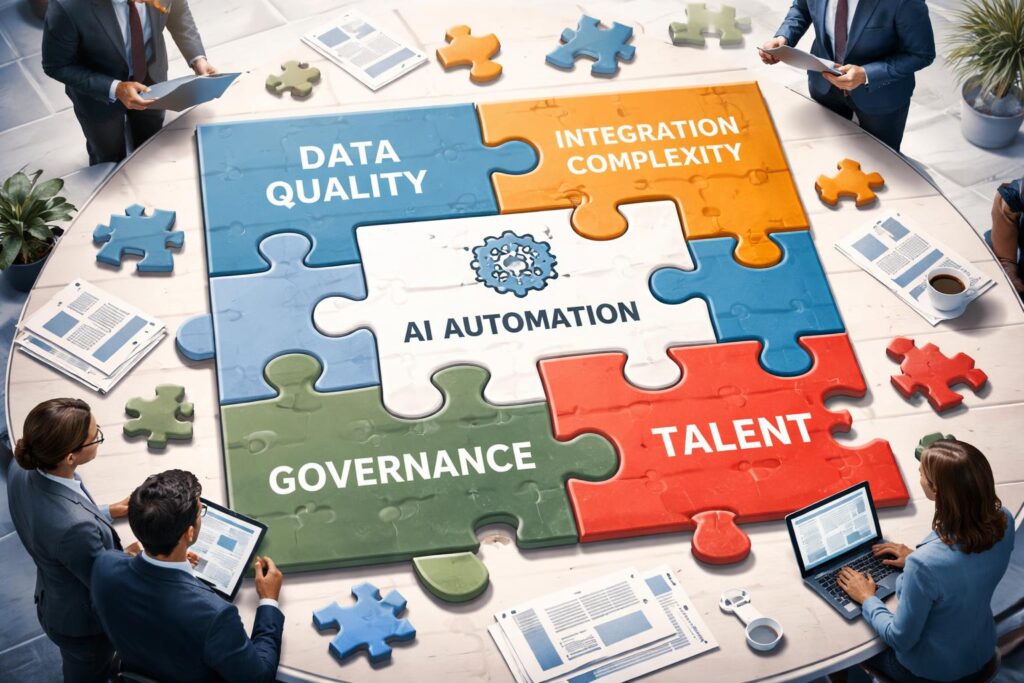
While the benefits are clear, the path to implementation is fraught with challenges that require careful management.
Data Maturity Limitations
Many SaaS companies have “data silos” or “dirty data” that prevent AI from being effective. Solving the data problem is often the most time-consuming part of the automation journey and requires a dedicated data engineering strategy.
Integration Complexity
Replacing legacy rule-based systems with AI can be complex. There is often a “transition period” where the old and new systems must coexist, requiring careful orchestration to avoid service disruptions.
Governance and Model Risk Management
AI can sometimes behave in unexpected ways. Establishing a governance framework to monitor for bias, hallucinations (in the case of LLMs), and performance drift is critical for maintaining trust with enterprise clients.
Talent Shortage
There is a significant gap between the demand for AI/ML expertise and the available talent pool. SaaS companies must either invest heavily in upskilling their existing teams or find strategic partners to fill the gap.
Best Practices for a Successful AI Automation Strategy
A successful transition to AI-powered automation requires a disciplined, strategic approach rather than a “bolt-on” mentality.
Start With the Processes That Have the Highest Cost or Friction
Identify the “low-hanging fruit.” This might be your customer support ticket volume, your manual QA cycle, or a particularly complex user onboarding flow. Automating these areas first provides the quickest ROI and builds internal momentum.
Build a Strong Data Foundation
Invest in data engineering early. Ensure your data is accessible, labeled, and secure. A strong data foundation is the most important prerequisite for any intelligent automation initiative.
Integrate AI Gradually Into the Product Lifecycle
Avoid the “big bang” release. Instead, introduce AI-powered features in phases. Start with “human-in-the-loop” systems where AI makes suggestions that a human approves, and gradually move toward full autonomy as the system’s reliability is proven.
Collaborate With Experienced AI and SaaS Partners
Given the talent shortage and technical complexity, many leaders find that partnering with specialized firms is the fastest way to achieve results. A partner with deep experience in both SaaS development and AI can help avoid common pitfalls and accelerate the implementation timeline.
Real-World Examples of AI-Powered SaaS Automation
Case 1: Marketing Automation Platform
- The Problem: Users spent hours manually segmenting audiences and A/B testing email subject lines, leading to slow campaign launches and high churn.
- The Solution: The platform integrated a predictive analytics engine that automatically segments users based on behavioral patterns and generates optimized content variations using generative AI.
- The Result: Campaign setup time was reduced by 70%, and users saw a 25% increase in engagement rates, leading to a significant drop in platform churn.
Case 2: Fintech SaaS for Expense Management
- The Problem: Manual reconciliation of receipts and fraud detection was overwhelming the internal audit teams of their enterprise clients.
- The Solution: The company implemented a computer vision and anomaly detection system that automatically extracts data from receipts and flags suspicious transactions in real-time.
- The Result: Manual intervention was reduced by 90%, and the platform’s ability to catch fraudulent activity increased by 40%, making it the preferred choice for large-scale enterprise clients.
Case 3: HR and Recruitment SaaS
- The Problem: Recruiters were drowning in thousands of resumes, often missing top-tier candidates due to the sheer volume of manual screening required.
- The Solution: An AI-powered ranking engine was introduced to “read” resumes and rank candidates based on fit, while an automated scheduling assistant handled interview logistics.
- The Result: Time-to-hire was slashed by 50%, and recruiter productivity doubled, allowing the company to move into a premium pricing tier.
Traditional SaaS vs. AI-Powered SaaS
| Feature | Traditional SaaS Development | AI-Powered SaaS Development |
| Automation Logic | Static, rule-based (If-This-Then-That). | Adaptive, probabilistic (Machine Learning). |
| Product Growth | Headcount-dependent (scaling requires more staff). | Decoupled (AI handles increased volume). |
| User Experience | One-size-fits-all dashboard. | Hyper-personalized, predictive UI. |
| Maintenance | Reactive patching and manual debugging. | Proactive, self-healing, and anomaly detection. |
| Release Cycles | Manual QA gates and scheduled deployments. | AI-gated CI/CD with automated risk assessment. |
| Data Usage | Historical reporting and storage. | Real-time inference and continuous learning. |
The further development of SaaS software creation is no longer only related to code being transferred to the cloud; it is regarding the intelligence of such code. The future of automation is AI-driven as the technology that will balance the complex and manual systems of the past with seamless and self-optimizing platforms of the future. To SaaS founders and engineering leaders, it is all too obvious that the decade to come in software will be characterized by companies who are able to move beyond tool creation to partner creation, on the part of their users.
With the future of AI-first in sight, the balance should be on the cooperation of the human creativity and machine efficiency. Through intelligent automation, SaaS businesses are able to achieve new levels of innovation, reliability, and scale, and they will guarantee that they are at the head of the digital economy.
Are you Ready to Modernize SaaS Architecture?
The shift towards AI-powered automation has to be a combination of strategic foresight and profound technical knowledge. To streamline your development cycle, or to add smart features to your product, our team can assist you in navigating the complexity of today software evolution.
Let’s discuss how we can accelerate your automation journey:
- AI Development Services – Build custom models that drive real business value.
- SaaS Development Expertise – Modernize your platform for the AI era.
- Case Studies – See how we’ve helped other SaaS leaders scale.