



Artificial intelligence-based real estate applications are transforming the nature of the operations of property companies on the core level. The platforms that used to store and display information are now predicting, automating decisions, and even learning out of each transaction. This does not represent a change that companies that develop or update real estate software can choose not to make anymore – it is the distinction between those platforms that grow and those that hit a plateau. The pressure is real.
The real estate business results in extremely large amounts of data on dozens of sources: MLS feeds, lease records, maintenance logs, market reports, CRM activity, and financial models. It is costly and inaccurate to handle that data manually. It is almost impossible to make good decisions out of it, quickly and consistently, without smart automation that is inherent to the platform. Enterprise clients commercial property companies, investment platforms, and large residential operators have upped the standards accordingly. They desire software that anticipates demand before it hits its zenith, identifies threats before they develop, and makes the experience more personal to each agent and consumer.
The pragmatic question to CTOs, product leaders, and executives in charge of digital transformation is not whether to invest in AI, but where to begin and how to develop it correctly.
In this article, we are going to take a walk through the ways AI is redefining real estate software – what it can do, what business value it can generate, what challenges it might bring, what practices can make the difference between a successful implementation and a costly experiment.
Why Real Estate Software Is Entering an AI-Driven Era
There have been various technological phases in real estate. The initial one was digitization – the transfer of paper documents to databases. Then there were cloud-based platforms that allowed those records to be viewed anywhere. At this point the industry is moving into a third stage that is not determined by the location of data but what the platform does with the data.

The initial two stages were satisfactory using rule-based systems. They used predetermined logic: when a property satisfies the specified requirements, rate it in this manner; when a tenant misses his/her payment by 30 days, activate this process. Such deterministic processing is effective in predictable and stable environments. Real estate markets are not predictable and stable. Conditions change, the behavior of buyers changes, the performance of assets does not match expectations, and the rules that had been effective last year are no longer effective this year.
The findings of the McKinsey survey of AI use in real estate and construction indicate that companies that integrate AI into their analytics processes perform better than other companies on the accuracy of the forecasts and the efficiency of the operations – not because AI takes the place of the human judgment, but because AI processes a great number of signals that a human team cannot effectively follow at once.
AI does not eliminate decision-making but enhances it. With the introduction of AVMs, a valuation analyst cannot be alienated; instead, they can be more productive by working on edge cases and client relationships, as opposed to running manual comps. An operations manager is not being replaced with an algorithm of predictive maintenance – they no longer wake up in the middle of the night because of emergency HVACs. This difference is significant to the way organizations adopt it and how product teams develop AI features that people will in fact consume.
What AI Means for Modern Real Estate Software
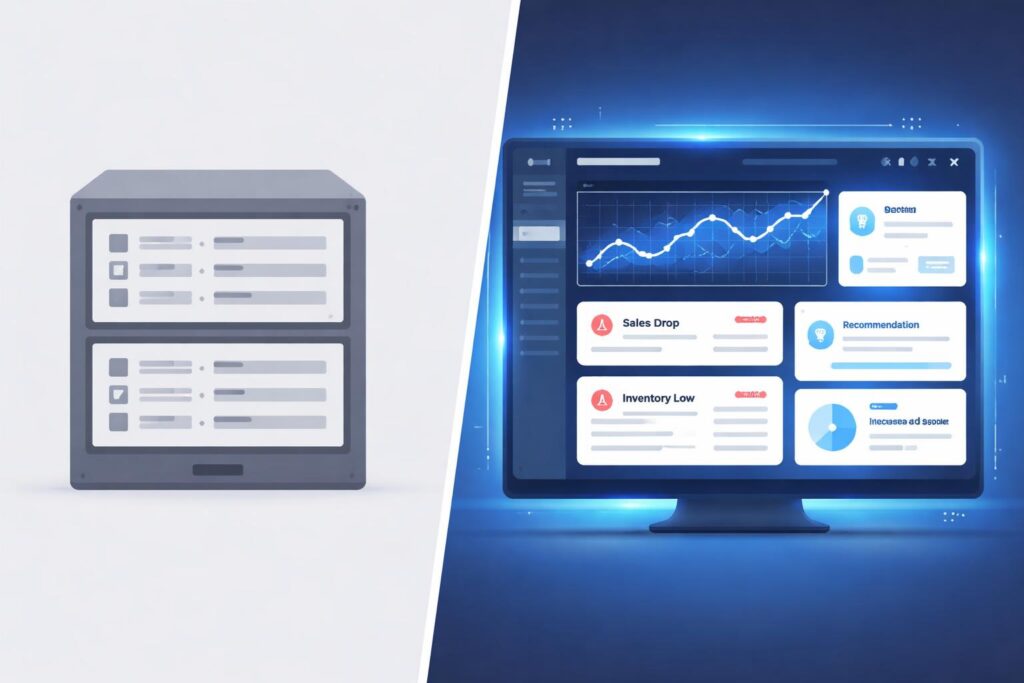
In Between Data Storage and Decision Support
The easiest way of defining the shift is as follows: older platforms are answering the question what happened? – new platforms respond to the question of what to do next.
Such a shift cannot be achieved simply by including a machine learning model to an already established system. It demands redesigning the whole data structure, constructing pipelines which cleanse and normalize information across various sources, and creating interfaces which expose model results when a decision must be taken – not deep in a report tab that no-one ever clicks on.
Used properly, it stops being a system of record and is a system of intelligence. Maintenance risk scores are displayed beside property units by property managers. Buyer match rankings are viewed by leasing agents as they operate their pipeline. Scenario forecasts with confidence intervals are viewed by investment analysts as opposed to single-point estimates.
The Reason Behind the Stalemate of Traditional Platforms
The same set of problems facing the legacy real estate platforms applies when they are expanding. Entry in data done manually brings in errors which accumulate with time. The relevance of the models of static scoring is lost with the changes in the market circumstances. The reporting tools that served well with a portfolio of 500 units will not work with 5,000 units. The problem behind this is that these systems were not designed to take over the work of providing analysis, but to assist human analysts.
The problem is aggravated by the economics. The amount of information, transactions, and decisions increases as a portfolio increases, but the platform does not become smarter. It leads to the organization employing more analysts in order to compensate them, hence eating up the benefits of growth in margins. With AI-based automation, that dependence is broken because analytical specifics are encoded into models that operate in the same fashion and at the same volume.
Core AI Capabilities Transforming Real Estate Software

Automated Property Valuation and Pricing Models
Automated valuation models – AVMs – are one of the most established AI applications in real estate. Traditional appraisals depend on manual comparables, appraiser judgment, and significant turnaround time. An AVM trained on transaction history, property attributes, location data, and macroeconomic signals can produce a valuation in seconds.
More advanced platforms go beyond a single estimate. They model scenarios – how does this property’s value change if interest rates rise 100 basis points, if a competing development opens nearby, or if zoning rules change? That turns valuation from a point-in-time answer into a planning tool.
Predictive Market and Demand Analytics
Most real estate analytics tools show what already happened. Absorption rates, vacancy reports, transaction volumes – these are lagging indicators that reflect market conditions from weeks or months ago. AI-driven forecasting pulls in leading signals instead: job posting trends, permitting activity, migration data, search behavior patterns.
The result is a platform that can tell an investment manager where demand is building before it shows up in transaction data – giving them a meaningful lead time advantage over competitors still reading backward-looking reports.
Intelligent Lead Scoring and Buyer Matching
High lead volumes are a common problem in residential and commercial real estate platforms. Online channels generate large numbers of inquiries, but most of them are low intent. Without intelligent filtering, agents spend the majority of their time on prospects who are not ready to transact.
AI-driven lead scoring models analyze behavioral signals – how a buyer searches, how often they engage, what properties they return to, where they are in the qualification process – and rank leads by purchase probability. Recommendation engines then match those buyers to relevant inventory, based not just on stated preferences but on patterns from comparable buyer profiles.
AI-Driven Property Management Automation
Predictive maintenance is one of the clearest ROI stories in property management AI. Sensors on HVAC systems, plumbing, and electrical equipment generate continuous telemetry. Models trained on historical failure data can identify equipment showing early signs of degradation and flag it for maintenance before it fails.
The financial logic is straightforward: a planned replacement costs a fraction of an emergency repair, and it does not displace tenants or generate negative reviews. Beyond maintenance, AI models can analyze payment behavior, service request patterns, and communication sentiment to predict which tenants are likely to leave at renewal – early enough for managers to intervene with targeted retention offers.
AI Across the Real Estate Software Lifecycle

AI in Data Ingestion and Normalization
Real estate data is messy. MLS systems use inconsistent field names. Third-party providers define the same metrics differently. IoT devices produce telemetry in incompatible formats. Legacy databases contain years of accumulated errors and gaps.
Before any AI model can perform reliably, this data problem has to be solved. Modern ingestion pipelines use natural language processing to extract structured data from unstructured documents – lease agreements, inspection reports, planning notices. Entity resolution algorithms match references to the same property or counterparty across different source systems. The output is a clean, unified data layer that every model downstream can trust.
Machine Learning Models for Forecasting and Risk
Forecasting applications in real estate software span a wide range. The table below summarizes the most common model types and what they are used for.
| Model Type | Application | Key Inputs |
|---|---|---|
| Regression and gradient boosting | Property valuation, rental income forecasting | Transaction history, property attributes, market data |
| Time-series forecasting | Vacancy rate prediction, demand modeling | Occupancy records, macro indicators, seasonal patterns |
| Classification models | Credit and tenant risk scoring | Payment history, behavioral signals, financial data |
| Ensemble methods | Investment ROI simulation | Multiple data streams combined for probabilistic outputs |
Advanced implementations produce probability distributions rather than single-point forecasts. This matters because it gives decision-makers a realistic view of the range of outcomes, not false precision dressed up as certainty.
AI-Enhanced UX and Personalization
A platform that generates useful insights but buries them in a separate analytics module will not change how people work. Effective AI integration means surfacing intelligence directly in the workflows where decisions happen.
That means personalized dashboards that adapt to each user’s role and behavior, notification systems that alert the right person to the right signal at the right time, and interfaces that answer questions in plain language rather than requiring users to build complex filters and queries. Some advanced platforms are beginning to deploy conversational interfaces that let users ask questions directly – “which units in Building C are most likely to turn over in the next 90 days?” – and receive a model-generated answer.
Continuous Learning Through MLOps
Real estate markets change, which means the models built on historical data need to change with them. A valuation model trained on pre-2022 transaction data performs differently in a high-rate environment. A demand forecasting model trained during a supply shortage will overestimate absorption in a more balanced market.
MLOps – the operational discipline of managing model lifecycles – addresses this through automated drift detection, systematic retraining pipelines, and A/B testing frameworks that evaluate updated models before they replace production versions. Research published through IEEE and industry analytics platforms confirms that MLOps maturity is a consistent differentiator between organizations that sustain AI performance and those that see models degrade within 12 to 18 months of deployment.
Architectural Foundations of AI-Powered Real Estate Platforms
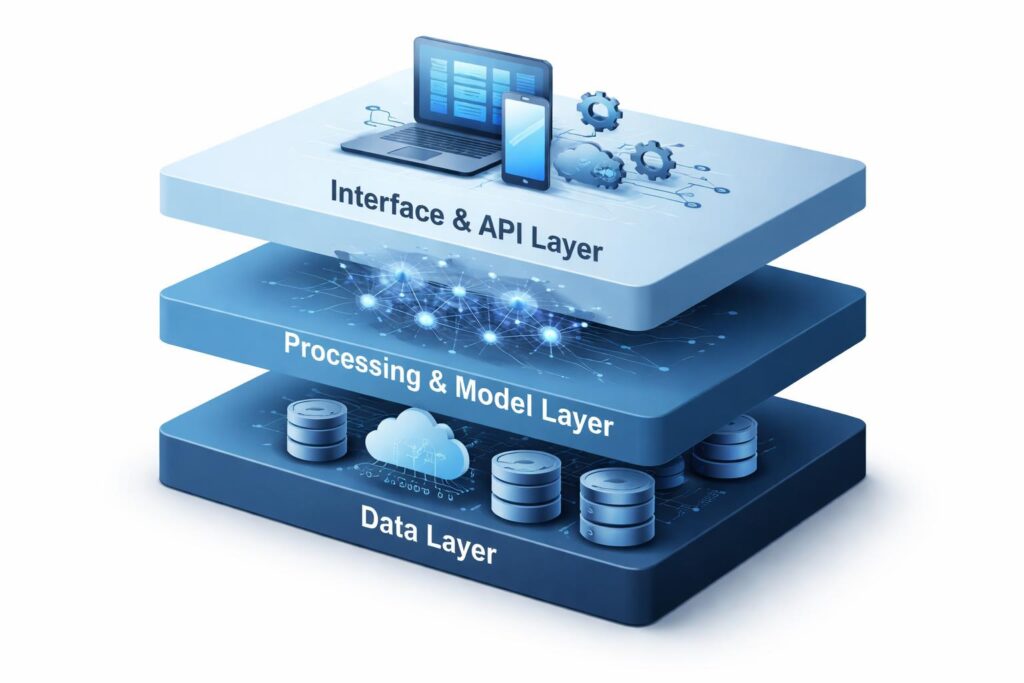
Data Architecture and Governance
AI is only as reliable as the data feeding it. A strong data architecture establishes clear lineage – every model input can be traced back to its source – alongside quality controls that catch problems before they propagate through the pipeline. In regulated markets, governance frameworks also need to address data residency requirements, access controls, and audit trails for decisions influenced by AI outputs.
The data lakehouse architecture has become a common pattern in mature proptech platforms. It combines the flexibility of a data lake, which handles raw and unstructured inputs, with the structure and query performance of a data warehouse. This lets analytical and machine learning workloads run on the same underlying data without the consistency issues that come from maintaining separate systems.
Cloud-Native and Event-Driven Architectures
Real-time intelligence requires real-time infrastructure. Batch processing systems that run overnight jobs cannot deliver the sub-second response times that live pricing recommendations, instant lead scoring, or immediate maintenance alerts require.
Cloud-native platforms built on containerized microservices and event streaming infrastructure handle continuous data flows from market feeds, IoT devices, and user interactions without the performance degradation that characterizes monolithic legacy systems. They also scale elastically – inference workloads that spike during peak demand periods do not require provisioning additional permanent capacity.
API-First Integration
Real estate software does not operate in isolation. It connects to CRM platforms, financial modeling tools, mapping providers, credit bureaus, and a growing range of proptech point solutions. An API-first architecture ensures that AI capabilities built within the platform are accessible to external systems, and that new data sources can be connected without rearchitecting the core platform.
Business Value of AI in Real Estate Software
The business case for AI in real estate platforms is not theoretical. The improvements it delivers are measurable and appear consistently across platform types.
Where AI delivers the clearest ROI:
- Valuation accuracy – AVMs trained on comprehensive data consistently outperform rule-based approaches on standard benchmarks, reducing pricing risk on acquisition and underwriting decisions
- Operational cost – automating routine data management, document processing, and maintenance coordination reduces administrative headcount requirements as portfolios scale
- Transaction velocity – AI-assisted valuation, document review, and buyer-property matching reduces elapsed time from first engagement to close, increasing throughput per agent or analyst
- Retention – predictive churn models give property managers early warning on at-risk tenants, enabling intervention before the renewal decision becomes final
- Agent and client experience – intelligent tools free agents from low-value administrative work and give clients faster, more relevant responses
Challenges of Implementing AI in Real Estate Software

Data Fragmentation and Quality
Data quality is the most common obstacle to successful AI implementation in real estate – not the algorithms. Property records maintained across dozens of county systems, inconsistent MLS field definitions, and legacy databases with years of accumulated errors create significant data preparation work before any modeling can begin. Organizations that underestimate this consistently find that data engineering consumes a disproportionate share of project budgets.
Legacy Systems and Integration
Most established real estate organizations run technology stacks assembled over many years, including on-premises databases, proprietary vendor platforms, and custom applications that predate modern API standards. Introducing AI capabilities into these environments requires careful planning to avoid disrupting live workflows. Incremental approaches – connecting AI capabilities to existing systems rather than replacing them outright – tend to deliver better outcomes than big-bang migrations.
Model Explainability and Regulatory Risk
As AI models influence credit decisions, property valuations, and tenant screening outcomes, regulatory scrutiny increases. In many jurisdictions, decisions affecting protected classes must be explainable to affected parties – a requirement that creates challenges for complex ensemble models. Model governance documentation, bias testing, and feature importance analysis are becoming standard requirements rather than optional practices.
Talent and Readiness
Building and maintaining AI-powered real estate platforms requires a combination of domain knowledge and technical capability that is genuinely scarce. Data scientists who understand real estate market dynamics, MLOps engineers who can operationalize models at production scale, and product managers who can translate business requirements into model specifications are not easy to hire. This gap drives significant demand for specialist development partners.
Best Practices for Building AI-Driven Real Estate Software
Start With High-Impact, Bounded Use Cases
Successful AI programs in real estate software almost always begin with a focused set of well-defined problems rather than broad platform transformation. Automated valuation, lead scoring, and predictive maintenance each have clear success metrics, established model architectures, and a realistic path to ROI within a reasonable timeframe. Starting here builds confidence, generates revenue justification for further investment, and creates the data infrastructure on which more complex applications can be built.
Invest in the Data Foundation First
No AI strategy survives poor data quality. Before significant investment in model development, audit existing data assets for completeness, consistency, and accessibility. Building unified pipelines that consolidate fragmented sources into a well-governed data environment is typically the highest-leverage pre-AI investment an organization can make. The data engineering work is unglamorous but determines the ceiling of everything built on top of it.
Embed AI Into Existing Workflows
AI features that require users to navigate to a separate analytical module are consistently underutilized. The most effective implementations put intelligence directly in the interface where decisions happen – a churn risk score on the tenant record, a lead ranking in the CRM pipeline, a valuation confidence interval on the property page. Reducing the distance between the model output and the decision it informs is one of the highest-leverage design choices in AI product development.
Partner With Teams That Know Both Domains
The intersection of AI engineering and real estate domain expertise is narrow. Teams that are strong in one but not the other consistently run into the same problems: technically sound models that do not reflect how the business actually works, or deep domain knowledge without the engineering discipline to get models into production reliably. Engaging partners with demonstrated experience in both accelerates delivery and reduces the risk of building something that works in a notebook but not in production.
Real-World Examples of AI in Real Estate Software
Commercial Real Estate Analytics Platform
Problem: A mid-market commercial analytics provider was losing enterprise clients to competitors with more sophisticated forecasting. Their platform produced reports based on static market data with 30-day lag times, and analysts spent roughly 40% of their time reconciling data from different sources.
Solution: The platform was rebuilt around an AI-powered ingestion layer that normalized inputs from 14 market data sources in real time. Gradient boosting models were deployed for vacancy forecasting and cap rate prediction, surfaced directly in the dashboard. An automated anomaly detection layer flagged data quality issues before they reached analysts.
Result: Forecast updates moved from monthly to daily. Analyst time on data reconciliation dropped by over 60%. Client retention improved in the following renewal cycle, and the platform could compete on forecast accuracy against significantly larger vendors.
Property Management SaaS
Problem: A property management platform serving large residential portfolios was seeing escalating maintenance costs driven by reactive repair workflows. Emergency interventions were expensive, and tenant satisfaction scores were declining as a result.
Solution: IoT integration was added to collect telemetry from HVAC, plumbing, and electrical systems. A predictive maintenance model generated daily risk scores by unit and automatically triggered work orders when thresholds were exceeded.
Result: Emergency repair incidents fell substantially in the first year. Tenant satisfaction improved, contributing to a measurable lift in renewal rates. The cost savings justified the platform investment within 14 months.
Real Estate CRM with AI Lead Scoring
Problem: A residential real estate technology company generated high lead volumes through online channels but struggled with conversion. Agents were spending most of their time on low-probability prospects while high-intent buyers experienced slow follow-up.
Solution: A behavioral scoring model was integrated into the CRM, analyzing search patterns, communication frequency, document submission status, and qualification signals. The interface surfaced top-ranked leads prominently and recommended follow-up actions by segment.
Result: Agent time allocation shifted toward higher-probability leads. Conversion rates improved and average time from first contact to offer submission decreased. Agent satisfaction with the platform increased as the quality of the lead pipeline improved.
Investment Analysis Platform
Problem: A commercial real estate investment platform needed to evaluate acquisition opportunities across multiple markets simultaneously while maintaining consistent underwriting standards. Manual analysis could not keep pace with deal flow.
Solution: An AI-powered underwriting module was built to ingest property financials, comparable transaction data, and market forecasts and generate standardized investment summaries with scenario analysis. A natural language summary generator produced initial deal memos from structured model outputs.
Result: Time to produce an initial investment analysis decreased dramatically. Deal coverage expanded without adding underwriting headcount. Investment committee members reported higher confidence in analysis consistency, reducing deliberation time on standard decisions.
AI Capabilities vs. Platform Maturity: A Quick Reference
The table below maps common AI capabilities to the platform maturity level typically required to implement them reliably.
| AI Capability | Minimum Maturity Requirement | Primary Dependency |
|---|---|---|
| Automated valuation models | Centralized, clean transaction data | Data quality and history depth |
| Lead scoring and buyer matching | Unified CRM with behavioral tracking | CRM integration and event logging |
| Predictive maintenance | IoT sensor infrastructure | Hardware deployment and telemetry pipeline |
| Demand and market forecasting | Multi-source data ingestion pipeline | Data architecture and external feeds |
| Churn prediction | Tenant behavioral data history | Operational data completeness |
| Conversational query interfaces | Stable underlying data models | Data governance and model reliability |
Organizations that try to skip maturity requirements – deploying demand forecasting models before establishing reliable data ingestion, for example – consistently find that model performance disappoints and confidence in AI erodes as a result. Sequencing matters.
Conclusion
AI is not something that gets added to real estate software as a feature. It is becoming the foundation on which competitive platforms are built. The gap between organizations that have embedded intelligence deeply into their workflows and those that have not is already measurable – in forecast accuracy, transaction speed, operational cost, and the ability to scale without proportional staffing growth.
The platforms that will define the next decade of proptech are being designed today with AI at their core. For product and technology leaders in real estate, the path forward is clear: invest in the data infrastructure that AI requires, sequence use cases by impact and feasibility, and build with architectural discipline. The organizations that do this thoughtfully will find that each AI capability they deploy makes the next one easier to build and more valuable to operate.
Ready to build the next generation of your real estate software with AI? Our team specializes in AI-powered real estate software development – from data architecture and machine learning model design to MLOps and full-platform delivery. Contact us to discuss how we can help you move from concept to production-ready AI capabilities.