


Real estate investment has always depended on data. But today, that data comes from dozens of sources at once – market indices, asset valuations, macroeconomic feeds, ESG scores, geospatial layers, and investor reporting portals. Most platforms still treat these sources as separate systems. The result is a fragmented picture that slows decisions and inflates risk. AI-driven data integration changes that equation. By connecting these streams into a unified analytical layer, modern real estate investment platforms can move from reactive reporting to predictive analytics in real time.
The pressure on investment teams has never been greater. Portfolio complexity is growing. Investors expect transparency on performance, risk exposure, and capital allocation – not quarterly, but continuously. At the same time, deal windows are compressing. The ability to assess an asset quickly, stress-test it against market scenarios, and benchmark it against comparable holdings is no longer a competitive edge; it is table stakes.
Against this backdrop, data fragmentation is the single biggest drag on investment performance. When analysts pull numbers from five different systems and reconcile them manually, errors creep in. Decisions lag behind the market. Governance breaks down. AI-driven data integration addresses these problems at the architectural level, not just the reporting layer.
This article examines how AI and integrated data infrastructure are reshaping real estate investment platforms – from the sources feeding these systems to the models powering decisions, and the business value firms are capturing as a result.
Why Data Integration Is Critical for Real Estate Investment

Real estate investment sits at the intersection of property markets, financial markets, and macroeconomic forces. A single asset decision pulls on cap rate trends, interest rate forecasts, tenant creditworthiness, local planning data, and portfolio correlation effects. Each of these inputs typically lives in a different system, owned by a different team, updated on a different schedule.
When data integration is weak, the consequences compound. An analyst relying on last month’s rent roll while the market has shifted by 40 basis points is not making an informed decision – they are making an assumption with a spreadsheet attached. Across a portfolio of hundreds of assets, this problem scales rapidly. Risk accumulates invisibly in the gaps between systems.
McKinsey research on AI in investment management consistently shows that firms with integrated, high-quality data infrastructure outperform peers on decision speed and risk-adjusted returns. The gap between data leaders and laggards in investment management is widening, not closing.
AI acts as the catalyst here. Machine learning models can reconcile inconsistent data formats, flag anomalies, and normalize inputs across sources without manual intervention. Natural language processing can extract structured signals from unstructured documents like lease agreements or planning reports. The result is a coherent, continuously updated data foundation that supports analytical decisions rather than undermining them.
The Role of AI in Modern Real Estate Investment Platforms

From Static Reporting to Intelligent Investment Insights
Traditional real estate platforms were built for reporting. They captured transactions, generated statements, and produced dashboards for quarterly reviews. These systems answered the question: what happened? Modern AI-enabled platforms answer a different question: what should we do next?
The shift is architectural as much as analytical. When data integration connects real-time market feeds to asset-level financials, machine learning models can generate continuous forecasts instead of periodic snapshots. A platform that previously produced a monthly NAV report can now surface intraday signals about valuation drift, covenant risk, or comparable transaction activity.
For investment teams, this means moving from a posture of review to a posture of anticipation. Portfolio managers can monitor live risk positions, receive early warnings on underperforming assets, and allocate capital based on forward-looking models rather than trailing data.
Why Traditional Data Integration Approaches Fail
Batch processing pipelines were the industry standard for connecting investment data sources through the 2010s. They worked well enough when data volumes were manageable and decision cycles were measured in days or weeks. Neither condition holds today.
Batch architectures introduce latency at every stage. Data extracted overnight is already stale by morning. When a market event triggers a portfolio reassessment, teams relying on yesterday’s data are making decisions on an outdated map. Beyond latency, traditional integration approaches struggle with scale. As platforms add data sources – alternative data providers, ESG platforms, third-party valuations – the complexity of maintaining batch pipelines grows faster than the teams managing them.
The deeper problem is that batch integration was designed to move data, not to understand it. It cannot reconcile conflicting inputs, flag data quality issues at ingestion, or adapt to schema changes in source systems. AI-native integration pipelines solve these problems by treating data quality as a continuous process rather than a one-time cleansing task.
Data Sources and Integration Challenges in Real Estate Investment

Market, Financial, and Property-Level Data
Real estate investment platforms draw on three distinct data layers, each with different update frequencies and quality characteristics:
- Market data includes transaction prices, cap rates, vacancy rates, and index benchmarks – typically sourced from third-party providers and updated daily or weekly.
- Financial data covers asset-level income statements, balance sheets, debt schedules, and fund-level accounts – maintained internally but often across disparate ERP or property management systems.
- Property-level data includes physical attributes, lease terms, tenant profiles, capital expenditure histories, and condition reports – the most granular and often the least structured layer.
Integrating these three layers into a coherent analytical foundation requires resolving significant inconsistencies. A property that appears in three different systems under three different identifiers is a common problem. Rent schedules maintained in local currency in one system and reporting currency in another create reconciliation errors. AI-powered data matching and entity resolution reduce this manual burden dramatically.
External and Alternative Data Sources
Beyond core investment data, leading platforms are incorporating a broader range of external inputs. Economic indicators – interest rates, employment data, consumer sentiment indices – provide macroeconomic context for asset performance models. ESG data is increasingly material for institutional investors, covering energy consumption, carbon footprint, and social impact metrics at the building level. Geospatial data layers add demographic trends, infrastructure development pipelines, and footfall analytics for retail and logistics assets. Third-party alternative data feeds, including satellite imagery and web-scraped demand signals, are moving from experimental to operational in larger platforms.
Each of these sources introduces its own integration complexity. Formats vary. Update schedules differ. Quality controls are inconsistent. An AI-native integration layer handles this heterogeneity at scale, applying automated quality checks and normalization rules that would take large data engineering teams weeks to implement manually.
Data Quality, Consistency, and Governance
The most sophisticated AI models produce unreliable outputs when trained on poor data. In real estate investment, the stakes of this problem are high. A risk model fed with stale or inconsistent inputs can understate exposure precisely when the portfolio is most vulnerable.
Strong data governance creates a single source of truth – a unified, versioned data layer that all models, reports, and dashboards draw from. This requires clear ownership policies, automated lineage tracking, and audit trails that satisfy regulatory requirements. Platforms that invest in governance early avoid the far more expensive process of cleaning up inconsistent data after it has already informed investment decisions.
AI-Powered Analytics for Investment Decision-Making
Predictive Models for Asset Performance and ROI
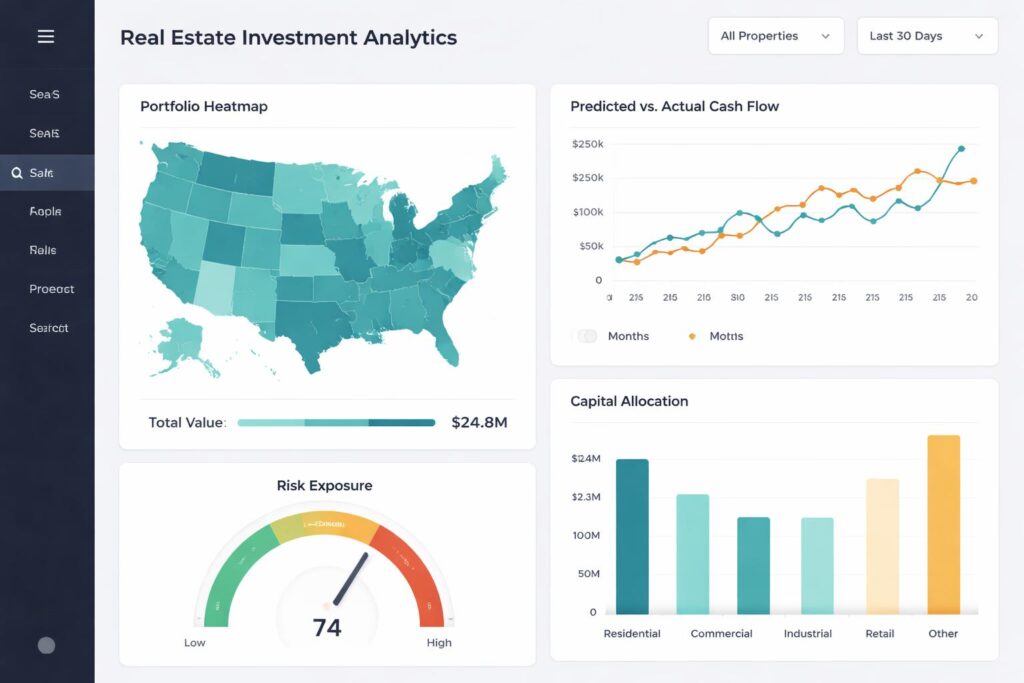
Cash flow forecasting is the most mature application of AI in real estate investment analytics. Models trained on historical rent growth, vacancy cycles, tenant renewal patterns, and capital expenditure trends can project asset-level income with substantially greater accuracy than manual analyst estimates. When integrated with live market data, these models update continuously rather than on a quarterly review cycle.
Valuation models add another layer. AI-driven automated valuation tools can benchmark assets against comparable transactions in real time, incorporating location characteristics, lease structure, and physical condition. For large portfolios, this enables continuous mark-to-market valuations that replace periodic appraisal processes – faster, cheaper, and less subject to individual appraiser judgment.
Risk Modelling and Scenario Analysis
Stress testing is where AI integration delivers some of its clearest value. Traditional scenario analysis required analysts to manually re-run financial models under different assumptions – a process that took days and typically covered only a handful of scenarios. AI-powered platforms run thousands of scenarios simultaneously, stress-testing every asset against interest rate shocks, vacancy spikes, tenant defaults, and macroeconomic downturns.
Sensitivity analysis identifies which variables drive the most variance in portfolio returns. For a logistics-heavy portfolio, that might be e-commerce penetration rates and last-mile land costs. For a residential fund, it could be wage growth and planning approval rates. Understanding these dependencies helps investment teams concentrate their analytical attention where it matters most.
Portfolio Optimisation and Capital Allocation
At the portfolio level, AI enables a more dynamic approach to capital allocation. Models can identify assets that are diluting risk-adjusted returns relative to comparable opportunities in the market. They can flag concentration risks – overexposure to a particular geography, sector, or tenant – before these become problems. And they can surface rebalancing opportunities that might not be visible to a team managing hundreds of assets manually.
The practical effect is that investment committees spend less time reviewing routine performance data and more time deliberating on strategic decisions. AI handles the monitoring function continuously; humans focus on judgment calls that require contextual expertise.
Architecture for AI and Data Integration Platforms
Unified Data Platforms and Pipelines
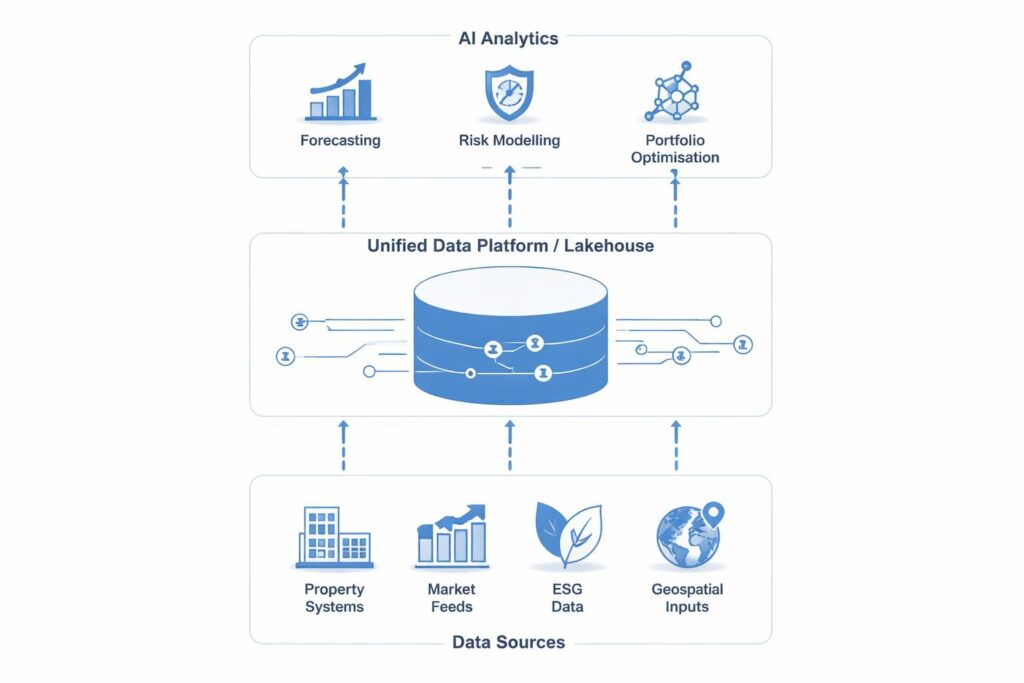
The modern standard for investment data infrastructure is the lakehouse architecture – a hybrid approach that combines the storage scale of a data lake with the governance and query performance of a data warehouse. For real estate investment platforms, this means maintaining a single storage layer for raw, curated, and consumption-ready data, with clearly defined pipelines connecting each stage.
Orchestration tools manage the scheduling, monitoring, and error handling of data pipelines across sources. When a third-party data provider changes its API schema, orchestration tooling can flag the issue and route data through a fallback path while engineers resolve the discrepancy – rather than silently propagating bad data downstream.
Cloud-Native and Event-Driven Architectures
Cloud-native infrastructure gives investment platforms the elasticity to handle peak analytical loads – end-of-quarter reporting, deal evaluation sprints, regulatory submissions – without maintaining expensive on-premises hardware year-round. Auto-scaling compute and managed database services reduce infrastructure management overhead significantly.
Event-driven architectures complement cloud infrastructure by enabling real-time data ingestion. When a comparable transaction closes in a target market, an event-driven pipeline can ingest that data, update the relevant valuation models, and surface the signal to portfolio managers within seconds – rather than waiting for the next batch run.
MLOps and Model Governance for Investment AI
Deploying predictive models in investment platforms requires more than technical accuracy. Models must be versioned, monitored, and retrained as market conditions shift. MLOps frameworks provide the infrastructure for this continuous lifecycle management. According to IEEE research on AI adoption in financial services, the gap between organisations that deploy AI models successfully and those that struggle is primarily an operational and governance challenge, not a technical one.
Model governance also addresses explainability requirements. Regulatory frameworks in many jurisdictions require that investment decisions informed by AI models can be explained in terms that compliance teams, auditors, and investors can understand. This is not just a legal requirement – it is a trust requirement. Platforms that cannot explain why a model flagged a particular risk are unlikely to see that model trusted by the investment team.
Business Value of AI-Driven Data Integration

Faster and More Accurate Investment Decisions
When data integration eliminates the reconciliation step, analysts reclaim hours that were previously spent cleaning and cross-checking inputs. Deal evaluation cycles that previously took two weeks can compress to two days. In competitive acquisition processes, this speed advantage is material.
Improved Risk Visibility and Control
Integrated data platforms give risk teams a continuous, portfolio-wide view of exposure. Live dashboards replace periodic reports. Anomaly detection models flag emerging risks before they reach threshold levels. Stress test results are available on demand rather than as quarterly exercises.
Scalable Analytics for Growing Portfolios
As portfolios grow, the marginal cost of adding analytical coverage for a new asset falls significantly on a well-integrated platform. The data ingestion pipelines, valuation models, and reporting templates are already built. Adding a new asset is a configuration task, not an engineering project.
Increased Investor Confidence and Transparency
Institutional investors are applying increasingly sophisticated scrutiny to the data practices of their managers. Platforms that can demonstrate clean data lineage, consistent valuation methodologies, and auditable model outputs attract and retain capital more effectively. Transparency is no longer a differentiator – it is a baseline expectation for institutional mandates.
Table 1: Business Value by Investment Function
| Investment Function | Traditional Approach | AI-Integrated Approach | Key Benefit |
|---|---|---|---|
| Deal Evaluation | Manual data pull, 10-15 days | Automated, 1-3 days | Speed to close |
| Risk Assessment | Quarterly stress test | Continuous monitoring | Earlier risk detection |
| Portfolio Reporting | Monthly static report | Live dashboards | Investor transparency |
| Capital Allocation | Analyst-driven models | AI-optimised recommendations | Better risk-adjusted returns |
| Valuation | Periodic appraisals | Continuous AI benchmarking | Lower cost, higher accuracy |
Challenges of Implementing AI and Data Integration

Legacy Systems and Siloed Data
Most established real estate investment firms carry significant legacy system debt. Property management platforms, ERP systems, and fund accounting tools were not designed to share data with each other, let alone feed AI models. Migration and integration projects require careful sequencing to avoid disrupting live operations. In practice, the most successful implementations do not attempt a wholesale platform replacement. Instead, they build an integration layer above existing systems, gradually bringing data into a unified foundation while legacy systems continue operating.
Data Security and Regulatory Compliance
Investment data is highly sensitive. Regulations including GDPR, AIFMD, and local fund management frameworks impose strict requirements on how data is stored, accessed, and processed. AI platforms that ingest third-party data must ensure that data licensing terms permit the intended analytical use. Cloud deployments require data residency controls that vary by jurisdiction. Building compliance into the architecture from the start is far less expensive than retrofitting it after deployment.
For firms building or upgrading their platforms, working with teams experienced in real estate software development ensures that regulatory requirements are addressed at the design stage rather than treated as an afterthought.
Model Explainability and Trust
Investment teams are not always ready to act on model outputs they cannot explain. A recommendation to reduce allocation to a particular geography carries more weight when the model surfaces the underlying drivers – rising vacancy rates, declining footfall data, tightening debt availability – rather than presenting a black-box score. Explainability is as much a change management challenge as a technical one.
Organisational Readiness and Skills Gap
AI implementation is as much an organisational challenge as a technical one. Investment firms frequently underestimate the skills required to operate AI-integrated platforms effectively. Data engineering, ML operations, and analytical skills need to exist either in-house or through reliable partnerships. Platforms built without the operational capability to maintain them degrade quickly as market conditions shift and models require retraining.
Best Practices for Building AI-Driven Investment Platforms
Prioritise High-Value Investment Use Cases
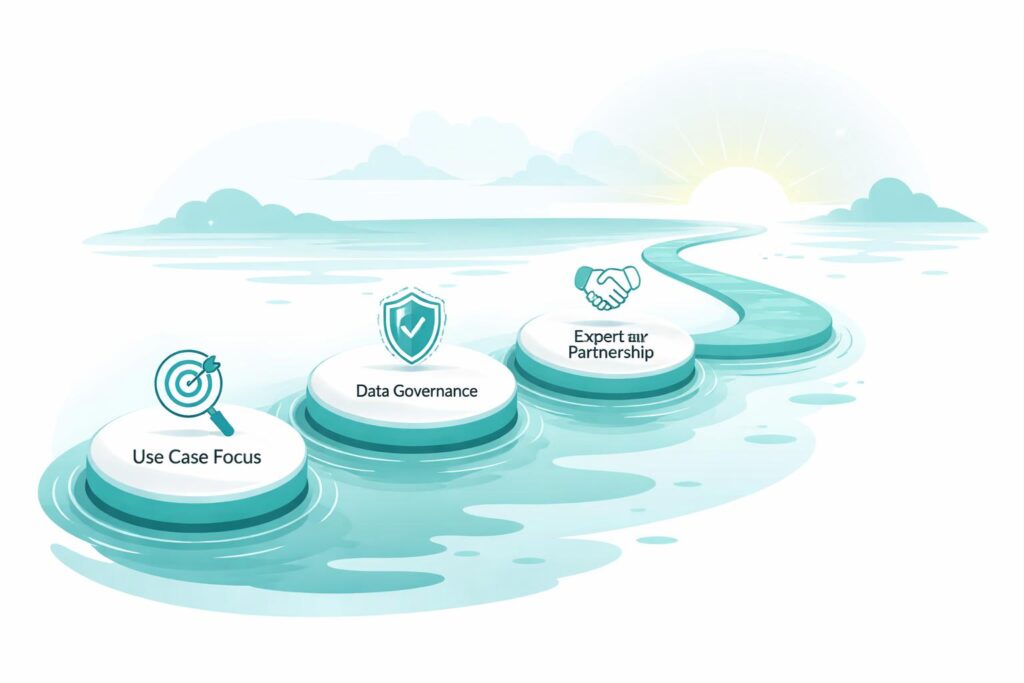
The most effective AI implementations start narrow and prove value quickly. Rather than attempting to integrate all data sources simultaneously, leading firms identify two or three analytical use cases with clear ROI – typically risk monitoring, deal evaluation speed, or investor reporting automation – and build the data foundation required to support those use cases first. Broader integration follows once the value case is established.
Establish Strong Data Governance Early
Data governance is easier to build than to retrofit. Firms that establish clear data ownership, quality standards, and lineage tracking at the outset of an integration project avoid the far more expensive process of cleaning up inconsistent data after it has informed investment decisions. Governance also supports regulatory compliance and investor due diligence requirements that will apply regardless of the platform’s analytical sophistication.
Strong governance practices are foundational to any serious data integration initiative – and they should be designed before the first pipeline is built, not bolted on afterward.
Design for Transparency and Explainability
Every model deployed in a production investment environment should have a corresponding explainability layer. This means documenting the features driving model outputs, building dashboards that surface the underlying data behind AI recommendations, and establishing review processes that keep human judgment in the loop on high-stakes decisions.
Partner With Experienced AI and PropTech Teams
Building AI-integrated investment platforms requires expertise across data engineering, machine learning, financial modelling, and regulatory compliance simultaneously. Most investment firms benefit from partnering with experienced teams rather than building all of these capabilities internally. The partner selection criteria should include demonstrable experience with investment-grade data systems, not just general AI development capability.
Firms exploring this path can start by reviewing relevant AI development approaches and the underlying analytics platforms that power them – these define the foundation for everything that follows.
Real-World Examples of AI and Data Integration in Real Estate Investment

1. Real Estate Investment Analytics Platform
Problem: A mid-market investment manager was operating with data spread across four property management systems, two ERP platforms, and multiple external market data subscriptions. Quarterly reporting took three weeks and was riddled with reconciliation errors.
Solution: A unified data lakehouse was built above the existing systems, with automated ingestion pipelines for all internal and external sources. A data quality layer applied entity resolution and anomaly detection at ingestion. A reporting layer generated live dashboards replacing the manual quarterly process.
Result: Reporting cycle reduced from three weeks to two days. Data errors eliminated at source. Analysts redirected from reconciliation to analysis.
2. AI-Powered Portfolio Management System
Problem: A large diversified real estate fund lacked visibility into cross-portfolio correlation risks. Asset-level performance data existed but was not connected to portfolio-level risk modelling.
Solution: An AI-powered risk platform was built connecting asset-level cash flow models with portfolio-level correlation matrices and macroeconomic scenario engines. Live dashboards surfaced concentration risks and early warning signals.
Result: Risk team identified two material concentration exposures before they became performance issues. Capital allocation decisions improved on a risk-adjusted basis.
3. Data-Driven Risk Assessment Solution
Problem: A commercial real estate debt fund was conducting manual covenant monitoring across 120 loans, requiring a team of four analysts to run weekly checks.
Solution: An automated monitoring platform ingested loan-level financial data and market benchmarks, applying rule-based and ML-powered alerts for covenant breach indicators. Analysts received prioritised exception reports rather than reviewing all loans weekly.
Result: Analyst capacity redirected to 30 highest-risk positions. Early warnings flagged two potential covenant breaches 60 days before they would have been identified manually.
4. Institutional Investment Dashboard
Problem: A real estate investment trust needed to improve investor reporting quality and frequency to meet expectations from a new institutional LP base.
Solution: An investor portal was built drawing on the firm’s integrated data platform, surfacing live NAV, performance attribution, ESG metrics, and scenario analysis outputs. All data was sourced from the same governed data layer used for internal investment decisions.
Result: Investor reporting cycle reduced from quarterly to monthly. LP satisfaction scores improved. Two institutional investors cited data quality and transparency as factors in increasing their allocation.
5. Geospatial Analytics Integration for a Logistics Fund
Problem: A logistics-focused fund was making acquisition decisions without access to systematic geospatial intelligence – infrastructure pipelines, planning approvals, demographic shifts – leading to missed early-mover opportunities.
Solution: A geospatial data integration layer was added to the investment platform, combining planning data APIs, satellite imagery analysis, and demographic feeds with the fund’s financial modelling infrastructure.
Result: Fund identified three emerging logistics submarkets 18 months ahead of comparable market activity. Acquisition prices on early positions were 12-15% below subsequent market levels.
Table 2: Integration Maturity Model for Real Estate Investment Platforms
| Maturity Level | Data State | Analytics Capability | AI Integration |
|---|---|---|---|
| Level 1 – Fragmented | Siloed systems, manual exports | Static spreadsheets | None |
| Level 2 – Connected | Batch integration, some automation | Scheduled reports | Basic rules-based |
| Level 3 – Integrated | Unified data layer, near real-time | Live dashboards, KPIs | Descriptive ML models |
| Level 4 – Intelligent | Full lakehouse, event-driven | Predictive analytics | Forecasting and risk AI |
| Level 5 – Autonomous | Self-healing pipelines, AI governance | Prescriptive, scenario AI | Full MLOps, explainable AI |
Conclusion
AI and data integration are not enhancements to real estate investment platforms – they are becoming the foundation that everything else is built on. The investment landscape is too complex, too fast-moving, and too data-intensive for platforms designed around periodic reporting cycles and manual data reconciliation. Firms that build integrated, AI-native data infrastructure gain a compounding advantage: better inputs produce better models, better models produce better decisions, and better decisions attract better capital.
The future of real estate investment is data-centric by design. Platforms that treat data integration as a one-time project rather than a continuous capability will fall behind peers who treat it as a strategic function. The firms that will lead the next cycle are those building the data foundation today – unifying their sources, governing their quality, and deploying AI where it amplifies human judgment rather than replacing it.
Ready to build an AI-powered data foundation for your real estate investment platform? Our team works with investment managers, PropTech firms, and asset management companies to design and deliver integrated analytics platforms tailored to real estate portfolios. Explore our case studies or get in touch to start a conversation about your data integration and AI strategy.