
The SaaS landscape has shifted from a race for features to a battle for efficiency. As markets saturate, the primary challenge for platforms with $1M to $50M ARR is no longer just “shipping code,” but managing the sheer complexity that comes with scale. Users are increasingly fatigued by dense interfaces, while backend infrastructures groan under the weight of massive datasets. In this high-stakes environment, AI integration has emerged as the definitive lever for enhancing SaaS product performance and driving SaaS product efficiency.

For leadership—CEOs, CTOs, and Product VPs—the conversation has moved beyond the novelty of generative chatbots. The real objective is structural: how to use machine learning to shorten the time-to-value, predict system bottlenecks before they occur, and transform a passive tool into an active partner for the user. High-performing SaaS is no longer defined just by uptime, but by how intelligently it handles the cognitive load of its customers.
Success in the modern market requires a fundamental rethink of product architecture. By embedding intelligence directly into the application logic, companies can move past the limitations of traditional software to achieve a level of responsiveness and personalization that was previously impossible. This article explores the analytical framework for integrating AI to optimize performance, reliability, and business value.
Why AI Has Become Essential to SaaS Performance
The SaaS industry is currently navigating a “complexity paradox.” While products have become more powerful, they have also become harder to use and more expensive to maintain. Traditional engineering focuses on incremental gains—refining SQL queries or optimizing CDN delivery—but these efforts often hit a ceiling when faced with non-linear user growth and data fragmentation. According to recent insights from McKinsey, the integration of AI into enterprise workflows is no longer a peripheral experiment but a core requirement for maintaining competitive operational margins.
User expectations have set a new baseline. Today’s B2B customers demand the same level of intuitiveness and speed they experience in premium B2C applications. They expect the software to anticipate their needs, automate repetitive tasks, and provide instant insights without requiring manual data manipulation. For a SaaS founder or product leader, AI is the only viable mechanism to meet these expectations at scale without infinitely scaling the human headcount in support or engineering.
Ultimately, AI integration is about resilience. A high-performing SaaS product must be able to handle fluctuating loads and diverse user behaviors without degrading the user experience. By moving from reactive logic to predictive modeling, SaaS companies can ensure that their products remain fast, reliable, and deeply relevant to every individual user.
SaaS Performance in the AI Era
In the traditional sense, SaaS performance was measured through technical metrics: latency, throughput, and availability. While these remain critical, the definition of performance in the AI era has expanded to include “user-centric performance.” This refers to how effectively a user can achieve their desired outcome.
Key Performance Constraints in Modern SaaS
Modern SaaS platforms often struggle with “interface bloat.” As more features are added to satisfy diverse customer segments, the product becomes a labyrinth.
Information Overload: Users struggle to find the 20% of features they use 80% of the time.
Latency Spikes: Massive datasets slow down dashboard rendering and reporting.
Onboarding Friction: High cognitive load leads to users abandoning the product before reaching “Aha!” moments.
Reactive Scaling: Infrastructure often lags behind sudden spikes in user activity.
Why Traditional Approaches Are No Longer Enough
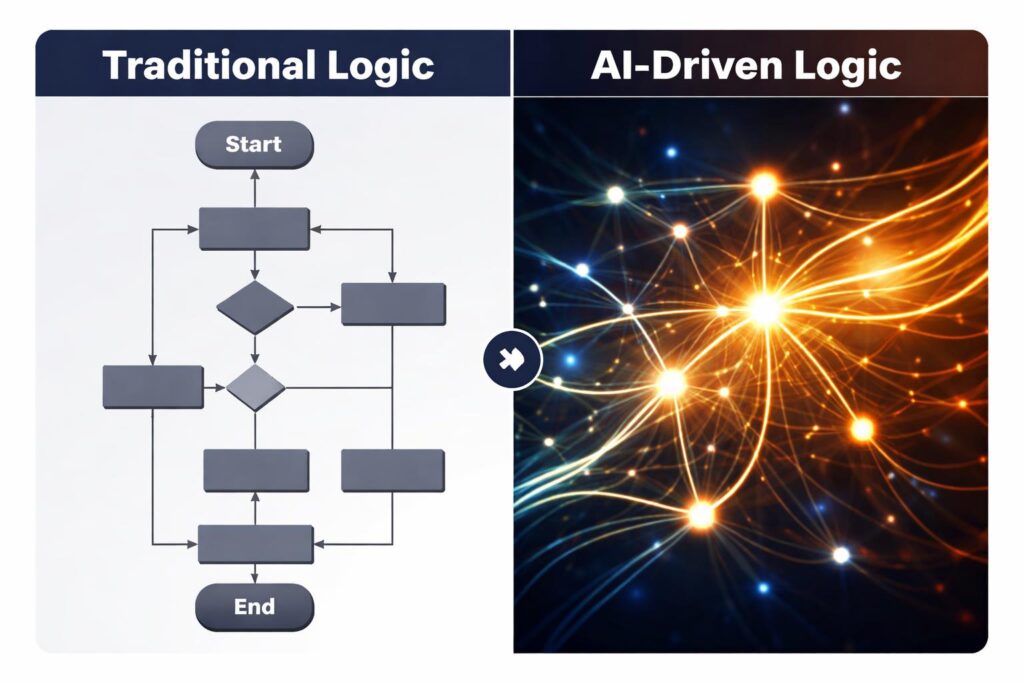
Conventional optimization techniques—such as code refactoring, caching strategies, and horizontal scaling—are necessary but insufficient for solving the “relevance problem.”
| Aspect | Traditional SaaS Optimization | AI-Enhanced Optimization |
| Data Handling | Manual indexing and caching | Predictive data pre-fetching |
| User Journey | Linear, hard-coded workflows | Dynamic, adaptive user paths |
| Resource Allocation | Reactive scaling based on load | Proactive forecasting of demand |
| Support | Ticket-based, human-led | Intelligent self-healing and bots |
How AI Integration Directly Improves SaaS Product Performance
Integrating AI into the core of a SaaS product acts as a force multiplier for every technical and functional layer.
Intelligent Workflow Automation
The most immediate impact of AI on performance is the elimination of “manual friction.” By analyzing how users interact with the product, AI can identify repetitive patterns and automate them. Instead of a user manually entering data from one module to another, an intelligent agent handles the mapping and execution.
Predictive User Assistance
Performance is also a function of clarity. AI-driven predictive assistance—such as contextual search, smart suggestions, and adaptive UIs—ensures that the user spends less time “searching” for value and more time “extracting” it. When the system predicts the next likely action, it can pre-fetch data or highlight the necessary tools.
Performance Optimization Through AI-driven Logic
On the infrastructure side, AI can be used for smart request routing and load forecasting. Instead of waiting for a server to hit 90% capacity to trigger an auto-scaling event, AI models can predict traffic spikes based on historical usage patterns and spin up resources in advance.
AI-Enriched Architecture for High-Performance SaaS
To reap these benefits, the underlying architecture must evolve. You cannot simply “bolt on” an AI layer to a legacy stack.
Data Infrastructure as a Foundation
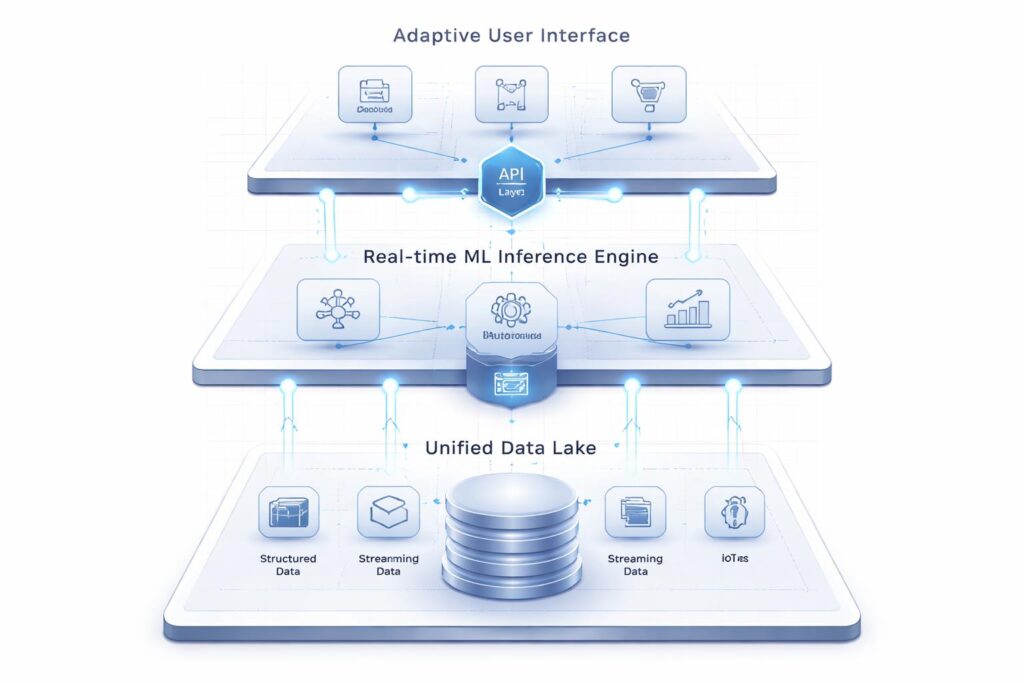
AI is only as good as the data it consumes. A high-performance AI integration requires robust data pipelines that ensure data quality, consistency, and low latency. This foundation allows the AI models to access the right information at the right time without creating bottlenecks in the primary application database.
ML Models Embedded Into Product Logic
Rather than treating AI as a separate microservice, high-performance SaaS embeds ML models directly into the product logic. This might involve edge computing for lower latency or specialized inference engines within the backend.
MLOps for Reliable Performance
Maintaining AI performance over time requires dedicated MLOps practices. Models can “drift” as user behavior changes. According to research on Statista, companies that invest in automated model monitoring see a 30% faster time-to-market for AI features.
The Business Value of AI-enhanced SaaS Performance

For the C-suite, the technical elegance of AI is secondary to its impact on the bottom line.
Reduced Churn: Faster time-to-value keeps users from looking at competitors.
Lower Support Costs: AI handles routine queries, freeing up human agents for complex issues.
Higher LTV: Increased feature adoption leads to higher expansion revenue.
Operational Efficiency: Automated backend processes reduce the need for manual DevOps intervention.
| Metric | Business Impact | AI Contribution |
| Time-to-Value (TTV) | Accelerated onboarding | Predictive setup and data mapping |
| Churn Rate | Improved retention | Early detection of disengaged users |
| Infrastructure Costs | Optimized margins | Smart resource management and caching |
| Feature Adoption | Increased product depth | Contextual nudges and recommendations |
Challenges in AI Integration for SaaS
Despite the clear advantages, the path to AI integration is fraught with technical and strategic hurdles.
Data Fragmentation and Poor Data Quality
The most common barrier is “dirty data.” If information is siloed across different modules or lacks a consistent schema, the AI will produce “hallucinations” or inaccurate predictions. Cleaning and unifying data is often the most time-consuming part of the integration process.
Integrating AI Without Degrading Performance
There is a risk that adding AI models will actually slow the product down. Large models require significant compute power. Balancing the “intelligence” of a model with its “speed” is a critical engineering trade-off that requires Data engineering expertise.
Best Practices for High-Performance AI Integration in SaaS
To navigate these challenges, leadership should follow a structured, performance-first roadmap for AI adoption.
Audit the Friction: Use heatmaps and logs to find where users get stuck.
Modularize AI: Build AI features as micro-services to prevent a single model failure from taking down the whole app.
Human-in-the-loop: Always provide a way for users to override AI decisions to maintain trust.
Partner Wisely: Work with AI development teams who understand SaaS development specificities.
Real SaaS Case Examples of AI Improving Performance
Case Study 1: Analytical SaaS Platform
The Problem: A data analytics platform struggled with slow query times as customer datasets grew. Users were waiting up to 30 seconds for reports.
The AI Solution: They implemented an AI-driven “Query Optimizer” that predicted which data subsets would be needed and pre-indexed them.
The Result: Average report generation time dropped from 30 seconds to under 2 seconds. User engagement increased by 45%.
Case Study 2: HR and Recruitment SaaS
The Problem: An HR platform was overwhelmed by “resume noise,” leading to recruiter fatigue.
The AI Solution: They integrated an NLP engine that ranked candidates based on “skill proximity” rather than just keywords.
The Result: Recruiters reported a 70% reduction in time spent on initial screening, and Case studies show “time-to-hire” improved by 30%.
Case Study 3: Fintech Payment SaaS
The Problem: High false-positive fraud alerts were frustrating legitimate users and clogging support lines.
The AI Solution: A behavioral ML model replaced static rules to analyze transaction patterns in real-time.
The Result: False positives decreased by 60%, and support ticket volume dropped by 50%.
What is Next?
The integration of AI is no longer a luxury for SaaS companies; it is the new standard for high-performance software. By moving beyond simple automation and into the realm of predictive, adaptive, and self-optimizing systems, SaaS providers can overcome the inherent limitations of traditional architecture. The result is a product that is not only faster and more reliable but also significantly more valuable to the end user.
As you look toward the future of your platform, remember that the most successful AI integrations are those that remain invisible to the user—they simply make the product work better, faster, and more intuitively. By focusing on the intersection of data integrity and user-centric design, you can ensure that your SaaS product remains a leader in an increasingly crowded marketplace.
Are you ready to transform your product’s performance through intelligent AI integration? Our team specializes in building high-scale AI solutions tailored for the SaaS ecosystem. From initial data strategy to full-scale MLOps implementation, we help you turn complexity into a competitive advantage. Contact us today for a strategic consultation on your AI roadmap.