Managing a workforce has never been more complex. Companies today operate across hybrid and distributed teams, multiple geographies, and several employment models at once. Employee expectations for digital tools have grown sharply, and pressure on productivity and retention has made HR a core business function rather than a back-office task. Custom HR software development is how forward-looking organisations respond to this reality – building intelligent automation and workforce management capabilities around their specific needs, not generic assumptions.
The traditional approach – buying an off-the-shelf HR system and adapting your processes to fit it – no longer works well for companies with complex or fast-changing workforce structures. Standard HR platforms handle payroll, onboarding, and basic reporting adequately. But when it comes to real-time workforce analytics, intelligent automation, or personalised employee experiences, they consistently fall short. The result is a patchwork of workarounds, manual processes, and disconnected data that costs both time and talent.
What custom HR software development offers is something different: a platform built to reflect how your organisation actually works, pulling data from across the business, automating the processes that matter most, and using AI to support better decisions at every level. This article explains why that matters, what it looks like in practice, and how organisations can approach it well.
Why Workforce Management Requires Custom HR Software
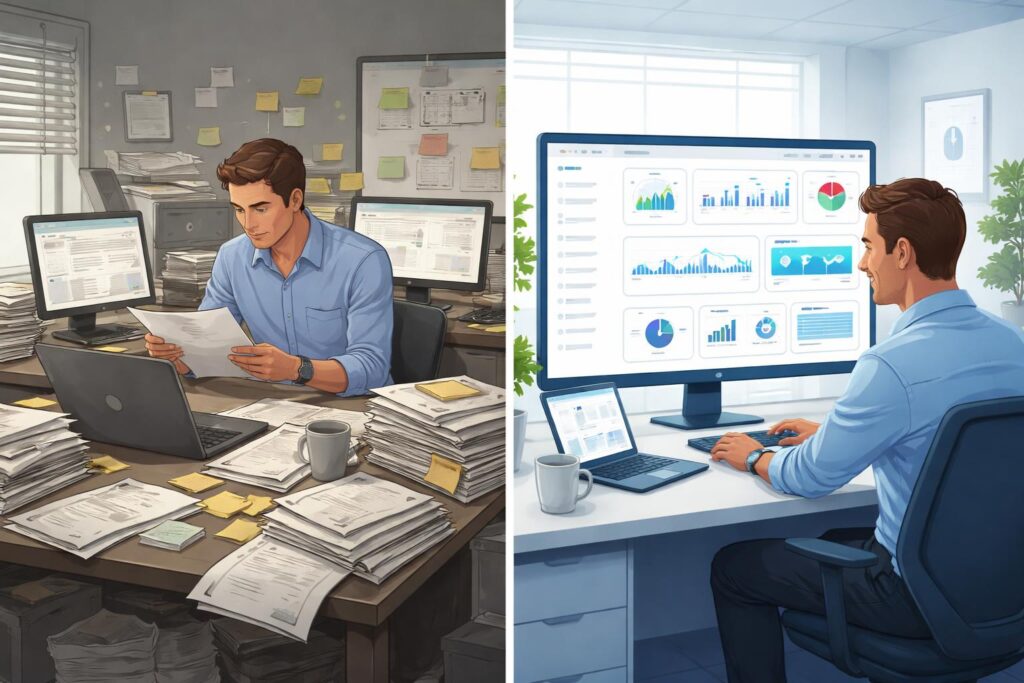
HR has changed fundamentally. It was once defined by compliance, record-keeping, and process administration. Today its mandate is far broader: attracting the right talent, keeping people engaged, building skills aligned with future business strategy, and giving leaders the data they need to make workforce decisions with confidence. The technology required to support that mandate is correspondingly more sophisticated.
Standard HR systems were not built for this. They automate administrative processes – and do that adequately – but offer little when it comes to predictive analytics, adaptive learning, or deep integration with the financial and operational systems that HR decisions increasingly depend on. Research from McKinsey has consistently shown that organisations with strong data capabilities in HR significantly outperform peers on both talent acquisition and retention – capabilities that standard platforms rarely deliver out of the box.
According to McKinsey’s research on the future of work, companies that invest in data-driven workforce management are far better positioned to adapt to labour market disruptions and shifting skill demands. This requires more than a standard HRIS. It requires a purpose-built platform that can collect, process, and act on workforce data in real time.
The scale of workforce complexity has also increased. A company managing 5,000 employees across multiple countries, employment types, and business units faces data, compliance, and reporting challenges that no standard HR platform was designed to handle holistically. Custom HR software development is the mechanism for building a platform that actually can.
What Custom HR Software Means for Modern Organisations
From Administrative HR Systems to Workforce Intelligence Platforms
The difference between an HR system and a workforce intelligence platform is significant. An HR system stores and processes data. A workforce intelligence platform uses that data to surface insights, automate decisions, and guide action. Custom HR software development is how you get from one to the other.
This shift changes what HR teams spend their time on, how managers make decisions about their people, and how the business thinks about workforce strategy overall. When the system can flag retention risks before they become resignations, recommend learning aligned with future capability needs, or model the impact of different hiring strategies, HR moves from reactive to proactive. That change in orientation is what drives measurable business value.
Most organisations get there gradually. They start with specific high-value use cases – automating onboarding, improving how performance data is collected and used – and expand from there. The key is that the architecture is designed from the outset to scale and to integrate with the broader enterprise data environment.
Limitations of Off-the-Shelf HR Solutions
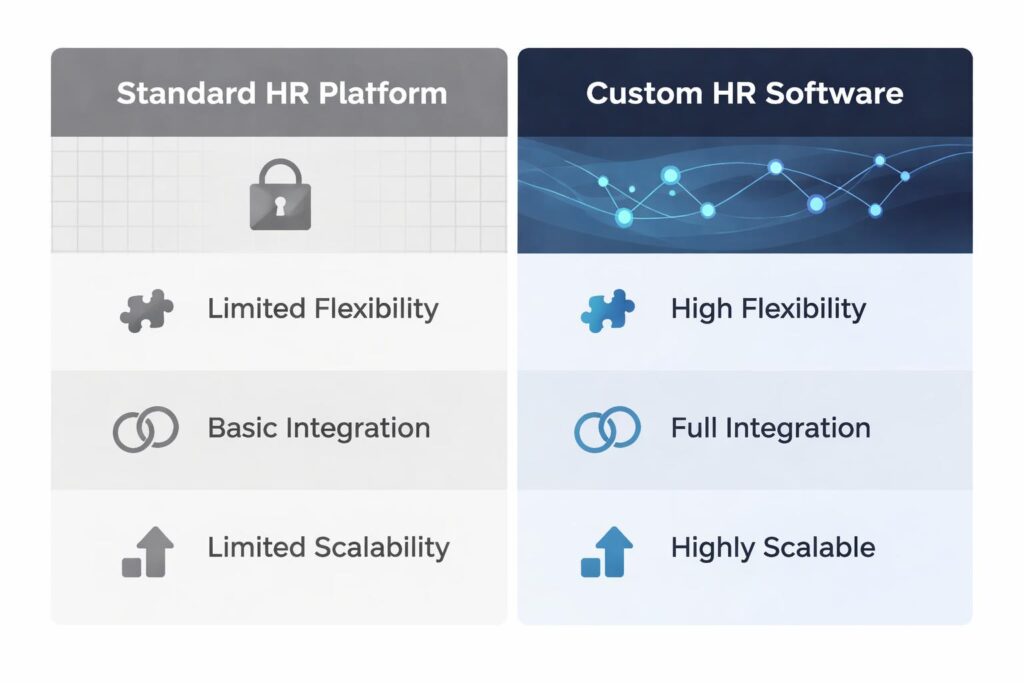
The limitations of standard HR platforms are well documented. They are designed to serve the broadest possible customer base, which means they are built around common processes rather than specific ones. For companies with unique workflows, complex organisational structures, or demanding integration requirements, this creates persistent friction.
Configuration options in standard platforms are typically surface-level. You can adjust field labels, set permissions, and configure certain process flows. But you cannot fundamentally change how the system handles data, what logic it applies to decisions, or how it connects to non-standard systems. This matters because the processes that differentiate high-performing organisations from average ones are rarely standard.
Beyond structural limitations, standard platforms create vendor dependency. Roadmap decisions are made by the vendor, not your business. Pricing increases at renewal. Features are bundled rather than modular. For organisations that view HR technology as a strategic asset, these constraints become increasingly difficult to accept.
Table 1: Off-the-Shelf HR Software vs. Custom HR Software Development
| Category | Off-the-Shelf HR Software | Custom HR Software |
|---|---|---|
| Flexibility | Fixed workflows, limited configuration | Fully tailored to your business processes |
| Integration | Pre-built connectors only | API-first design for any enterprise system |
| Scalability | Vendor-controlled upgrade cycles | Scales on your timeline and architecture |
| Data ownership | Shared cloud environment | Dedicated environment, full data control |
| AI capabilities | Generic, vendor-defined models | Custom models trained on your own data |
| Total cost of ownership | Rising licence fees plus workarounds | Higher upfront, lower long-term cost |
| Compliance controls | Standard templates | Built-in to architecture from day one |
Core Capabilities of Custom HR Software Solutions
Workforce Planning and Capacity Management
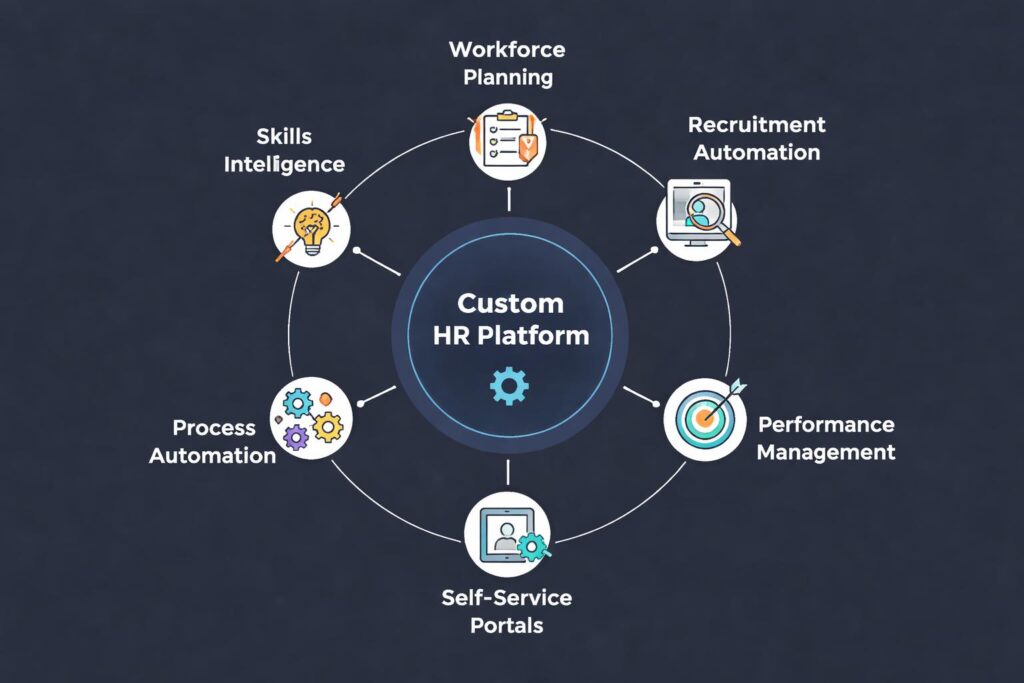
Workforce planning is one of the highest-value applications of custom HR software development. The ability to model future talent needs based on business forecasts, skill assessments, and external labour market data gives HR and business leaders a meaningful planning advantage. Custom platforms can integrate headcount data with financial forecasts, project pipelines, and skills inventories to produce dynamic capacity models that update in real time.
This is particularly valuable in industries with variable demand patterns – professional services, technology, or healthcare – where the cost of over- or under-staffing is significant. A custom workforce planning module reflects the specific cost structures, role families, and planning horizons that matter to your business, rather than the generic templates found in standard systems.
Talent Acquisition and Intelligent Recruitment Automation
Recruiting is one of the most resource-intensive HR processes and one of the most amenable to intelligent automation. Custom HR software can incorporate AI-driven candidate screening, skills matching, and interview scheduling to reduce time-to-hire and improve candidate quality. More importantly, it can be trained on your own hiring data, learning what characteristics predict success in your specific roles and culture rather than relying on population averages.
Custom recruitment platforms can also connect directly with your ATS, job boards, internal mobility programmes, and employer branding assets – creating a unified candidate experience that reflects your organisation’s identity. This unified approach is not possible with standard platforms that treat every client the same way. You can learn more about the technical approach in our AI development services.
Performance Management and Employee Development
Performance management has evolved significantly. The annual review cycle has largely given way to continuous feedback models, OKR-based goal setting, and development-focused conversations. Custom HR software can support any performance model your organisation uses – capturing feedback in formats that work for your teams, surfacing it in ways that are useful to managers, and connecting it directly to learning and development recommendations.
Data-driven development planning is a particular strength of custom solutions. By connecting performance data with skills frameworks, career path models, and learning content, a custom platform can generate personalised development recommendations at scale. Standard platforms can only approximate this with generic functionality.
HR Process Automation and Self-Service Portals
The volume of routine HR transactions in any mid-size organisation is substantial. Leave requests, onboarding workflows, policy acknowledgements, benefit enrolments, offboarding processes – each involves multiple steps, stakeholders, and data points. Custom HR software can automate these end-to-end, including the conditional logic, approval workflows, and system integrations that standard platforms handle poorly or not at all.
Employee self-service portals built on custom platforms deliver a significantly better experience than the generic portals attached to standard HRIS systems. When the portal is designed around your specific processes and information architecture, employees find what they need faster, complete tasks with fewer steps, and have more confidence that the system reflects their actual situation.
AI and Analytics in Workforce Management Software
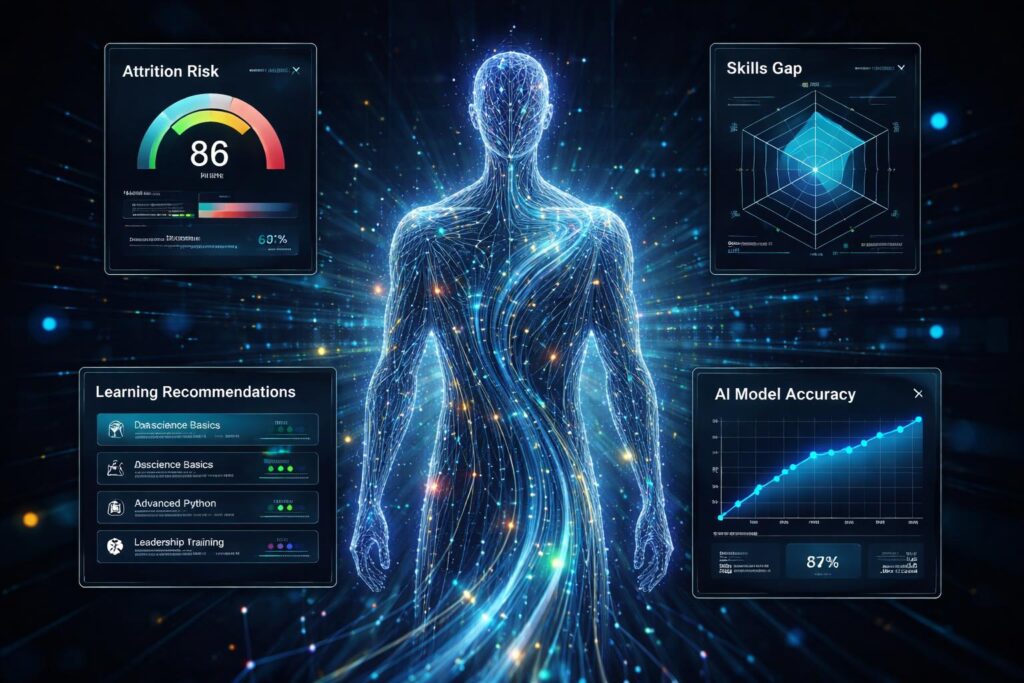
Predictive Analytics for Attrition and Retention
Employee attrition is expensive. The fully loaded cost of replacing a skilled employee typically ranges from 50% to 200% of annual salary, depending on role complexity and seniority. Predictive analytics built into custom HR software can identify employees at elevated risk of leaving – based on a range of signals – before the decision is made. This gives managers and HR teams the window to intervene effectively.
Custom attrition models are trained on your specific data: tenure patterns, performance trajectories, compensation benchmarks, engagement survey results, and behavioural signals such as leave frequency or login patterns. This produces far more accurate predictions than the generic attrition tools found in standard HR platforms, which rely on population averages rather than your specific workforce context.
Skills Intelligence and Learning Recommendations
The skills challenge facing most large organisations is acute. Rapid technology change, shifting business models, and evolving customer expectations mean the skills required today are not the same ones needed in three years. Custom HR software can build and maintain a living skills inventory – mapping current capabilities across the workforce, identifying gaps relative to future needs, and generating personalised upskilling and reskilling recommendations.
This kind of skills intelligence is only possible when the platform connects to all relevant data sources: job architectures, performance records, learning completion data, project histories, and external skills benchmarks. Custom solutions make these connections in ways that standard platforms, which typically treat learning management as a separate module, cannot replicate.
AI-Enhanced Employee Experience
The employee experience has become a strategic differentiator. Organisations that personalise the experience – providing relevant information at the right moment, streamlining administrative interactions, and supporting employees through key moments in their career journey – see measurable improvements in engagement and retention. AI is central to this personalisation.
Custom HR software can use AI to power intelligent virtual assistants, personalised content feeds, proactive notifications, and adaptive onboarding journeys. These capabilities are far more effective when built on your own data and designed for your specific employee population than when purchased as generic add-ons to a standard platform.
Continuous Optimisation Through MLOps
AI models degrade over time if they are not maintained. The workforce patterns that existed when a model was trained change as the organisation evolves, the labour market shifts, and business strategy adjusts. According to Statista research on AI adoption in enterprise HR, organisations that implement structured model maintenance practices see substantially better AI performance over time than those that treat AI as a one-time implementation.
Custom HR software built with MLOps principles ensures that the models powering attrition prediction, skills matching, and performance analytics are retrained regularly, monitored for drift, and updated as new data becomes available. This is the difference between AI that works at go-live and AI that continues to deliver value two years later.
Architecture of Scalable Custom HR Software
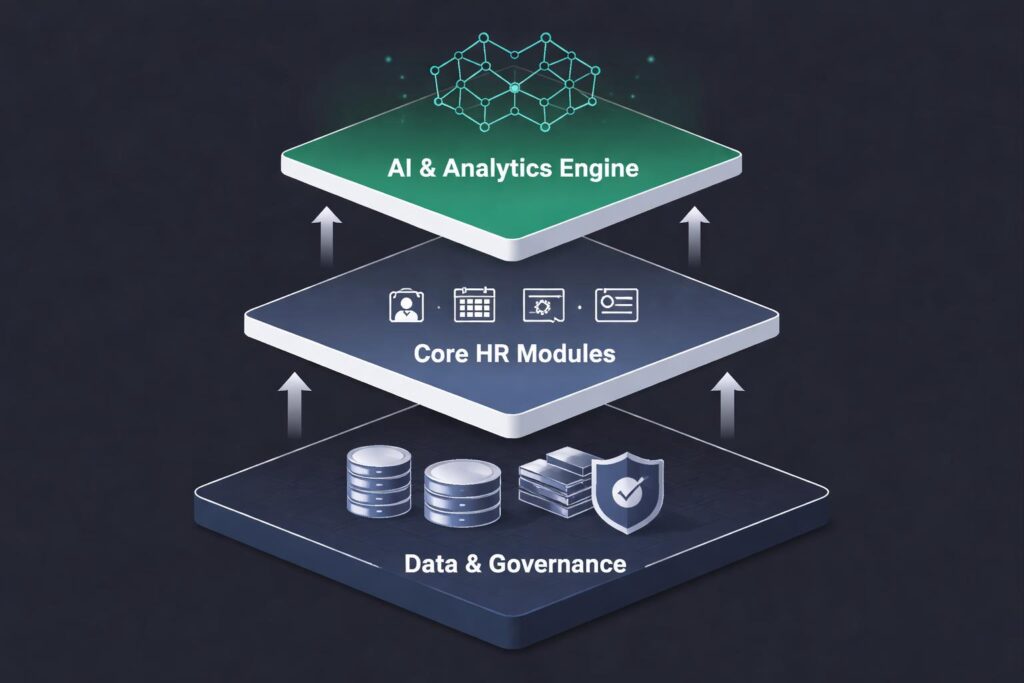
Data Architecture and HR Data Governance
The foundation of any effective custom HR software solution is a robust data architecture. HR data is sensitive, subject to complex regulatory requirements, and often distributed across multiple systems. A well-designed data layer establishes clear ownership, defines data quality standards, implements privacy controls from the ground up, and provides the clean, consistent data that analytics and AI capabilities depend on.
HR data governance is not an afterthought in custom development – it is a design principle. GDPR, CCPA, and sector-specific regulations impose specific requirements on how employee data is stored, processed, and accessed. Custom solutions build these requirements into the architecture directly, rather than retrofitting compliance controls onto a platform designed for a different context. See how we approach this in our data engineering practice.
Cloud-Native and Modular Architectures
Modern custom HR software is built on cloud-native, microservices-based architectures. This approach provides the scalability and resilience that enterprise HR platforms require, while also enabling modular development. Rather than building a monolithic system all at once, organisations can start with the modules that deliver the highest immediate value and expand incrementally.
Cloud-native architecture also enables the elastic scaling required by HR workloads that vary significantly in intensity – annual performance cycles, open enrolment periods, mass onboarding events. The platform scales to meet demand without manual intervention or the performance degradation that affects on-premise systems.
API-First Integration With Enterprise Ecosystems
Custom HR software does not operate in isolation. It must exchange data with ERP systems, payroll platforms, finance systems, learning management tools, and an expanding ecosystem of point solutions. An API-first architecture makes these integrations reliable, maintainable, and extensible.
This matters particularly for organisations with complex enterprise technology stacks. Standard HR platforms offer pre-built connectors for common integrations, but these are often shallow, difficult to extend, and dependent on vendor support. Custom solutions with well-designed APIs give organisations full control over how data moves between systems, enabling the end-to-end automation that drives real operational efficiency.
Business Value of Custom HR Software Development
Table 2: Business Outcomes From Custom HR Software
| Business Area | Typical Outcome |
|---|---|
| Workforce productivity | 20-35% reduction in time spent on manual HR tasks through automation |
| Operational HR costs | Up to 40% lower cost per HR transaction compared to fragmented toolsets |
| Talent retention | Predictive models that flag at-risk employees 60-90 days in advance |
| Decision-making speed | Real-time analytics dashboards accessible to HR, finance, and leadership |
| Compliance management | Automated audit trails and role-based data access across all HR systems |
| Time-to-hire | AI-assisted screening reduces recruitment cycle by 30-50% on average |
Increased Workforce Productivity
When routine HR processes are automated and employees have access to better self-service tools, the time recovered is significant. HR teams shift from managing transactions to focusing on work that requires human judgment. Managers get better information faster, reducing the time spent seeking answers and making decisions with incomplete data. These productivity gains compound over time as the platform learns and improves.
Reduced HR Operational Costs
Custom HR software consolidates functionality that organisations currently address through multiple point solutions, each with its own licence cost, integration overhead, and maintenance requirement. The total cost of ownership comparison typically favours custom development at scale, particularly when the cost of ongoing platform customisation, integration maintenance, and process workarounds in standard systems is fully accounted for.
Better Decision-Making Through Data
Real-time workforce analytics changes how business decisions are made. When HR, finance, and operations share a common view of workforce data – aligned around the metrics that matter to the business – the quality and speed of decisions improve materially. Custom platforms are designed to provide this shared view, connecting data from across the enterprise in ways that standard HR systems cannot match.
Improved Employee Retention and Engagement
Retention is where the financial impact of better HR software is most visible. When predictive models identify at-risk employees early, when personalised development plans keep people engaged and growing, and when the day-to-day experience of using HR systems is genuinely good, the result is measurable improvement in retention metrics. For organisations where talent is a primary competitive differentiator, this alone justifies the investment.
Challenges of Building Custom HR Software
Data Privacy and Regulatory Compliance
HR data is among the most sensitive in any organisation. Building a custom platform that handles this data responsibly requires deep knowledge of applicable regulations and a security architecture designed specifically for the sensitivity of employee information. This is not a challenge unique to custom development, but it must be addressed explicitly in the design process rather than assumed to be handled by a vendor.
Change Management and Adoption
The best-designed HR platform delivers no value if employees and managers do not use it effectively. Change management is consistently underestimated in HR technology projects. Custom development projects should include structured change programmes, training tailored to different user groups, and feedback mechanisms that allow the platform to be refined based on real usage patterns. Design for adoption must start at the requirements stage, not after development is complete.
Integration With Legacy HR Systems
Most organisations beginning a custom HR software development project have existing systems that store years of valuable data and support processes that cannot be disrupted overnight. Integrating with or migrating from legacy HR systems is technically complex and requires careful data mapping, validation, and cutover planning. This complexity is manageable, but it must be scoped accurately from the outset. Explore how we handle this in our custom software development work.
Talent and AI Readiness
Realising the full value of AI capabilities in custom HR software requires a degree of internal readiness that not all organisations have at the start of a project. This includes data quality and completeness, the analytical capabilities of the HR team, and the willingness of managers to act on AI-generated recommendations. Building this readiness in parallel with platform development is essential to achieving intended outcomes.
Best Practices for Successful Custom HR Software Development
Start With High-Impact Workforce Use Cases
The scope of what is possible with custom HR software is broad. Starting with the use cases that deliver the highest measurable value – typically those combining significant process volume with high decision-making impact – creates early wins that build organisational confidence and provide the data foundation for more advanced capabilities.
List 1: High-Impact Starting Points for Custom HR Software Projects
- Automated onboarding and offboarding workflows that connect HR, IT, finance, and facilities in a single process
- Recruitment automation with AI-assisted screening and candidate matching based on your historical hiring data
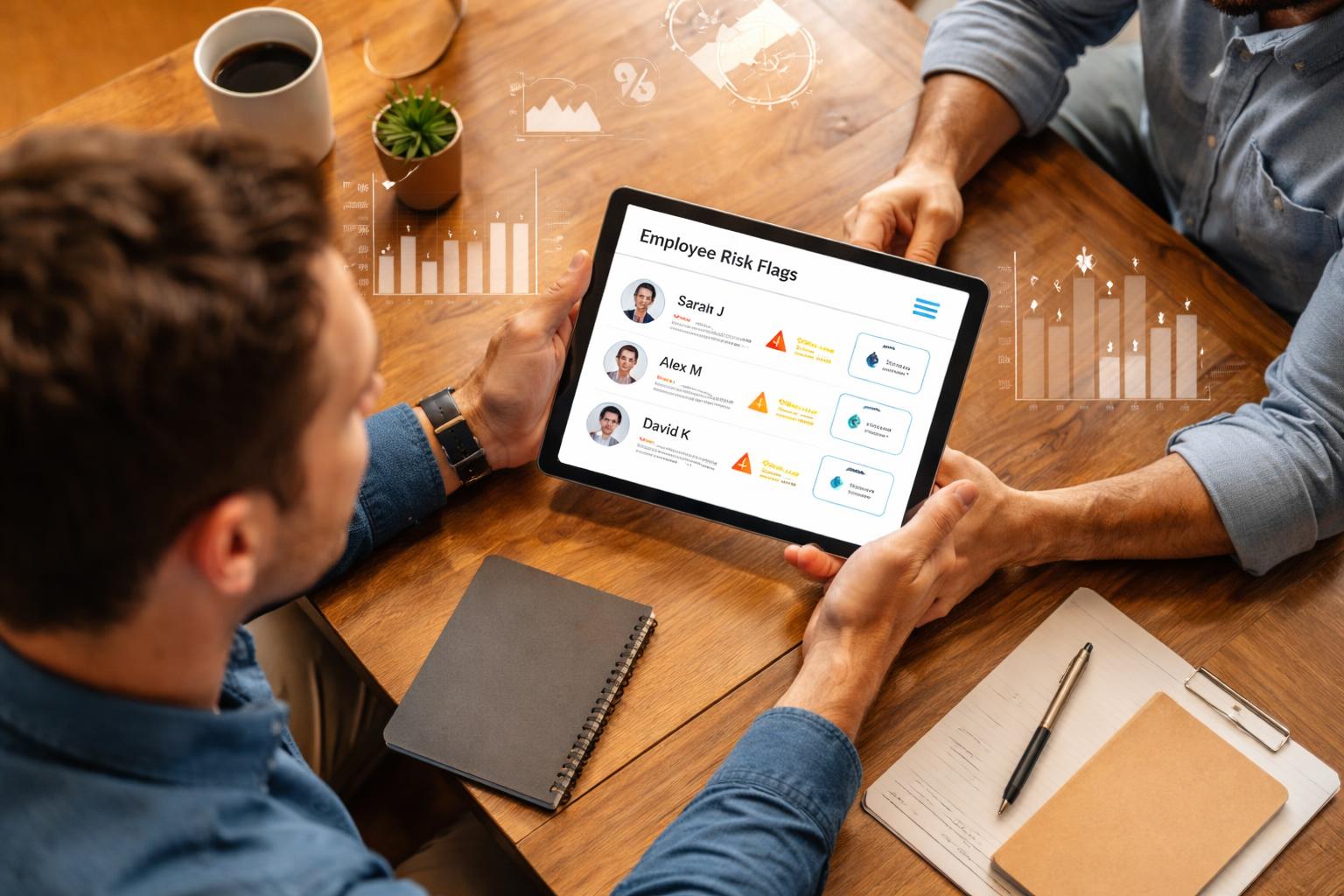
- Attrition risk dashboards that surface early warning signals to line managers before turnover decisions are made
- Skills gap analysis tied directly to workforce planning and learning content recommendations
- Manager self-service portals that reduce HR inquiry volume by handling routine requests automatically
- Real-time HR cost reporting integrated with finance and headcount planning systems
Build a Strong HR Data Foundation
Data quality determines the ceiling on what analytics and AI capabilities can achieve. Before investing heavily in advanced functionality, organisations should invest in data governance, master data management, and the integration infrastructure needed to bring data from all relevant systems into a clean, consistent state. This work pays dividends throughout the life of the platform.
Design for Employee-Centric UX
HR software is used by everyone in the organisation, not just HR professionals. Design decisions that prioritise HR administrative needs over the employee experience are one of the most common causes of poor adoption. Custom development provides the opportunity to design interfaces that genuinely work for the people using them, tested and refined through proper user research and iterative design.
Partner With Experienced HR Software Development Teams
Custom HR software development combines domain complexity – HR processes, compliance requirements, organisational design – with significant technical complexity: data architecture, AI and ML, cloud infrastructure. Partnering with a team that has deep experience in both is the most reliable way to navigate this combination. Internal technology teams rarely have all the required expertise, and the cost of learning on a project of this complexity is high. Review our HR software development capabilities for more detail on how experienced teams approach these challenges.
Real-World Examples of Custom HR Software
Case 1: Enterprise Workforce Management Platform
Problem: A financial services company with 12,000 employees across six countries was managing workforce planning through a combination of spreadsheets, a legacy HRIS, and manual headcount reporting. Finance and HR operated with different data, producing conflicting forecasts and slowing hiring decisions by four to six weeks.
Solution: A custom workforce management platform was built to integrate HR, finance, and operations data into a single real-time model. Role-based dashboards gave HR, finance, and business unit leaders a shared view of headcount, cost, and capacity. Automated scenario modelling replaced the manual spreadsheet process entirely.
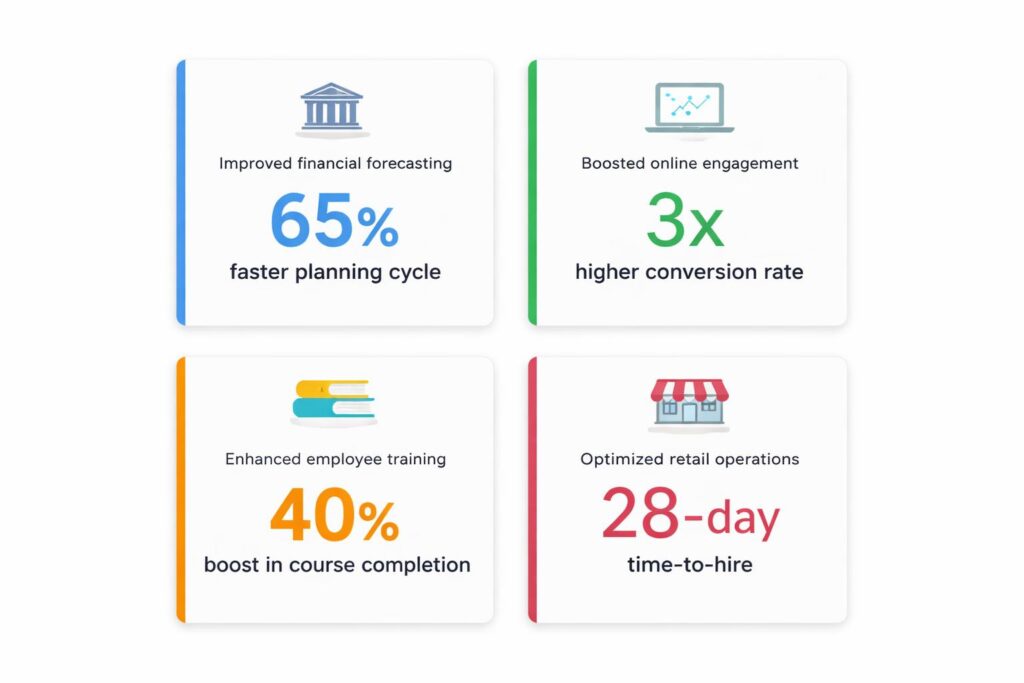
Result: Time from workforce planning cycle to approved headcount dropped by 65%. Finance and HR alignment improved materially, with a single source of truth replacing the previous competing data sets. HR operational reporting that previously required two days per month was fully automated.
Case 2: AI-Powered Recruitment System
Problem: A technology company hiring 800 people per year was spending 60% of recruiter time on initial screening – reviewing CVs, scheduling calls, and filtering applications that did not progress past the first interview. Time-to-hire averaged 47 days.
Solution: A custom AI recruitment platform was developed, trained on five years of historical hiring data to identify the candidate signals that most strongly predicted success in each role family. Automated screening, scheduling, and initial assessment reduced recruiter involvement to shortlisted candidates only.
Result: Time-to-hire fell to 28 days. Recruiter capacity freed up was redirected to candidate experience and employer branding. Offer acceptance rate improved by 18% as more recruiter time was available for the human elements of the hiring process.
Case 3: Learning and Skills Management Solution
Problem: A professional services firm with 6,000 consultants had no way to map current skills against future client demand. Learning was tracked in a separate LMS with no connection to project staffing, performance, or career planning. Skills data was largely self-reported and unreliable.
Solution: A custom skills intelligence platform was built, connecting performance reviews, project histories, certification records, and learning completions into a single skills profile for every employee. Automated gap analysis compared current skills against a dynamic capability model tied to projected client demand. Personalised learning paths were generated weekly for each employee.
Result: Skills data completeness improved from 34% to 91% within six months. Project staffing time fell by 40% as skill matching was automated. Employee engagement scores for career development – previously the lowest-rated item in surveys – increased by 22 points within one year.
Case 4: Employee Performance Analytics Platform
Problem: A retail group with 15,000 employees across 400 locations had performance data scattered across three systems, none of which connected to business outcomes such as store revenue, customer satisfaction, or shrinkage. Managers received annual performance reports that were too late to influence decisions.
Solution: A custom performance analytics platform integrated HR, operational, and financial data to surface real-time insights at the store, region, and individual level. Manager dashboards linked performance signals to business outcomes, making the connection between people decisions and commercial results visible and actionable.
Result: Store managers reported a 30% reduction in time spent preparing for performance conversations. Correlation analysis between performance data and business outcomes identified three previously unknown drivers of store productivity. Employee development investment was redeployed toward these areas, contributing to a 12% improvement in same-store sales performance over 18 months.
Conclusion
Custom HR software development has moved from a specialist option to a strategic necessity for organisations that take workforce management seriously. The complexity of modern workforces – distributed, multi-generational, operating across employment types and geographies – cannot be managed well with platforms designed for the average case. The organisations that outperform on talent acquisition, retention, and productivity are those that have built systems that reflect how their workforces actually work.
The future of HR is data-driven and AI-powered. Not because technology is an end in itself, but because the decisions that matter most in HR – who to hire, who is at risk of leaving, where to invest in development, how to plan for future capability needs – are better when they are informed by good data and supported by intelligent automation. Custom HR software development is how organisations build the foundation for that future. The question is not whether to invest in it, but when and how to start.
Ready to Build Smarter Workforce Management?
If your organisation is navigating the limitations of standard HR systems or looking to build AI-driven workforce management capabilities, we would welcome the conversation. Our team has deep experience in HR software development, AI development, and data engineering specifically for complex workforce environments. Explore our case studies or get in touch to discuss where custom HR software development could make the most difference for your organisation.