

Banking technology has come to the age where stability and innovation should go hand in hand. Digital has taken customers by storm, instant payments have become the norm and regulatory scrutiny is only increasing. Meanwhile, core banking platforms continue to be structurally complex. A typical core system is an amalgam of long-ago-developed legacy systems tied to cloud-native services, data platforms and third-party integrations. Internal IT departments are required to provide both improved availability, robust cyber security protection and maintain faster product releases and complete regulatory compliance, all under increasing cost pressure.
By 2025, banking IT landscapes are more productive but far less governable. Hybrid and multi-cloud architectures, API-first ecosystems, open banking integrations, and data-driven services introduce architectural complexity and operational risk. Cyber threats constantly change both in volume and sophistication, and customers bombard you with expectations — leaving no room for downtime, latency or error. Regulatory environments are requiring more and more operational resilience, traceability and incident readiness.

Managed IT Services are therefore evolving from a tactical outsourcing model into a strategic operating framework. Instead of delegating isolated technical activities, banks rely on managed service providers to operate, secure, optimize, and continuously improve large portions of their technology estate. Industry analysis from McKinsey indicates that financial institutions with mature IT operating models and automation-driven service management achieve materially higher productivity and faster digital transformation outcomes.
In this environment, the role of Managed IT Services in modern banking is to create a stable operational foundation that enables innovation, improves resilience, and supports long-term cost efficiency.
What Managed IT Services Include in the Banking Sector
Managed IT Services in banking encompass the continuous operation and optimization of technology assets across infrastructure, platforms, applications, and security layers. The scope extends far beyond traditional helpdesk or hosting services and integrates governance, automation, monitoring, and lifecycle management.
Financial institutions typically apply managed services to core banking platforms, middleware, databases, cloud environments, network infrastructure, endpoint estates, and cybersecurity operations. Providers operate these environments based on predefined service levels, incident response models, compliance requirements, and continuous improvement frameworks.
Core Components of Managed IT Services in Banking
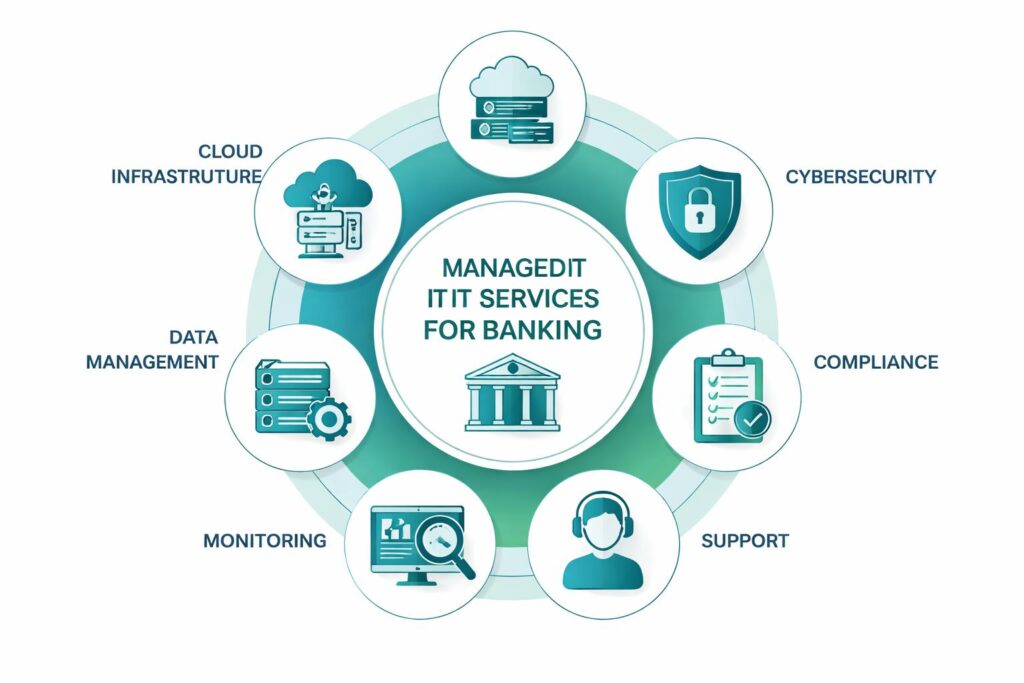
Banks typically structure managed services around several interconnected operational domains. Each domain supports a different layer of the banking technology stack, but together they form a single operating model focused on stability, security, scalability, and continuous improvement rather than isolated technical execution.
Core Banking Operations
This is a domain where the stability, security and performance of mission critical transactional platforms are paramount. Managed teams for 24/7 monitoring of systems, scheduled patching and performance tuning/capacity planning and controlled release management in order to reduce downtime and risk.
At most banks, that also entails their rising advancements of legacy platforms with API-enablement, modular refactoring and infrastructure upgrades that extend life-cycle while improving integration flexibility.
Infrastructure and Platform Management
In infrastructure management, the lifecycle elements compute, storage, virtualization layers, backup systems and network connectivity are included in an on-premise data center or in the cloud. Service providers are responsible for capacity planning, redundancy, hardware lifecycle management and disaster recovery preparedness.
Platform services generally comprise container platforms, middleware, databases and identity services that enable applications to run at scale.
Monitoring and Observability
Modern banking environments generate massive volumes of operational telemetry. Managed services consolidate metrics, logs, traces, and event data into centralized observability platforms. This enables early detection of performance degradation, abnormal transaction behavior, and infrastructure bottlenecks. Advanced analytics and alerting models reduce noise and improve root cause analysis, helping teams resolve incidents faster and prevent recurring failures.
Automation and Configuration Management
Automation reduces operational dependency on manual intervention and improves consistency across environments. Infrastructure as Code, automated provisioning pipelines, policy enforcement engines, and standardized configuration baselines allow banks to deploy environments rapidly while maintaining governance controls. Automated patching, scaling, and compliance checks improve reliability and auditability while lowering operational cost and human error.
Service Desk and Operational Support
The service desk acts as the operational interface between business users and IT platforms. Managed providers operate incident management workflows, access control processes, change coordination, and escalation procedures aligned with defined service levels. Mature service desk operations focus not only on ticket resolution but also on trend analysis, problem management, and continuous service improvement.
Cybersecurity Operations
Cybersecurity services integrate continuous threat monitoring, vulnerability scanning, identity protection, incident response, and regulatory reporting. Security operations centers correlate telemetry from endpoints, networks, cloud platforms, and applications to detect abnormal behavior and respond rapidly to threats. Managed security improves consistency of controls and supports compliance with financial regulations and industry standards.
Cloud Governance and Cost Optimization
As cloud adoption expands, governance becomes essential for financial control and risk management. Managed providers enforce workload placement policies, identity governance, encryption standards, and data residency controls. Cost optimization frameworks analyze consumption patterns, eliminate waste, and align cloud spending with business demand while maintaining resilience and regulatory compliance.
These domains operate as a unified operational model rather than isolated service silos. Their maturity directly influences system reliability, regulatory readiness, scalability, and the bank’s ability to evolve its digital capabilities with confidence.
Traditional IT Outsourcing vs Managed IT Services in Banking
| Dimension | Traditional IT Outsourcing | Managed IT Services |
| Scope of responsibility | Task-based delivery and staff augmentation | End-to-end operational accountability |
| Governance model | Fragmented vendor coordination | Centralized service governance |
| Performance measurement | Activity tracking | SLA-driven outcomes and KPIs |
| Automation maturity | Limited automation | High automation and standardized tooling |
| Risk ownership | Shared and often unclear | Clearly defined provider responsibility |
| Scalability | Linear with headcount | Elastic and automation-driven |
| Cost predictability | Variable operational costs | Predictable OPEX-based pricing |
The primary distinction lies in accountability, automation depth, and outcome ownership rather than task execution.
Why Banks Are Increasingly Choosing Managed IT Services
Rising Infrastructure Complexity
Modern banking technology has moved far beyond the monolithic systems of the past. Today’s architecture typically involves microservices where applications break down into dozens or hundreds of small, independent components. Each component needs separate deployment, monitoring, and maintenance. While this approach enables faster development and better scalability, it multiplies the operational workload significantly.
Integration requirements add another layer of complexity. Banks connect to payment networks, credit bureaus, fintech partners, fraud detection services, regulatory reporting systems, and customer identity verification platforms. Each connection represents a potential failure point and a security boundary requiring oversight. When you add hybrid cloud deployments where some workloads run on-premises for compliance reasons while others use public cloud for flexibility, the management challenge becomes substantial.
API-first architectures, necessary for open banking and partner ecosystems, require sophisticated gateway management, security controls, and usage monitoring. Meanwhile, legacy core banking platforms continue running critical processes, creating technical debt that must be managed during gradual modernization efforts. Keeping everything working together smoothly while maintaining high availability demands expertise that is difficult and expensive to maintain internally.
Cost Optimization and Predictable Budgeting

The financial model of managed services aligns well with modern banking needs. Traditional IT operations require large capital investments in hardware, software licenses, and data center facilities. These assets depreciate over time and become obsolete, creating a constant cycle of refresh spending. Managed services shift this to an operational expense model where banks pay for services consumed rather than assets owned.
Cost Structure Comparison
| Traditional In-House IT | Managed IT Services |
| Large upfront capital expenditure | Predictable monthly operational costs |
| Fixed capacity regardless of utilization | Scalable capacity matching actual needs |
| Internal staff costs for 24/7 coverage | Shared resource model reducing per-unit costs |
| Unexpected costs for failures and emergencies | Service levels with defined response included |
| Separate investments in tools and automation | Provider tools amortized across clients |
Total cost of ownership extends beyond direct technology spending. It includes staffing costs, training programs, management overhead, facilities, and the opportunity cost of having technical staff focused on maintaining infrastructure instead of building new capabilities. Managed service providers achieve economies of scale by serving multiple clients, spreading the cost of specialized tools, automation platforms, and expert personnel across their customer base.
Budget predictability represents a major advantage for financial planning. Managed services typically operate under subscription pricing with clearly defined service levels. Banks can forecast IT expenses accurately, reducing variance and supporting better financial management. The variable cost structure also allows scaling services up or down based on business needs without the fixed costs and lead times associated with internal capacity changes.
Enhanced Cybersecurity and Compliance

Cybersecurity in banking has become a continuous operational requirement. Financial institutions face threats from organized crime, nation-state actors, and opportunistic attackers using increasingly advanced techniques. The impact of security breaches extends beyond immediate financial losses to include regulatory penalties, reputational damage, and customer attrition.
Managed security services provide capabilities that many banks struggle to maintain internally:
- 24/7 security operations centers monitoring for threats and anomalies
- Threat intelligence integration bringing real-time information about emerging attack patterns
- Rapid incident response minimizing damage when breaches occur
- Continuous vulnerability assessment identifying weaknesses before attackers exploit them
- Forensic analysis capabilities for post-incident investigation and learning
Compliance requirements create additional operational burden. PCI DSS mandates specific controls for payment card data including network segmentation, encryption, and regular security testing. GDPR requires data protection measures and breach notification procedures. PSD2 demands strong authentication for payment services. The Digital Operational Resilience Act establishes comprehensive requirements for ICT risk management, incident reporting, and third-party oversight. According to IEEE standards for information security management, effective compliance requires not just implementing controls but continuously demonstrating their effectiveness through monitoring, documentation, and audit readiness.
Managed service providers specializing in financial services bring established frameworks, automated compliance reporting, and experience navigating regulatory examinations. They maintain certifications like ISO 27001 and SOC 2 that demonstrate their own security posture. This expertise reduces compliance risk and operational burden for banking clients while helping them meet examiner expectations.
Talent Gap and Workforce Scalability
The shortage of qualified technology professionals creates a fundamental constraint for banks. Demand for cloud architects, security engineers, DevOps specialists, and site reliability engineers far exceeds supply. Competition drives compensation beyond what many financial institutions can afford, especially regional banks competing against technology companies and larger financial firms. Even successful recruitment often leads to retention challenges as professionals seek diverse experiences and advancement opportunities.
Managed IT services address this through several mechanisms:
Talent Advantages of Managed Services
- Deep bench of specialized experts across multiple technology domains
- Rapid deployment without lengthy recruitment and onboarding cycles
- Staff rotation across projects maintaining engagement and skill development
- Follow-the-sun support models providing 24/7 coverage without shift work
- No single points of failure where one person holds critical knowledge
- Flexible capacity scaling without permanent headcount commitments
The 24/7 operational requirement in banking presents particular workforce challenges. Providing round-the-clock monitoring and support internally requires substantial staff duplication across shifts. Managed service providers achieve efficiency through globally distributed teams, ensuring continuous coverage without requiring individual clients to staff nights and weekends.
Scalability represents another critical dimension. Banks experience variable demand based on business cycles, regulatory projects, and strategic initiatives. Maintaining sufficient internal capacity for peak periods results in underutilization during normal operations. Modern banking technology services enable flexible capacity adjustment, allowing institutions to scale support levels matching actual requirements without fixed cost burdens.
How Managed IT Providers Support the Banking Technology Stack

Core Banking Infrastructure Support
Core systems remain central to transaction processing and regulatory reporting. Managed providers maintain stability through proactive monitoring, controlled patching, and modernization programs that introduce APIs and automation while preserving reliability.
Cloud and Hybrid-cloud Environments
Providers orchestrate workload placement, identity management, network segmentation, encryption, and cost optimization across distributed cloud estates. Governance models enforce consistent configuration and audit traceability.
Network and Endpoint Management
Managed network operations ensure availability, segmentation, and capacity planning across branches and remote environments. Endpoint management includes patching, compliance enforcement, identity-based access, and secure remote connectivity.
Application Support and Reliability Engineering
Site Reliability Engineering practices integrate observability, automated remediation, and performance modeling. Proactive incident prevention reduces customer impact and operational volatility.
Strategic Benefits of Managed IT Services for Banks
Operational Efficiency and Automation
Providers drive efficiency through systematic automation. Infrastructure provisioning reduces from days to minutes. Configuration management ensures consistency. Automated backup improves reliability while freeing staff.
Automation Impact
| Process | Traditional | Managed Services | Time Savings |
| Server provisioning | 2-5 days | Under 1 hour | 90%+ |
| Security patching | Monthly windows | Continuous automated | 70-80% |
| Backup operations | Manual monitoring | Automated validation | 85%+ |
| Incident triage | Manual investigation | AI-assisted | 50-60% |
Internal IT teams redirect time from routine maintenance toward strategic planning, architecture evolution, and collaboration on digital initiatives.
Faster Product Launches and Innovation Enablement
Stable infrastructure accelerates innovation. Development teams with reliable environments, automated pipelines, and responsive support spend less time on obstacles and more time building value.
The time-to-market advantage proves significant in competitive markets. Institutions that rapidly launch products and iterate gain advantages over slower competitors. Managed services enable this through on-demand infrastructure, pre-configured environments, and operational support allowing quick movement without compromising stability.
Improved Customer Experience
Customer experience depends on technology reliability. Mobile applications must respond instantly, web portals must handle volumes without slowdown, and payments must complete reliably.
Managed services improve experience through proactive monitoring detecting issues before customer impact, rapid incident response minimizing problem duration, capacity management ensuring adequate resources during peaks, and security measures protecting data. Reliability improvements translate to higher transaction success rates, better availability, and consistent performance.
Business Continuity and Disaster Recovery
Regulatory requirements mandate specific recovery objectives while customers expect continuous availability. Managed providers implement enterprise-grade continuity frameworks with multi-region deployments ensuring localized failures don’t disrupt service, automated failover redirecting traffic without manual intervention, and comprehensive backup strategies.
Regular testing through failover drills and recovery simulations validates capabilities and trains teams. Documentation of runbooks ensures critical knowledge is accessible, providing assurance to executives, regulators, and customers.
Challenges in Adopting Managed IT Services
Regulatory Oversight and Data Privacy
Financial regulation creates unique considerations. Regulatory frameworks require banks to implement comprehensive vendor management programs. Examination authorities evaluate whether banks maintain adequate oversight and whether data protection meets compliance requirements.
Data sovereignty presents challenges as some jurisdictions mandate financial data remain within national borders. Banks must implement technical controls including data residency configurations, encryption key management, and access restrictions satisfying requirements.
Key Regulatory Considerations
- Vendor risk assessment and monitoring programs
- Contractual terms addressing regulatory responsibilities
- Data location and cross-border transfer controls
- Audit rights and regulatory examination support
- Incident notification and reporting procedures
- Exit strategies and data portability provisions
Integration With Legacy Systems
Legacy systems present major challenges. Banks operate platforms developed over decades that often lack modern APIs and use proprietary protocols, making integration with managed service tooling difficult.
Migration requires phased approaches maintaining business continuity. This involves running parallel operations during transitions, implementing new monitoring alongside existing tools, and systematically transferring knowledge. Integration requires detailed documentation, dependency mapping, cutover planning, and extensive testing.
Cultural and Organizational Barriers
Organizational culture often presents the most difficult challenge. IT teams may view outsourcing as threatening. Middle management might resist changes reducing their control. Business units may fear losing responsiveness.
Change management becomes critical. Banks need clear communication about rationale, transparency about role evolution, and active staff involvement. Successful transitions redefine internal IT roles toward relationship management, architecture, and strategic planning rather than operations.
Best Practices for Selecting and Working With a Managed IT Partner
Defining Clear KPIs and SLAs
Effective relationships start with clear performance expectations. Service level agreements should define specific metrics covering availability, performance, response times, and resolution timelines aligned with business requirements.
Essential SLA Metrics
| Metric Category | Example KPIs | Typical Targets |
| Availability | System uptime for critical applications | 99.9%+ |
| Performance | Transaction processing response time | Under 2 seconds |
| Incident Response | Time to initial response for critical issues | Within 15 minutes |
| Resolution Time | Mean time to resolve high-priority incidents | Under 4 hours |
| Security | Time to patch critical vulnerabilities | Within 24 hours |
KPIs should extend beyond operations to include business-aligned measures like customer satisfaction, time-to-market, and cost efficiency trends.
Ensuring Security and Compliance Readiness
Selecting providers requires rigorous security evaluation. Banks should assess certifications including ISO 27001, SOC 2, and industry-specific accreditations. Due diligence should examine experience with PCI DSS, GDPR, and banking regulations.
Contractual terms must address security responsibilities clearly, including breach notification, forensic support, and regulatory reporting. Right-to-audit clauses enable periodic verification of security controls.
Building a Long-term Modernization Strategy
Managed services should support technology evolution. Best partnerships involve collaborative roadmap development where provider expertise informs strategic planning. Providers should invest in understanding specific business models and strategic objectives.
The relationship should include continuous improvement mechanisms through regular business reviews assessing performance trends, identifying optimization opportunities, and aligning on priorities.
Communication and Governance Models
Clear governance ensures effective relationships, typically including executive steering committees, operational management forums, technical working groups, and regular business reviews.
Governance Elements
- Defined escalation paths for senior attention
- Regular meeting cadence at appropriate levels
- Shared dashboards providing performance visibility
- Collaborative problem-solving culture
- Joint continuous improvement initiatives
- Clear decision-making authority
Case Observations From the Banking Sector
European Retail Bank: Infrastructure Consolidation
A mid-sized European retail bank operating across multiple countries faced fragmented infrastructure challenges. Each country maintained separate data centers, different platforms, and local IT teams, creating inefficiencies through duplicated costs and inconsistent security.
The bank engaged a managed service provider to lead multi-year infrastructure consolidation. The provider assessed existing environments, designed hybrid cloud architecture, and executed phased migration. Critical applications moved to centralized private cloud meeting data sovereignty requirements while less-regulated workloads transitioned to public cloud.
Results were substantial. Infrastructure costs decreased 35 percent through eliminated duplication. Security strengthened with standardized controls. Time-to-market for new products reduced from 9-12 months to 3-4 months. Internal IT teams redirected toward customer experience improvements and digital product development.
Digital-Only Bank: Rapid Scaling
A digital-only bank launching in a competitive market needed to scale rapidly while maintaining reliability. Customer acquisition exceeded expectations by 300 percent within 18 months, creating pressure on infrastructure and operations.
The bank partnered with a managed service provider specializing in cloud operations. The provider implemented comprehensive monitoring, established 24/7 coverage, and created automated scaling policies ensuring infrastructure grew with customer demand.
Application availability improved from 98.5 percent to 99.95 percent. The bank successfully processed a major product launch tripling transaction volumes without degradation. Internal developers regained focus on innovation rather than operational firefighting.
Payment Institution: Security Hardening
A payment institution processing transactions across continents faced regulatory pressure and cyber threats. Internal security assessment revealed gaps in monitoring, patch management, and incident response. Regulators indicated concern during examinations.
The institution engaged a managed security service provider with payment systems expertise. The provider conducted security assessments, implemented 24/7 security operations, automated vulnerability management, and established incident response procedures.
The transformation significantly reduced risk. The institution achieved full PCI DSS compliance. Regular assessments identify and remediate issues before exploitation. The security operations center detected and prevented several targeted attacks. Subsequent regulatory examination showed satisfaction with improved security posture.
Conclusion
The role of Managed IT Services in modern banking continues to expand as infrastructure complexity, cybersecurity risk, and regulatory scrutiny intensify. Managed operating models enable banks to balance resilience, scalability, cost efficiency, and innovation capacity without excessive internal operational burden.
Institutions that align managed services with governance maturity and long-term modernization strategies position themselves for sustainable digital growth.
Partner With Experts in Banking Infrastructure Management
Our managed IT services for banks combine deep financial services knowledge with enterprise-grade capabilities in IT infrastructure management in finance, cloud operations, and cybersecurity. We help financial institutions optimize costs, strengthen security postures, and build reliable foundations for digital innovation.
Contact us to discuss how modern banking technology services can support your institution’s technology strategy and business objectives.