

The financial tech industry has seen massive changes in 2025. What began as a sprint to digitize simple banking services has turned into something far more complicated. Users no longer simply want digital access to their accounts. They want financial services to really get them, to anticipate what they need and to slide into place in whatever app or platform they are already using.

At the same time, regulation keeps tightening. And in Europe, the Digital Operational Resilience Act (DORA) is driving banks to integrate security and compliance into their systems from day one and not simply bolt it on subsequently. Similar frameworks are emerging globally. Meanwhile, competition has surged — dramatically. Traditional banks are under pressure from challenger banks and embedded finance providers that run on entirely different cost basis and technology approaches. Fintech revenue growth is projected by McKinsey to be nearly three times that of traditional banking between 2023 and 2028.
It is this confluence of evolving user expectations, tighter regulation and intense competition that are making 2025 a pivotal moment. Firms stitching together the
ir technology with AI-native architectures, cloud-optimized software and a security-first mindset will benefit from compounding returns. The companies that do take a piecemeal approach, piling on new features to old systems, may find themselves hampered by technical debt at the very moment they need to be flexible in response market changes.
Trend 1: AI-Driven Personalization and Intelligent Financial Assistants
Artificial intelligence has evolved from being a proof feature to necessity in FinTech apps 2026. The degree of customization goes far deeper than mere customer segments. Today’s systems learn in real time, constantly altering the size and placement of interface elements, product recommendations and the timing of communications based on how each individual person actually uses an app.
Modern recommendation engines use transaction history, browsing behavior, external signals from other data sources, and contextual factors to surface financially significant products and actions in the perfect moments. This means much better conversion rates and more satisfied customers. FinTech AI is now a competitive separator, not just a feature.
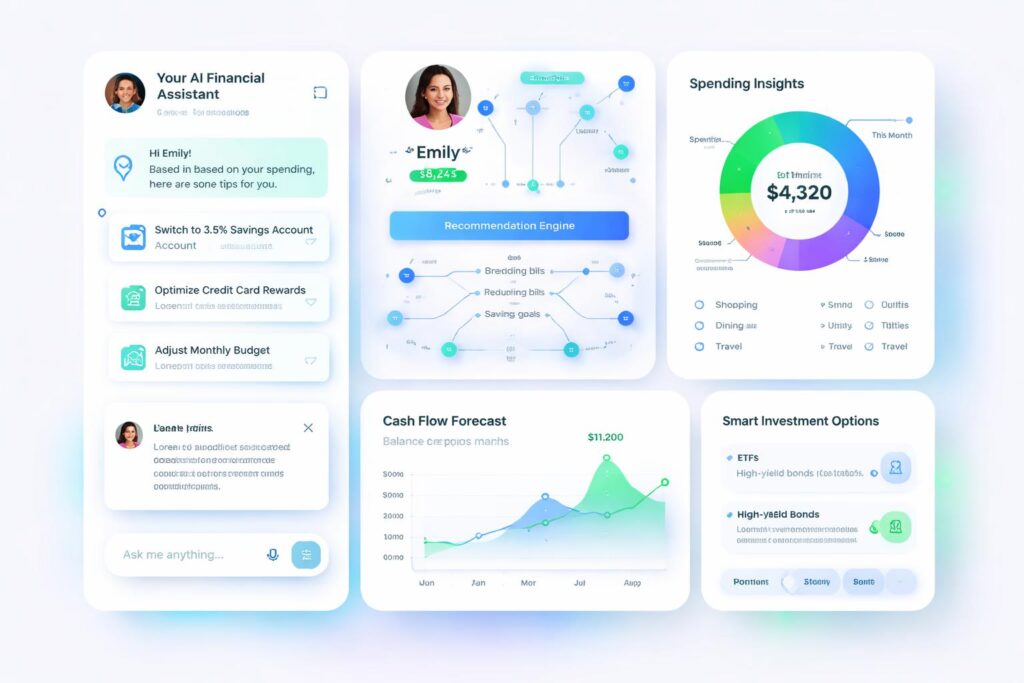
Clever chatbots are long gone in the world of smart financial assistants. These systems can now deal with complex, multi-turn conversations and offer proactive assistance. They combine account aggregation, spending analysis, savings optimization, and investment recommendations in chatbots to help financial decisions feel more manageable. The most sophisticated e-book bots leverage large language models that have been fine-tuned on financial domain–specific knowledge to extrapolate complex products, answer regulatory questions, and walk users through a process such as a mortgage application or retirement planning.
The damage to business, on many fronts, is already evident. Companies that have adopted AI-driven personalization typically witness an increase in retention of 15-25 percent as users encounter more personalized experiences and a reduction in cognitive load and decision fatigue.
Cross-selling is so much more powerful when product recommendations are based on actual needs instead of demographics. The cost to acquire a customer is reduced while referral rates increase among very satisfied members who feel the app truly understands their financial position.
Implementation does present challenges. However, successful personalization requires single view of customers that brought together details from multiple touchpoints with additional layers of data security and privacy compliance. Model training requires large amounts of labelled data, continuous surveillance for drift and bias in models and strong testing frameworks to ensure recommendations adhere to regulatory standards and fiduciary duty.
Businesses will need to walk the line between personalization depth and privacy squalor, as we introduce per-experience controls that reveal how their data drives their experience and let them make adjustments.
Trend 2: Embedded Finance and Banking-as-a-Service Expansion
The inclusion of financial functionalities into non-fin products has undoubtedly grown faster. Embedded finance has gone from being a niche offering to an expectation of the mainstream. E-commerce marketplaces, SaaS providers, healthcare systems and logistics companies are adding payments processing, lending, insurance and account management to their core user experience more than ever. This is an indication of the significant shift in customer behavior. In other words, if users are on an app looking to make a financial transaction, they expect that action to occur in the same context and not get shunted off to the stand alone banking app.

It has been Banking-as-a-Service platforms that have arisen as the key enablers for this. These are the infrastructure providers who offer a solution on which non-financial players can build, if they don’t want to apply for banking licenses or develop regulatory knowledge internally. BaaS companies take care of the difficult backend activities, ensure regulatory standards and connect to financial rails while their customers are free to dedicate themselves to user experience and business model innovation.
The technical infrastructure necessary to power embedded finance is built using API-first Design. Today’s BaaS offerings provide rich APIs that support partners in embedding payments and account opening, card issuance, lending flows with minimal engineering investments. This modularity enables companies to select the specific financial capabilities that fit their value proposition rather than building transport infrastructure to support a full stack of financial services.
The business model implications extend beyond revenue diversification. Companies embedding financial services report improved customer retention as users become more dependent on the platform for critical financial activities. Transaction data generated through embedded finance provides valuable insights for product development and personalization. Perhaps most significantly, controlling the financial layer allows platforms to capture margin that would otherwise flow to external payment processors or financial institutions.
In terms of FinTech development trends, this means the technical prerequisites have changed. To build and implement successful embedded finance solutions, organizations need deep knowledge of API design, real-time transaction processing, multi-tenancy architecture, and regulatory compliance in various location. The development community needs a fine balance of flexibility for varied use cases and the demands for security and reliability, which are inevitable in financial services.
Embedded Finance Implementation Requirements:
| Technical Component | Key Requirements | Business Impact |
| API Infrastructure | RESTful design, comprehensive documentation, versioning strategy, rate limiting | Enables partner integration, reduces time-to-market for new use cases |
| Compliance Layer | Automated KYC/AML, transaction monitoring, regulatory reporting across jurisdictions | Maintains compliance while scaling across geographies and use cases |
| Transaction Processing | Real-time settlement, idempotency, reconciliation, fraud detection | Ensures reliability and trust in financial operations |
| Multi-tenancy Architecture | Data isolation, customizable workflows, white-label capabilities | Supports diverse partners with varying requirements and branding needs |
Trend 3: Strengthened Security: Zero Trust, Biometric Authentication, and Real-time Fraud Detection
In FinTech apps 2025, Security has emerged as a key driver of innovation, not simply a comply and lodge item. The threat landscape progressed well ahead of what legacy security was capable of. Advanced fraud tactics like synthetic identity manipulation and ATO attacks have pressed the industry to completely rethink how financial applications are authenticating users and identifying malicious activity.

Zero Trust architecture has moved from theoretical framework to practical implementation standard. Rather than trusting users and devices inside the network perimeter, Zero Trust models verify every access request regardless of origin. This approach assumes breach as the default state and requires continuous validation of user identity, device health, and contextual factors before granting access to sensitive data or transactions. For financial services, this means implementing granular access controls, microsegmentation, and continuous monitoring throughout the application stack.
Biometric identification has come a long way since mere fingerprint scanning. State of the art biometrics systems use foreign methods such as fingerprint recognition, face recognition, palm vein biometrics in combination with AI like Convolutional Neural Networks and Support Vector Machines. Behavioral biometrics study how users interact with their devices: typing patterns, mouse movements, network navigations and touch-screen operations. These patterns create a fingerprint that is much harder for fraudsters to mimic – even if they have hijacked stolen credentials.
Real-time fraud detection has been transformed by machine learning models that analyze transaction patterns, device fingerprints, location data, and behavioral signals to identify suspicious activity before it causes damage. These systems move beyond simple rule-based checks to understand normal behavior patterns for individual users and flag deviations that suggest account compromise or fraud attempts. Natural language processing enhances fraud detection by analyzing communication patterns in customer service interactions and transaction descriptions to identify social engineering attempts and other sophisticated fraud schemes.
The technical implementation requires significant infrastructure investment. Real-time fraud detection systems must process high-velocity transaction streams with latency measured in milliseconds while maintaining model accuracy. This demands distributed computing architectures, efficient feature engineering pipelines, and robust model serving infrastructure. Organizations must also address the challenge of imbalanced datasets, where fraudulent transactions represent a tiny fraction of total volume, requiring specialized sampling and training techniques.
Organizations building comprehensive cybersecurity capabilities must approach security as a continuous process rather than a one-time implementation. This requires dedicated security operations centers, regular penetration testing, continuous vulnerability assessment, and incident response planning that accounts for increasingly sophisticated attack vectors.
Trend 4: Regulatory Tech (RegTech) Automation and Compliance Intelligence
Compliance is no longer a manual, labor-intensive task and has become automated and intelligence driven. The amount and complexity of financial regulations in the world is growing, which incurs that manual compliance strategies are expensive to manage and operationally dangerous. AI and ML enabled regtech offerings automate various aspects of AML checks, KYC verification, transaction monitoring and regulatory reporting.
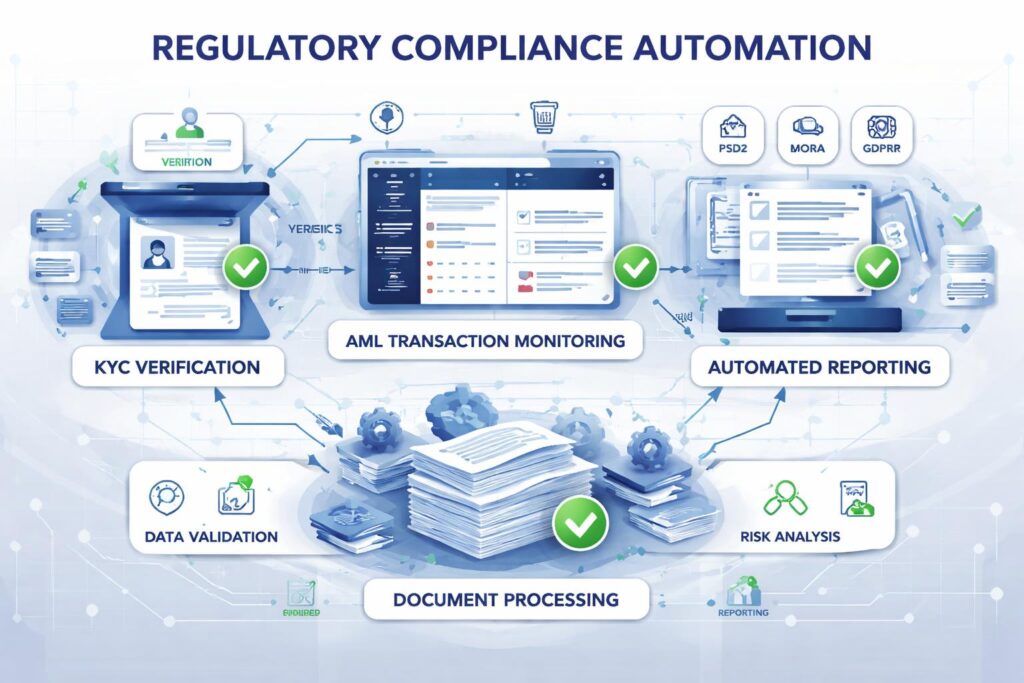
Natural language processing has become central to compliance operations. NLP systems parse regulatory texts, extract requirements, and map them to internal controls and processes. This automation dramatically reduces the time required to assess regulatory changes and implement necessary adjustments. ML models analyze transaction patterns to identify potentially suspicious activity, reducing false positives that plague traditional rule-based monitoring systems while improving detection of genuine compliance risks.
The business impact extends beyond cost reduction. Automated KYC processes reduce customer onboarding friction, improving conversion rates and customer experience while maintaining compliance standards. Real-time transaction monitoring enables faster response to potential compliance issues, reducing exposure and demonstrating regulatory diligence. Automated reporting reduces the manual effort required for regulatory filings while improving accuracy and consistency.
FinTech companies must adapt to frameworks like PSD2 in Europe, which mandates strong customer authentication and open banking standards, DORA, which establishes digital operational resilience requirements, and GDPR, which governs personal data processing. Each framework imposes specific technical requirements that must be embedded in application architecture. Cloud-native fintech development approaches facilitate compliance by enabling rapid configuration changes, comprehensive audit logging, and geographic data residency controls.
Implementation requires careful attention to data quality and governance. Compliance automation depends on accurate, well-structured data. Organizations must invest in data quality processes, master data management, and data lineage tracking to ensure compliance systems operate on reliable information. The regulatory landscape’s constant evolution also demands flexible architecture that can accommodate new requirements without extensive rework.
RegTech Automation Impact Analysis:
| Compliance Function | Traditional Approach | Automated Approach | Cost Reduction | Accuracy Improvement |
| KYC Verification | Manual document review, 3-5 days | AI-powered verification, under 1 hour | 60-70% | 40-50% fewer false rejections |
| Transaction Monitoring | Rule-based systems, high false positives | ML-based pattern detection | 45-55% | 35-45% better detection rates |
| Regulatory Reporting | Manual data aggregation, error-prone | Automated extraction and validation | 50-60% | 90%+ reduction in filing errors |
| AML Screening | Batch processing, delayed alerts | Real-time screening with context | 40-50% | 30-40% faster suspicious activity identification |
Trend 5: Low-Code and High-Performance Cloud-Native Architectures
Low-code development platforms and cloud-native architectures have converged to dramatically reduce time-to-market for financial applications. Low-code platforms enable rapid prototyping and development of standard functionality through visual development interfaces and pre-built components, while cloud-native approaches provide the scalability, resilience, and operational efficiency required for production financial services.
Cloud-native fintech development leverages microservices architecture, containerization, serverless computing, and event-driven systems to build applications that scale elastically with demand, recover automatically from failures, and deploy updates without downtime. Kubernetes has become the standard orchestration platform, managing containerized services across distributed infrastructure. Serverless computing handles variable workloads efficiently, charging only for actual compute consumption rather than provisioned capacity.
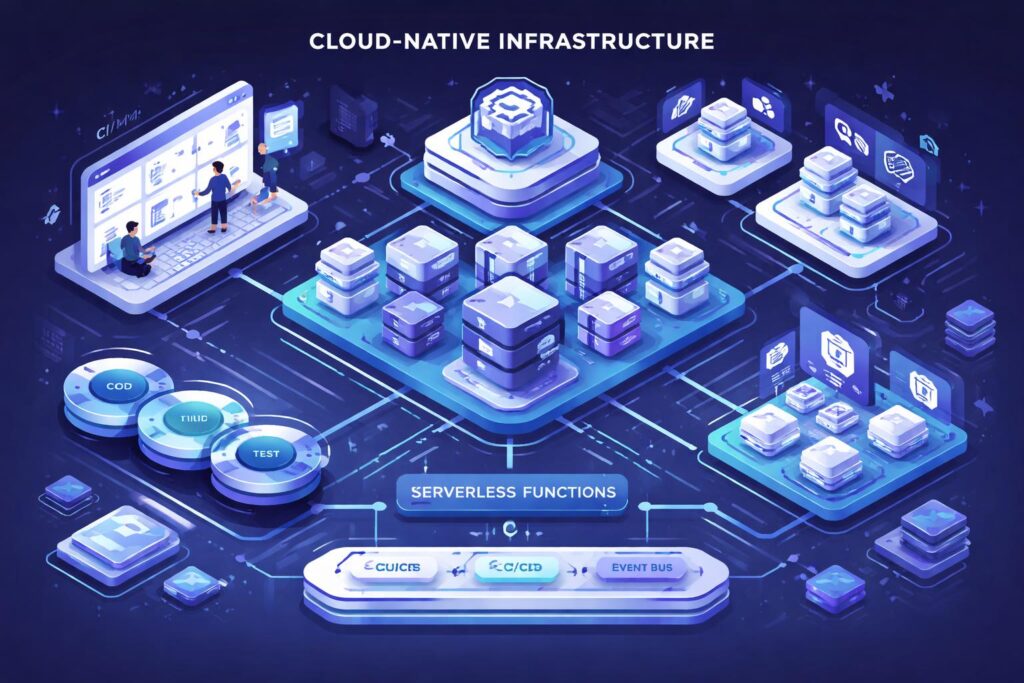
Event-driven architectures enable real-time processing of financial transactions, market data, and user interactions. Rather than synchronous request-response patterns, event-driven systems publish events to message brokers that distribute them to interested services. This decoupling improves resilience, as services can process events at their own pace, and enables sophisticated patterns like event sourcing, where system state derives from an immutable event log.
The business impact manifests in multiple ways. Reduced time-to-market enables faster response to market opportunities and competitive threats. Elastic scalability ensures applications handle demand spikes without over-provisioning infrastructure during normal operations, directly impacting operational costs. Development velocity improves as teams can work on services independently, deploying updates on different cadences without coordinating releases.
Implementation requires cultural and organizational changes alongside technical adoption. Cloud-native development demands DevOps practices that unify development and operations teams, automated testing and deployment pipelines, and comprehensive observability to understand system behavior in production. Organizations must invest in training, tooling, and process changes to realize the full benefits of cloud-native approaches.
Cloud-Native Architecture Benefits:
Cloud-native architectures translate to real business results. Time-to-market for new features are typically 40-60 percent lowered when teams independently deploy (as they no longer have to get in sync on release windows). Typically, the cost of infrastructure can be 30-45% lower just by right-sizing resources and getting rid of over-provisioning. With automated failover and geographic distribution, application availability increases to 99.95 percent or higher. Development team is 25-40 percent more productive by focusing on business logic, not infrastructure. These benefits multiply over time, as the gap widens between organizations that adopt cloud-native practices and those holding on to traditional deployment methods.
Additional Emerging Trends to Watch
Several secondary trends are reinforcing the major shifts described above. Payment orchestration platforms are emerging as critical infrastructure, enabling merchants and financial services providers to manage multiple payment methods, processors, and acquirers through unified interfaces. These platforms optimize routing based on cost, success rates, and business rules, improving authorization rates while reducing processing costs.
Next-generation digital wallets are evolving beyond simple payment storage to become comprehensive financial management tools. Modern wallets integrate loyalty programs, receipts, financial planning features, and even investment capabilities, positioning themselves as primary financial interfaces for consumers. The technical challenge lies in maintaining performance and security while integrating diverse third-party services and data sources.
Advanced analytics platforms are enabling financial institutions to derive insights from massive transaction datasets, customer interaction logs, and external data sources. These platforms combine data warehousing, real-time stream processing, and machine learning to power use cases from fraud detection to personalized marketing to risk management. The shift toward real-time analytics requires new approaches to data architecture and processing pipelines.
Emerging Technologies Reshaping FinTech:
Open banking is being rolled out on the global stage and mandates that banks open up customer data via standardised APIs (Application Programming Interfaces), upon request by an account holder. This opens the door for third-party developers to come scrub in with novel financial management tools, and makes it even harder for traditional banks to compete. Decentralized finance ideas are moving from cryptocurrency circles to traditional financial services at a time when blockchain is already being proposed as an alternative to faster settlements and brokered services with less cost. Quantum computers, although still nascent, may be a game changer with implications both for keeping us secure and valuing things. Enterprises need to watch these trends and determine when a technology becomes viable for the production.
What These Trends Mean for Product Strategy and Development
These trends fundamentally reshape how organizations should approach FinTech product development. The traditional feature-driven development model, where products are defined by lists of capabilities to be built sequentially, proves inadequate. Instead, companies must think in terms of platform capabilities that enable multiple use cases and evolve continuously based on data and user behavior.
Technical architecture decisions have long-term strategic implications. Choosing monolithic architecture limits ability to scale specific components independently and slows feature development as the codebase grows. API-first design enables embedded finance opportunities and partnership strategies. Cloud-native approaches provide the operational flexibility to respond to market changes rapidly. These architectural decisions, made early in product development, constrain or enable strategic options years later.
Partner selection becomes critical. The complexity of modern FinTech development, spanning AI implementation, cloud infrastructure, security operations, and regulatory compliance, exceeds the capacity of most organizations to build entirely in-house. Choosing development partners with deep expertise in financial services, proven experience with relevant technologies, and understanding of regulatory requirements can dramatically accelerate time-to-market while reducing technical and compliance risk.
Data strategy moves from afterthought to foundation. AI-driven personalization, real-time fraud detection, and compliance automation all depend on high-quality, well-governed data. Organizations must invest in data platforms, governance processes, and quality controls from the beginning rather than attempting to retrofit data capabilities onto existing systems. This requires dedicated roles, tooling, and executive attention.
How FinTech Companies Should Prepare for 2025
Preparing for success in 2025 requires deliberate capability building across multiple dimensions. AI readiness encompasses more than acquiring ML talent. It requires data infrastructure to support model training and serving, MLOps processes to manage model lifecycle, governance frameworks to ensure responsible AI use, and organizational understanding of where AI creates value versus where traditional approaches suffice.
Cloud maturity involves understanding not just how to run applications in cloud environments but how to architect for cloud-native patterns. This means adopting infrastructure-as-code practices, implementing comprehensive observability, designing for failure, and optimizing costs through appropriate service selection and resource management. Many organizations struggle with cloud cost management because they migrate existing architectures without redesigning for cloud economics.
Cybersecurity resilience requires shifting from perimeter defense to defense in depth. Organizations must implement Zero Trust principles, deploy behavioral analytics for threat detection, establish incident response capabilities, and maintain security awareness throughout the organization. The expanding attack surface created by API integrations, third-party services, and mobile applications demands continuous security assessment and improvement.
Essential Preparation Checklist for 2025:
Organizations should systematically assess their readiness across critical capability areas. Data infrastructure maturity determines whether AI initiatives can access the quality and volume of information needed for effective model training. Cloud architecture patterns influence scalability, resilience, and operational cost structures. Security posture establishes baseline protection against evolving threat landscapes. Regulatory compliance capabilities ensure new features and services meet legal requirements without creating delays. Technical talent composition affects the organization’s ability to implement and maintain modern architectures. Partner ecosystem quality provides access to specialized expertise and accelerated capability development. Executive understanding of technology’s strategic role shapes investment priorities and organizational commitment.
For organizations seeking to accelerate their transformation, partnering with experienced FinTech development specialists provides access to proven implementation patterns, reduces technical risk, and shortens time-to-market for critical initiatives.
Regulatory compliance capability must become embedded in development processes rather than treated as a gate at the end. This means implementing compliance requirements in technical architecture, automating compliance checks in CI/CD pipelines, maintaining comprehensive audit logs, and establishing clear accountability for compliance outcomes. Organizations that treat compliance as an operational concern rather than a development concern inevitably face expensive remediation efforts.
Perhaps most critically, organizations need development partners who bring deep expertise across these domains. The complexity of modern FinTech development, combined with the speed required to compete effectively, makes it impractical for most organizations to build all necessary capabilities internally. Selecting partners with proven experience in AI implementation, cloud architecture, security operations, and financial services regulations can dramatically accelerate capability development while reducing risk.
Real-world Examples and Case Observations
A European challenger bank faced user acquisition costs that made its business model unsustainable. Traditional digital marketing was expensive and ineffective at targeting users likely to become engaged customers. The bank implemented an AI-driven personalization engine that analyzed user behavior across the website and mobile app, adjusting content, product recommendations, and interface elements in real time based on engagement signals and predicted needs.
The solution integrated customer data from multiple touchpoints into a unified platform, trained recommendation models on historical conversion data, and deployed real-time decisioning infrastructure that could personalize experiences with sub-second latency. The implementation required careful attention to privacy compliance, implementing transparent controls that let users understand and manage how their data influenced their experience.
Results exceeded expectations. Customer acquisition costs decreased by 34 percent as marketing campaigns targeted users more likely to convert and remain engaged. Conversion rates from visitor to account holder improved by 22 percent due to personalized onboarding flows that addressed individual user concerns. Most significantly, six-month retention improved by 28 percent as the personalized experience continued post-acquisition, surfacing relevant products and features that kept users engaged with the platform.
A payments processor serving e-commerce merchants struggled with fraud rates that threatened merchant relationships and profitability. Traditional rule-based fraud detection generated high false positive rates, declining legitimate transactions and frustrating customers, while still missing sophisticated fraud attempts that adapted to known detection patterns.
The company implemented a machine learning-based fraud detection system that analyzed transaction patterns, device fingerprints, behavioral signals, and merchant-specific risk factors in real time. The system used ensemble models combining multiple ML algorithms to identify fraudulent transactions while minimizing false positives. Continuous learning capabilities allowed the system to adapt to new fraud patterns without manual rule updates.
The technical implementation required building low-latency scoring infrastructure capable of evaluating transactions in under 100 milliseconds, developing feature engineering pipelines that extracted signals from raw transaction data, and creating model monitoring systems that detected performance degradation and triggered retraining. The team also implemented explainability features that helped fraud analysts understand model decisions and refine detection strategies.
Fraud losses decreased by 47 percent within six months of deployment as the system detected previously unidentified fraud patterns and adapted to fraudster tactics. False positive rates dropped by 41 percent, reducing customer friction and improving merchant satisfaction. The reduction in manual review requirements decreased operational costs by 33 percent while improving detection accuracy.
A wealth management platform needed to comply with increasingly complex regulatory requirements across multiple jurisdictions while maintaining rapid product development velocity. Manual compliance processes created bottlenecks that delayed feature releases and increased the risk of compliance gaps as regulations evolved.
The platform implemented an automated compliance intelligence system that used natural language processing to parse regulatory updates, identified relevant requirements, and mapped them to specific system controls and processes. ML models automated transaction monitoring for suspicious patterns, KYC verification workflows, and regulatory reporting generation. The system integrated with the development pipeline to assess proposed changes against compliance requirements before deployment.
Implementation required developing a comprehensive compliance knowledge graph that mapped regulations to technical controls, creating automated testing frameworks that validated compliance requirements, and establishing governance processes that ensured compliance automation remained aligned with regulatory intent. The team also built audit capabilities that provided regulators with comprehensive evidence of compliance controls and their effectiveness.
Time to implement regulatory changes decreased by 56 percent as automation reduced manual interpretation and mapping work. Compliance costs decreased by 38 percent through reduced manual processes and improved accuracy that eliminated expensive remediation. Perhaps most importantly, development velocity improved as compliance checks integrated into normal development workflows rather than creating separate approval processes, enabling the platform to release features 40 percent faster while maintaining compliance standards.
Conclusion
The FinTech landscape in 2025 is being reshaped by forces that demand fundamental changes in how financial applications are conceived, built, and operated. AI-driven personalization has moved from competitive advantage to basic expectation. Embedded finance is transforming business models and creating new opportunities for companies willing to rethink traditional boundaries. Security requirements have intensified to the point where traditional approaches prove inadequate. Regulatory complexity demands automation and intelligence. Cloud-native architectures have become essential for achieving the scale, resilience, and velocity the market demands.
Companies that embrace these changes, building on AI-first principles, cloud-native architectures, and security-by-design approaches, will establish compounding advantages. Those that approach transformation incrementally risk accumulating technical debt and organizational inertia that constrains their ability to compete precisely when market conditions demand maximum adaptability. The question facing financial services leaders is not whether to transform but how quickly they can build the capabilities required to succeed in this new environment.
The path forward requires expertise across multiple domains, from AI implementation to cloud architecture to security operations to regulatory compliance. Few organizations can build all necessary capabilities internally at the speed the market demands. Selecting development partners who bring proven experience, deep technical expertise, and understanding of financial services creates the foundation for successful transformation.
Ready to build the future of financial services?
Our team specializes in developing AI-first financial products with the security, compliance, and scalability that modern FinTech demands. We bring deep expertise in intelligent personalization systems, cloud-native architecture, advanced security implementations, and regulatory compliance automation.
Whether you’re launching a new financial product, modernizing existing systems, or exploring embedded finance opportunities, we can help you navigate the technical complexity and accelerate your time to market.