


AI Model Integration
Most AI initiatives don’t stall because the model is wrong — they stall because the integration, optimization, and scaling around it never got the same attention as the model selection itself. We connect the AI models you’ve already chosen — one or several, across text, vision, and audio — into your existing product and infrastructure, and tune them to run reliably at production cost and latency.
What Is AI Model Integration
AI model integration is the technical work of connecting an already-selected AI model — or several — to your existing product, APIs, and infrastructure, and tuning it to perform reliably at production scale. It’s distinct from building a model or an agent: the model is chosen, the job is plumbing and performance.
That distinction matters for scoping the right engagement. If you need a model trained or fine-tuned on your data, that’s LLM development services. If you need a system that plans and takes autonomous action, that’s AI agent development. AI model integration sits underneath both — and stands on its own when your model or agent is already picked and the problem is getting it into production cleanly, quickly, and at a sustainable cost.
In practice, this covers API architecture, request routing across one or multiple model providers, latency and cost optimization, and reliability engineering — the layer most teams underestimate until a promising pilot stalls trying to reach production.
Multimodal & Multi-Model Integration
Multimodal AI processes more than one type of data — text, images, audio, video, sensor or time-series streams — within a single model or pipeline. Multi-model architecture is a related but different problem: several separate, specialized models (say, a vision model, a generative model, and a predictive model) working together in one system, each handling the part it’s best suited for.
Multimodal LLM Integration
A multimodal LLM accepts more than one input type in a single call — text and an image, for instance — and reasons across them together. Multimodal llm integration solutions handle the input formatting, token/context management, and response parsing needed to use that capability reliably inside a product, rather than treating each data type as a separate, disconnected request.
Multi-Model Architecture
Some problems need more than one model because no single model is good at everything. Multi-model integration connects specialized models — vision, generative, predictive — through a shared architecture, often coordinated by something like the Model Context Protocol, so each model’s output becomes usable input for the next step rather than a dead end.
Industries We Serve
- FinTech — Integrating fraud-detection and document-analysis models behind a single API layer so risk teams query one interface instead of several.
- Healthcare — Combining imaging models with text-based clinical documentation tools in one coordinated pipeline.
- E-Commerce — Connecting visual search and recommendation models to product catalog data without duplicating infrastructure.
- HR Tech — Integrating resume-parsing and candidate-scoring models into existing applicant tracking systems via API, without replacing the ATS.
Common Multi-Agent Orchestration Pitfalls
Most of our integration work starts with a system that’s already live and running into one of a handful of recurring problems.

Latency That Doesn't Hold Up
at Scale
An integration that felt fast in a demo slows down under real concurrent load, usually because inference calls are blocking instead of asynchronous.

API Costs That Scale Faster
Than Usage
Every request routes through the same large model regardless of complexity, when a smaller model would handle most of them at a fraction of the cost.

Single-Provider
Lock-In
The integration is wired directly to one model provider’s SDK, making it expensive to switch providers or add a second one later.

Inconsistent Output
Across Modalities
Text, image, and audio inputs are handled through separate, disconnected code paths instead of a unified pipeline, producing inconsistent results.

No Fallback When
a Model Call Fails
A single provider outage or rate limit takes down the whole feature, with no retry logic or secondary model to fall back on.
No Visibility Into What's
Actually Happening
Without latency, cost, and error-rate monitoring on the integration layer itself, problems get reported by users before they show up in any dashboard.
Our AI Model Integration Services
Ai model integration services cover the full path from architecture design to a system that’s monitored and optimized in production, not a one-time API connection that degrades quietly over time.
API & Infrastructure Integration
We connect models into your existing stack via REST or gRPC, deployed through microservices architecture on AWS, Azure, or GCP — designed to slot into what you already run rather than requiring you to rearchitect around the model. This includes handling multiple model providers behind a single internal interface, so switching or adding a provider later doesn’t mean rewriting the integration layer.
Performance & Cost Optimization
An integration that works in a demo doesn’t always hold up at production volume. We reduce latency through asynchronous inference pipelines and techniques like quantization, pruning, and runtimes such as ONNX or TensorRT, and we reduce cost by right-sizing which model handles which request instead of routing everything through the most expensive option by default.
Multi-Provider Orchestration
Depending on a single model provider means a single point of failure. We build routing layers that distribute requests across multiple providers, with fallback logic so a rate limit or outage on one provider doesn’t take down the feature — instead of that failure reaching your users.
Multimodal Pipeline Integration
Text, image, and audio inputs handled through separate, disconnected code paths produce inconsistent results. We unify these into a single pipeline with consistent input formatting and response handling, so a multimodal feature behaves predictably regardless of which data type triggered it.
Reliability & Monitoring Engineering
An integration without monitoring means problems get reported by users before they show up anywhere else. We build observability into the integration layer itself — latency, error rate, and cost tracked per model and per provider — so degradation gets caught before it compounds.
Model Migration & Provider Switching
Model pricing, licensing, and capability shift constantly, and today’s provider isn’t guaranteed to be next year’s best option. We architect integrations so switching a model or provider is a configuration change against a shared interface, not a rewrite of the surrounding system.
Development Process
Our development process starts with auditing what you already have — most integration problems trace back to architecture decisions made before performance was ever measured.
1
Discovery & Current-Stack Audit
Review your existing models, API calls, and infrastructure to identify where latency, cost, or reliability issues originate.
2
Integration Architecture
Design the API layer, request routing, and (where relevant) multi-model coordination needed for your specific product.
3
Implementation
Build the integration into your existing product and infrastructure, without requiring a rebuild of what already works.
4
Optimization
Apply latency and cost reduction techniques based on measured production load, not assumptions.
5
Monitoring & Support
Track latency, cost, and reliability over time, adjusting as usage patterns and model provider pricing shift.
Technologies & Frameworks We Work With
Our integration stack spans API protocols, deployment infrastructure, optimization runtimes, and the major model providers.
1. API protocols
REST, gRPC
2. Deployment & orchestration
Kubernetes, microservices architecture across AWS, Azure, and GCP
3. Optimization runtimes
ONNX, TensorRT, quantization and pruning techniques
4. Model providers
AWS Bedrock, Azure OpenAI, GPT, Claude, Llama, Gemini APIs
5. Retrieval infrastructure
Vector databases for grounding multi-model pipelines in current data
Why Choose Genius Software
We work as an AI model integration and optimisation agency — the work of connecting and tuning models you’ve already chosen, not a shop that only wants to sell you a new one.
Integration-First, Not Model-First
We start from your existing product and infrastructure and work backward to the integration, instead of pushing a new model or platform you don’t need.
Comfortable With Live Systems
Most of our integration work starts with something already in production and underperforming — we’re built for that, not just greenfield builds.
Multi-Provider Fluency
We’re not tied to one model vendor, so the architecture we recommend isn’t shaped by a partnership we need to justify.
Independently Verified Track Record
Genius Software is a Clutch Top 100 Global Service Provider and Upwork Top Rated Plus agency, not just self-reported case studies.
Senior Engineering Bench
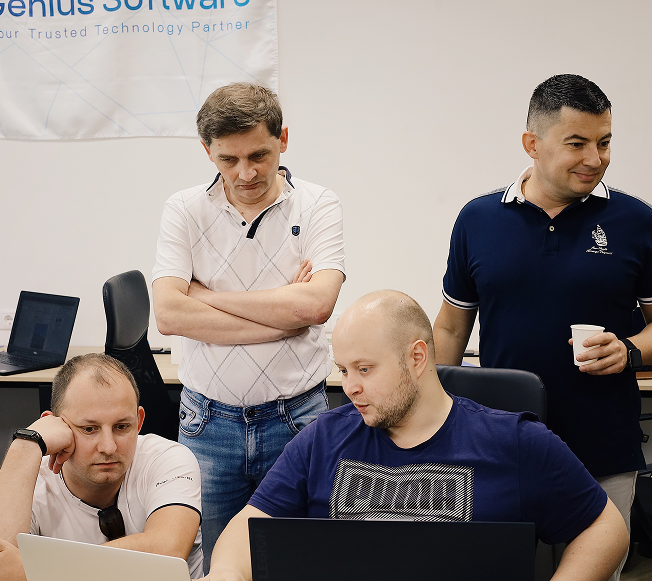
Delivery teams across Estonia, Ukraine, and Poland with hands-on experience on the performance and reliability side of AI integration, not just the initial connection.
Security & Data Handling
Every request that passes through an integration layer touches your data, often on its way to a third-party model provider — so the integration architecture is where data handling risk actually lives, not an afterthought bolted on later.
- Encryption in transit and at rest — Requests and any cached responses are encrypted, whether the data is moving to a hosted API or staying inside your own infrastructure.
- Provider-level data controls — We configure retention, logging, and training-opt-out settings on each model provider’s side, so proprietary data isn’t retained or used to train a provider’s model without your knowledge.
- Access control across the integration layer — Role-based permissions govern who and what can call each model, not just who can access the underlying product.
- Compliance-aware architecture — For regulated industries, we design the integration to keep sensitive data inside infrastructure aligned with GDPR, HIPAA, or SOC 2 requirements, including which requests are allowed to leave your environment at all.
Get Started with Genius Software Development
Our development process moves from strategy through production support, validating the agent with real users before expanding its scope.
Step 1
Contact Us
Reach out to us through our Contact Page to discuss your project requirements. Our team will get back to you promptly to schedule a consultation.
Step 2
Consultation
During the consultation, we’ll discuss your needs, goals, and any specific challenges you’re facing. We’ll provide you with an overview of how we can help.
Step 3
Proposal
Based on the consultation, we’ll create a detailed proposal outlining the project scope, timeline, and costs. You’ll have the opportunity to review and provide feedback.
Step 4
Agreement
Once you’re satisfied with the proposal, we’ll formalize the agreement and begin the project. Our team will work diligently to deliver a solution that meets your expectations.
Our Portfolio


Our Clients Say
Genius Software developed a healthcare platform for a smart solutions and innovative products firm. The team created a secure platform for booking and managing appointments with patient and doctor dashboards. Genius Software’s work resulted in a 60% reduction in average booking time, a 4.9/5 user satisfaction score, and expansion to two new markets. The team was proactive, detail-oriented, and made effective UX decisions. They worked in sprints, kept the client updated, and solved problems quickly.

Iryna Stakhiv
Review from


Spain
5.0
Thanks to Genius Software’s work, the client achieved a 50% reduction in loan processing time, and the platform processed over 70% of loan requests. The team was transparent, responsive, and quick to adjust to changes. Genius Software’s expertise and ability to solve business problems stood out.

Michael Carter
Review from

Estonia
5.0
Working with Genius Software has been a great experience for our team at Artemis. ʼThey really stand out because of their professional approach and deep technical knowledge.
Communication was always clear and timely, which made the whole development process feel straightforward and predictable. They delivered exactly what we needed, earning a well-deserved 5.0 rating. I’d definitely recommend them to anyone looking for a reliable, expert development partner.

Attila P.
Review from


Hungary
5.0
I’ve seen many partnerships, but Genius stood out. They fit right into our workflows, were responsive, and offered smart suggestions. Their balance of technical expertise with usability and compliance impressed us. The platform is now fast, secure, and delivering real value – this felt like a partnership, not outsourcing.

Alina
Review from

Estonia
5.0
We very enjoyed working with Genius team on our web-app project and they helped our team to deliver this project within the deadline. All new features were delivered as planned using clear communication, they also helped with the solution architecture improvements so we highly recommend this team and will be happy to work again, thanks guys!

Elliot Baker
Review from

United States
5.0
Genius Software delivered a stable, fast, and secure platform on time, with zero major bugs at launch and 99.9% uptime. The team led a smooth and transparent process, conducting sprints and demos and responding quickly to all requests. They were also proactive and handled all changes well.

Tetiana Bykova
Review from

Cyprus
5.0
Genius Software developed the backend and mobile features of a fitness app. The team built the app’s architecture, including the workout and nutrition program modules and progress tracking system. Genius Software delivered a stable and personalized app, resulting in positive user feedback and exceeding adoption projections. The team executed a clear and straightforward process, ensuring a smooth launch.

Andrii Kovalenko
Review from

England
5.0
Excellent work! Your attention to detail, thorough testing, and clear documentation were top-notch. I appreciate your proactive communication, timely delivery, and professionalism throughout the project. Looking forward to working with you again in the future!

Chris Workum
Review from

Netherlands
5.0
Working with the Genius team was a game-changer for our complex Java project! They delivered every feature on time, kept communication crystal clear, and even elevated our solution architecture. Highly recommended — we’d gladly team up again!

Viktoria
Review from
United States
5.0
I’ve had a great experience working with Genius Software on our Identity Governance and Administration SaaS platform. Building enterprise-level security software is never easy, but their team handled the complexity with total professionalism.
The technical expertise they brought to the table was obvious from day one. They didn’t just follow instructions; they really dug into the architecture to ensure the platform was both scalable and secure.

Patrick P.
Review from
USA
5.0
Genius team is great, super proactive, very on top of the tasks and what is required, communicating with multiple people and navigating what was new to her fast. Proposing also improvements for the team and helping to drive some.
Ryan G.
Review from
USA
5.0
Genius Software developed and deployed an AI chatbot for a mobile solutions company. The team created a self-learning, multilingual system with a microservices-based architecture and live response accuracy. After launching the chatbot, the client experienced a 70% reduction in repetitive expert inquiries, over 90% response accuracy across five languages, and 100% user adoption within the first month.

Kate Zashalovska
Review from

Ukraine
5.0
Genius Software has delivered a high-quality product that has reduced manual transaction review time by four times, fraud detection, and financial losses from fraudulent operations. The team follows an Agile methodology, adapts well to shifting priorities, and integrates seamlessly with the client.

Olexandr
Review from
Estonia
5.0
Genius Software built a blockchain based platform for managing on chain operations and user interactions for our mutual client. The platform served as a single environment where users could connect wallets, interact with smart contracts, and track transaction activity in real time. They get things done fast and with minimal fuss. The product just works.

Anastasiia Cherednichenko
Review from
Ukraine
5.0
It was a pleasure working with the Genius Software team on our embedded platform development project. The team is incredibly organized and made the entire development process feel seamless. The technical execution was spot on, and their ability to manage the project’s moving parts ensured we stayed on schedule without any major hiccups. We were happy to provide a 5.0 rating for the quality of work delivered. I highly recommend the team for anyone needing a reliable, sharp project manager for technical builds.
Jordi B.
Review from

United Kingdom
5.0
Genius Software developed and designed a blockchain platform for an IT company. Genius Software delivered a reliable platform that was adopted shortly after release. The team provided clear structure, quick turnaround, and full visibility into all blockchain activity. Moreover, Genius Software communicated effectively through virtual meetings, emails, and messages.

Alexey Cherevuta
Review from
Ukraine
5.0
Genius Software developed a cloud-based hospitality platform for a software development company. They built the infrastructure, integrated multiple systems, and created user-facing apps. The platform was launched on time and successfully enabled the client to onboard over 1,000 properties while remaining stable under heavy booking traffic. The team consistently met deadlines and impressed the client with their open communication, reliability, and high-quality work.

Khrystyna Gorodnyk
Review from
Estonia
5.0
We enjoyed working with Genius team on our solution architecture technical audit and code review, he helped our team to identify technical design issues and improve it, also suggested cool engineering AI tools for our dev team, so we highly recommend him and will be happy to work again.

Oleksii Myrnyi
Review from
Estonia
5.0
Great help with our business analysis projects and some advice as well.

Caroline B.
Review from

Denmark
5.0
Genius Software delivered a production-ready platform with secure and scalable infrastructure. The client adopted the platform quickly, and property listings and ad management became much faster. The team had clear deadlines and solid deliveries.

Iryna Seleman
Review from
Estonia
5.0
Genius Software designed and developed an AI-based mobile app for a software development company. The app had an OCR system that extracted data, auto-filled forms, and integrated with compliance systems. Genius Software delivered an impressive product with an OCR accuracy above 95%, a 40% reduction in inspection time, and 90% fewer manual errors in compliance reports.

Viacheslav K.
Review from

Saudi Arabia
5.0
I really enjoyed working with the Genius Software team on our recent project. They are an exceptional team that is consistently positive, friendly, and efficient.
Beyond their technical skills, they genuinely promote a great working environment, which makes the whole process much smoother. I highly recommend them for any team looking for professionals who can keep things organized while maintaining high morale.

Erik Saar
Review from
Estonia
5.0
The Genius QA Automation team did a fantastic job on our project. They were incredibly helpful throughout the process, providing high-quality testing that gave us a lot of confidence in our product. It’s clear they know their way around automation, and they were quick to adapt to our specific testing needs. I’d be happy to keep working with them on future QA and testing tasks. They definitely earned their 5.0 rating. If you need a team that’s efficient and easy to collaborate with, I highly recommend them.
Emma Johansson
Review from
Estonia
5.0
Genius Software delivered a production-ready platform with secure and scalable infrastructure. The client adopted the platform quickly, and property listings and ad management became much faster. The team had clear deadlines and solid deliveries.

Vladislav Komovich
Review from
Ukraine
5.0
We chose Genius Software because they truly understood our business needs. We needed a reliable software partner with skilled engineers, efficient management, and zero downtime — and that’s exactly what they delivered. Their flexibility, transparency, and innovative approach continue to add great value to our collaboration.

Jeroen Megchelen
Review from
Netherlands
5.0
The system has produced a significant competitive advantage in the industry thanks to Genius Software well-thought opinions. They shouldered the burden of constantly updating a project management tool with a high level of detail and were committed to producing the best possible solution

Martin Goutry
Review from
United Kingdom
5.0
We were looking for a trusted technology partner with strong expertise, solid management, and fair pricing. Sergey and the Genius Software team impressed us with their technical knowledge, business understanding, and communication. They built a skilled engineering team, implemented a mature Scrum process, and delivered a high-load web, mobile, and API solution on time and within budget.

Matas Jakutes
Review from
USA
5.0
Sergey and his team helped us rebuild our web platform from a legacy system to a modern, high-load technology stack. They established a mature project management process, designed and developed scalable architecture, and delivered the solution within our budget and timeline. Their dedication and transparency ensured full visibility at every stage of the project.

Anders Filipsen
Review from
Denmark
5.0

Meet us in Estonia
Sergey Lvov
Chief Executive Officer
Address
Talinn, Kesklinna Linnaosa,
Kaupmehe tn 7/120, 10114

Meet us in Poland
Sergey Lvov
Chief Executive Officer
Address
Warsawa, Krakowskie
Przedmieschie 13, 00-071

Meet us in USA
Sergey Lvov
Chief Executive Officer
Address
USA, Tampa, FL 33602, 501 E
Kennedy Blvd #1400

Meet us in Ukraine
Veronika Marchenko
Business Development
Address
Ukraine, Kyiv,
Yaroslaviv Val 15, 01001
Contact Us
Have a question or idea? Our team is here to help
Frequently asked questions
What is AI model integration?
AI model integration is the work of connecting an already-selected AI model into your existing product, APIs, and infrastructure, and tuning it to run reliably at production scale — distinct from building or fine-tuning the model itself.
What is the difference between model integration and building a new AI model?
AI model integration services start with a model that’s already chosen; the work is architecture, connection, and optimization. Building a new model involves training or fine-tuning, which is a separate service.
What does multimodal AI integration involve?
Multimodal AI integration services handle a model that processes more than one data type — text, images, audio — in a single pipeline, including input formatting, context management, and response parsing so the product can use that capability reliably. This is what multimodal LLM integration solutions are built to solve.
What is multi-model integration, and when do I need it?
Multi-model integration connects several specialized models — vision, generative, predictive — into one coordinated system. You need multi-model ai integration when no single model handles your full use case well on its own.
How do you integrate an AI model into an existing product without a full rebuild?
AI model integration is designed around your current architecture — connecting via REST or gRPC and microservices so the model slots into what you already run, rather than requiring you to rearchitect the product around it.
How is AI model performance optimized after integration?
AI integration and optimization covers latency reduction through asynchronous inference and techniques like quantization and pruning, along with cost optimization by routing requests to the right-sized model instead of the most expensive one by default.
How much does AI model integration cost?
Cost depends on how many models and providers are involved, the complexity of your existing infrastructure, and how much optimization work is needed. An audit of your current stack is the fastest way to get an accurate estimate.
Do you work as an integration and optimisation agency for AI already in production?
Yes — a significant share of our work is optimizing AI integrations that are already live but underperforming on latency, cost, or reliability, not just building new ones from scratch.


