

Introduction to Machine Learning
Arthur Samuel, a pioneer of artificial intelligence, built the first self-learning system for playing checkers in the 1950s. His observation was that the more the system played, the better its performance. Machine learning has really taken off in recent years, fuelled by advances in statistics and computer science, better data sets and the growth of neural networks.
Whether you believe it or not, machine learning is everywhere today: automated translation, image recognition, voice search technology, and more. Social media platforms enable users to tag and share photos of friends using facial recognition technology. Images of text are converted into moving types using optical character recognition (OCR) technology. Machine learning-based recommender machines suggest what movies or TV shows to watch next based on user preferences. Consumers may soon be able to drive self-driving cars that use machine learning experience to navigate.
How machine learning works and the ways you can use it in your business is what we’ll be explaining in this guide. Plus, we’ll introduce you to machine learning software tech and show you how to get started with no-code machine learning.
What is Machine Learning?
Machine learning (ML) is a model of artificial intelligence (AI). Machine learning mostly aims to understand the structure of data and fix that data into models that humans can understand and use.
Machine learning is different from traditional computing. In traditional computer science, algorithms are sets of explicitly programmed instructions that are used by computers to perform calculations or solve problems. Rather, machine learning algorithms train computers on data inputs and use statistical analysis to output data that fall within a specified range. In order to automate decision-making based on data input, machine learning allows computers to build models from sample data.
Traditional programming involves writing instructions to tell the computer how to convert input data into the desired output. Commands are usually based on an IF-THEN structure: if certain conditions are met, the software performs a certain action. Machine learning is described as a fancy labeler machine by Google’s Chief Decision Scientist, Cassie Kozyrkov. Consider a scenario where we want to build a system that can separate cats and dogs in images. Instead of crafting rules like “if pointy ears and long tail, then cat,” machine learning algorithms can analyze vast amounts of labelled cat and dog images to automatically learn the distinguishing features.
Machine Learning Classification
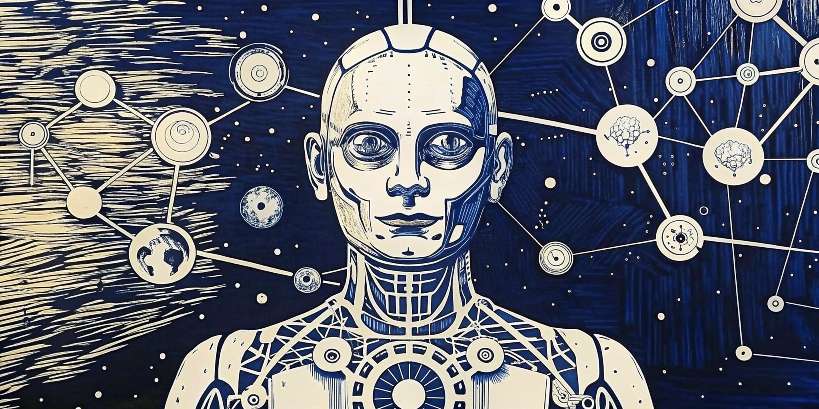
In the scope of machine learning, algorithms can be categorised into several different types, each of which serves a specific purpose in product development:
| Type of Learning | Description | Example |
| Supervised Learning | Models trained on labeled data for predictions or classifications based on learned patterns. | Distinguishing between images of cats and dogs. |
| Unsupervised Learning | Identifying hidden patterns in unlabeled data to uncover relationships and groupings within the data. | Clustering similar customer profiles for targeted marketing. |
| Semi-supervised Learning | Combines supervised and unsupervised learning, using a small amount of labeled data and a larger pool of unlabeled data to enhance model accuracy. | Using labeled data for a portion of image recognition tasks while utilizing unlabeled data for the rest. |
| Deep Learning (DL) | Subset of machine learning employing neural networks to process complex data representations, excelling in tasks like image and speech recognition. | Training models for advanced image recognition or natural language processing. |
| Reinforcement Learning | Focuses on training agents to make sequential decisions based on rewards and punishments. Applications include training autonomous systems and game-playing AI. | Developing AI agents capable of mastering complex games or controlling autonomous vehicles. |
Knowledge of these types and their real-life impact provides a strong foundation for navigation through the diverse landscape of machine learning algorithms.
Types of Supervised Learning
- Classification: It refers to a problem where the output variable is a category, for example, “black”, “white”, “sick”, or “healthy.”
- Regression: In regression, training data generates a single output using a probabilistic interpretation. This prediction considers input variable correlations. For instance, it can forecast house prices based on factors like location and size.
- Naive Bayesian Model: t assigns class labels using a graph with a main node and multiple branches. Each branch is seen as separate from the main. This model, used in supervised learning, helps create simple classifiers and is good for small datasets. While assuming attribute independence, it’s also flexible for complex problems.
- Decision Trees: A decision tree is like a flowchart. It makes choices based on conditions and predicts outcomes. It’s used to label new data. In the tree, the endpoints show labels, and the middle points show traits. Decision trees are good for problems with categories or yes/no questions. ID3 and CART are popular decision tree methods.
- Neural Networks: This algorithm groups data, finds patterns, and understands sensory info. Yet, neural networks need lots of computer power. They might be tricky with many observations. They’re often called ‘black-box’ as understanding their predictions is tough.
Types of Unsupervised Learning
- Clustering: A clustering task involves identifying natural groupings within data, such as clustering customers based on their buying habits.
- Association: An association rule learning task involves discovering patterns that describe significant portions of your data, for example, identifying that people who drink A often also order B.
How Machine Learning Works

To grasp the concept of machine learning, you must first comprehend the meaning of a “tag.” To train image recognition, you would label photos of animals like cows, horses, or bears with their corresponding names. This process is also known as data labeling.
The machine learning model can then identify similar dog images and label them accurately.
Then, depending on the analysis you’re performing, you label it. If you’re doing sentiment analysis, for instance, you supply the model with customer feedback and tag each comment as Positive, Neutral, or Negative.
The simplest machine learning process involves three steps:
- Provide training data to a machine learning model. In our example, this could be comments from customers on social media or customer service records.
- Label the training data with an intended outcome. In this case, instruct your sentiment analysis model to classify each comment or piece of data as Positive, Neutral, or Negative. The model then converts the training data into text vectors – numbers that indicate data traits.
- Test your model by using new, untested data. The algorithms learn to predict tags for new data because they have been trained on manually labelled samples.
If your model works well with the testing data and meets the required standards, it is suitable for deployment with new data. You will need to continue training if the model does not perform accurately. Moreover, as language used by individuals and industries evolves, you may need to continuously educate your model with fresh information.
Use Cases of Machine Learning
Machine learning is increasingly applied across various sectors. With the shift to remote work and the growing reliance on smartphones and machine learning-powered technologies, its use cases are almost limitless.
- Healthcare: Computers can help doctors spot diseases like cancer in X-rays. They can also predict when a patient might get worse and need extra care.
- Money Stuff: Computers help banks decide if you can borrow money and how much. They’re also really good at finding unusual spending that might be fraud.
- Shopping: Ever notice how websites recommend things you might like? That’s machine learning. It’s like a helper that suggests cool stuff to buy.
- Self-Driving Cars: Yep, robots are learning to drive cars! They look at the road, figure out where to go, and even stop for obstacles.
- Talking to Computers: You know Siri and Alexa? They understand what we say because of machine learning. They learn how humans talk and help us find information.
- Saving Energy: Machine learning helps use electricity wisely. It figures out when we need more or less power, so we don’t waste it.
- Checking for Mistakes: Factories use machine learning to check if products are made right. If not, they can stop before things get worse.
- Fun Stuff: Ever see a robot drawing or writing stories? That’s also machine learning. It helps robots be creative and make cool things.
- Farm Magic: Farms use it too! Machines decide when to water crops and how to keep them healthy.
- Keeping Us Safe: Machine learning helps predict where crimes might happen, so police can be ready. It also helps track diseases like COVID-19.
How does Netflix create personalised movie recommendations and Google Maps predict traffic peaks, as well as inform the creation of new content? Through the implementation of machine learning techniques.
For instance, UberEats applies machine learning to approximate the best times for drivers to collect food orders. Similarly, Spotify utilises machine learning to provide tailored content and personalised marketing. Moreover, Dell employs machine learning text analysis to save countless hours scrutinising thousands of staff surveys and listening to the voice of the employee (VoE) to enhance employee satisfaction.
Final Thoughts
In simple terms, machine learning empowers computers to learn from data, making them smarter over time. It transforms industries, from healthcare to entertainment, enhancing our lives. Curious to explore more? Check out Genius Software, a leading company making waves in this exciting field!
More insights:
12 Must-Have Features in Recruitment Automation...
Automation is one of the most noteworthy 2021 recruiting trends. Harvard Business School reports, 75% …
Scrum Tips to Be a Successful Scrum Master...
Scrum is a dominant framework for implementing principles of Agile software development that have …
Business Analyst Benefits for a Software...
People often confuse project managers and business analysts as they have seemingly similar responsibilities…
Read more

Scrum Tips to Be a Successful Scrum Master...
Scrum Tips to Be a Successful Scrum Master of Remote Teams Home Companies have been…

12 Must-Have Features in Recruitment Automation...
12 Must-Have Features in Recruitment Automation Software Home Companies have been moving their business to…

How Exactly Cloud Computing Can Benefit ...
espite its numerous advantages, cloud computing has its flaws — many of its advantages could be…

When to Hire a Business Analyst?
When to assign BA to a project? When you have
Limited budget with no understanding…

Real estate investment has always depended on data. But today, that data comes from dozens of sources at once –

Losing good employees is expensive. Replacing one mid-level professional can cost anywhere from 50% to 200% of their annual salary

Managing a workforce has never been more complex. Companies today operate across hybrid and distributed teams, multiple geographies, and several

The real estate industry is changing fast. PropTech innovations are transforming how buildings are managed, operated, and valued – shifting