


AI Agent Development for Healthcare











Why Build Healthcare AI Agents with Genius Software
Well-scoped agents change where staff time goes. Instead of re-keying member IDs into payer portals, a biller reviews exceptions the agent has already flagged. Instead of chasing referral attachments by phone, a coordinator sees which cases are blocked and why. Multi-step work becomes visible: each tool call, retrieved document, and approval is logged, so supervisors can trace how an outcome was reached and where a process consistently stalls. Manual data transfer between systems drops, and handling rules stay consistent across shifts and sites.
Genius Software builds AI-powered products end to end — discovery, UX/UI design, engineering, QA, and ongoing support — for the US market. Our teams work in Python with TensorFlow and PyTorch, React, Node.js, and .NET, deployed on AWS with Docker and Kubernetes, and have delivered AI chatbots, enterprise voice platforms, and healthcare platforms across prior engagements.
Industry Challenges
The Challenges of Building AI-Powered Software
Most healthcare operational work is not a single decision — it is a sequence of lookups, comparisons, and handoffs across systems that were never designed to talk to each other. Eligibility verification is a typical example: a staff member opens the practice management system, re-keys member details into a payer portal or clearinghouse, interprets a coverage response, compares it against what the patient reported at registration, and updates the record. Referral management follows a similar pattern, with faxed or scanned documents, incomplete demographics, missing clinical attachments, and manual follow-up when nothing comes back from the receiving practice.
Rules-based automation handles the predictable slice of this work. It breaks when a payer changes a screen, a document arrives as an unstructured PDF, or a clinical note contains the needed detail in free text. Standalone chatbots have the opposite limitation: they answer questions in conversation but have no authority to retrieve a FHIR resource, reconcile two conflicting records, or queue a task for a human reviewer.
Meanwhile, every one of these workflows touches protected health information, so automation cannot be bolted on without access controls, logging, and defined boundaries on what the system is permitted to do on its own. That combination — unstructured inputs, cross-system state, and PHI exposure — is what makes purpose-built agent engineering a separate discipline.
Our Approach
Efficient & Informed Trading
A healthcare AI agent is an application pattern, not a model. In a typical design, an LLM reasons over a task description and then calls explicitly defined tools — a FHIR read against Patient, Coverage, or DocumentReference resources; an HL7 v2 message consumer; an internal REST endpoint; a database query — rather than acting through screens or free text. Each tool call is constrained by a schema, and agent output is validated against structured formats before anything is written back to a system of record.
Workflow state matters more than conversation. Prior authorization or denial follow-up can span days, so the agent needs durable state: what has been submitted, what response arrived, what remains blocked, and which step requires a person. Retrieval-augmented generation grounds answers in payer policy documents, internal SOPs, or clinical documentation instead of model recall, with citations preserved for review. Simple cases need one agent with a handful of tools; orchestration or multiple specialized agents are justified only when a workflow genuinely spans distinct domains.
Controls are designed in from the start: role-based and least-privilege access to PHI, encryption in transit and at rest, data minimization in prompts, logging of every tool call and model output for traceability, prompt injection defenses on untrusted document inputs, and explicit human approval gates before clinically or financially consequential actions. Technical safeguards support HIPAA obligations but do not satisfy them alone — BAAs, policies, and compliance review remain the covered entity’s responsibility.
Genius Software delivers this as a full engineering engagement: workflow discovery, integration feasibility assessment, UX/UI design, build, QA, pilot validation, and ongoing support and maintenance.
Technologies We Use
We use proven, industry-leading technologies across every layer of development. Our team is experienced in everything from JavaScript and Python to cloud platforms and containerization — so we can pick the best tools for your specific product, not just the most popular ones.
Our Portfolio

My Perfect Coach Fitness App
A personalized fitness application with custom training plans. Our client asked us to create a fitness platform that offers personalized training plans and expert guidance. They wanted a solution that would cater to individual needs and provide a customized fitness experience. In response, we developed My Perfect Coach, a platform that delivers on their requirements.

Digital Healthcare Platform
Our healthcare platform revolutionizes the way patients connect with healthcare professionals, making it easier than ever to manage your health. Whether you need a routine check-up, a specialist consultation, or urgent care, our platform brings the best doctors to your fingertips. Designed with both patients and physicians in mind, we streamline the entire process...
Explore Our Full Project Portfolio
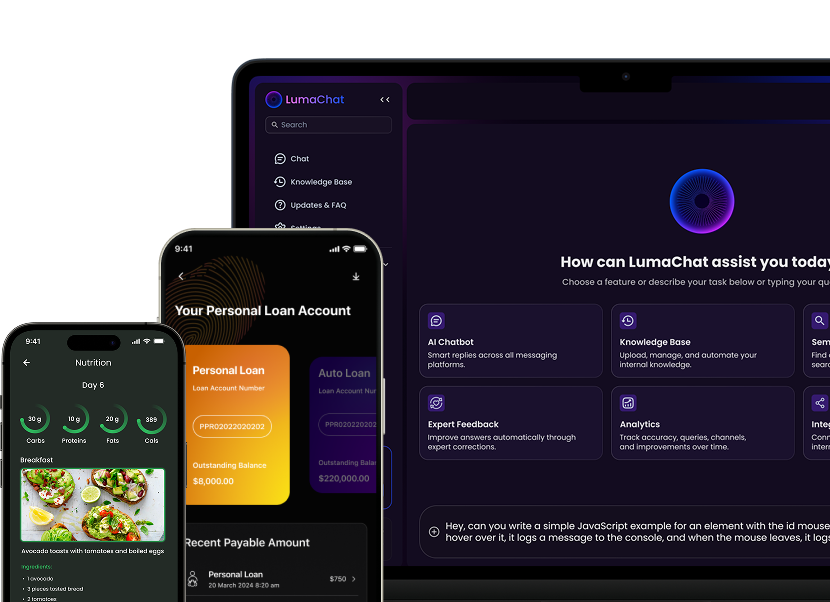
Explore a selection of real-world products we've designed and built across multiple industries and platforms.
Frequently asked questions
The strongest candidates are high-volume administrative workflows with clear success criteria: insurance eligibility verification, claims status tracking, denial triage and categorization, referral intake from unstructured documents, appointment coordination, and summarizing records for a clinician's review. These share a pattern — structured systems, messy inputs, and repeatable decisions a person can audit. Workflows requiring diagnosis, treatment selection, or prescribing are not appropriate for autonomous agent action and require clinician authority and oversight.
Integration usually happens through APIs rather than screen automation. FHIR REST endpoints expose discrete resources such as Patient, Encounter, Coverage, and Observation; SMART on FHIR supports authorized app access within some EHR environments; HL7 v2 interfaces remain common for ADT, orders, and results messaging. What is actually available depends on the specific vendor, version, and your organization's contract and interface configuration, so we run an integration feasibility review before committing to an architecture.
A chatbot generates responses in a conversation. An agent plans a task, calls defined tools to read and write data in other systems, maintains state across steps that may span days, validates its own output against expected structures, and escalates to a human when confidence or policy requires it. The practical difference is authority and accountability: an agent performs actions inside your systems, so it needs permissions, execution boundaries, and an audit trail.
Through system design and organizational controls together. On the engineering side: least-privilege service accounts, role-based access, encryption in transit and at rest, minimizing PHI sent into model context, logging tool calls and outputs, and keeping processing within environments covered by appropriate agreements. On the organizational side: business associate agreements with model and infrastructure vendors, policy review, and workforce training. No technology, cloud platform, or architecture makes an implementation HIPAA compliant by itself.
We build an evaluation set from real historical cases with known correct outcomes, then measure task completion, factual grounding against source data, structured output validity, and escalation behavior on ambiguous inputs. Pilots typically run in shadow or human-approval mode so staff review every action before it takes effect, which produces both a safety margin and labeled data for improvement. Monitoring continues in production, since payer rules, document formats, and model behavior all change over time.
Four factors dominate: how many systems the agent must touch and whether modern APIs exist for them; how much unstructured input is involved, since documents and free-text notes require extraction and validation work; the level of human oversight and audit evidence required; and the readiness of your data and environments for testing with de-identified or production-equivalent records. A short discovery phase scoping one workflow end to end usually gives the most reliable estimate.

Meet us in Estonia
Sergey Lvov
Chief Executive Officer
Address
Talinn, Kesklinna Linnaosa,
Kaupmehe tn 7/120, 10114

Meet us in Poland
Sergey Lvov
Chief Executive Officer
Address
Warsawa, Krakowskie
Przedmieschie 13, 00-071

Meet us in USA
Sergey Lvov
Chief Executive Officer
Address
USA, Tampa, FL 33602, 501 E
Kennedy Blvd #1400

Meet us in Ukraine
Veronika Marchenko
Business Development
Address
Ukraine, Kyiv,
Yaroslaviv Val 15, 01001
Contact Us
Have a question or idea? Our team is here to help


