



Most engineering teams reach the same inflection point twelve to eighteen months into their AI roadmap: the off-the-shelf LLM integration that shipped fast and looked impressive in demos is now costing more to operate than originally budgeted, generating outputs too generic for domain-critical workflows, and creating compliance surface area that legal won’t sign off on. The problem is not that LLM integration was the wrong call — it frequently is the right call. The problem is that the architectural decision was made without a defensible framework for evaluating when a foundation model’s general capability becomes a liability rather than an asset. This article provides that framework. We will examine the infrastructure economics of LLM API dependency versus owned model training pipelines, map the decision criteria across latency requirements, data governance constraints, and total cost of ownership, and benchmark both approaches against the operational demands of enterprise SaaS, FinTech, and regulated-industry deployments. By the end, you will have a scoring rubric you can apply to your product in a single planning session.
The Architectural Fault Line Between LLM Integration and Custom Model Training
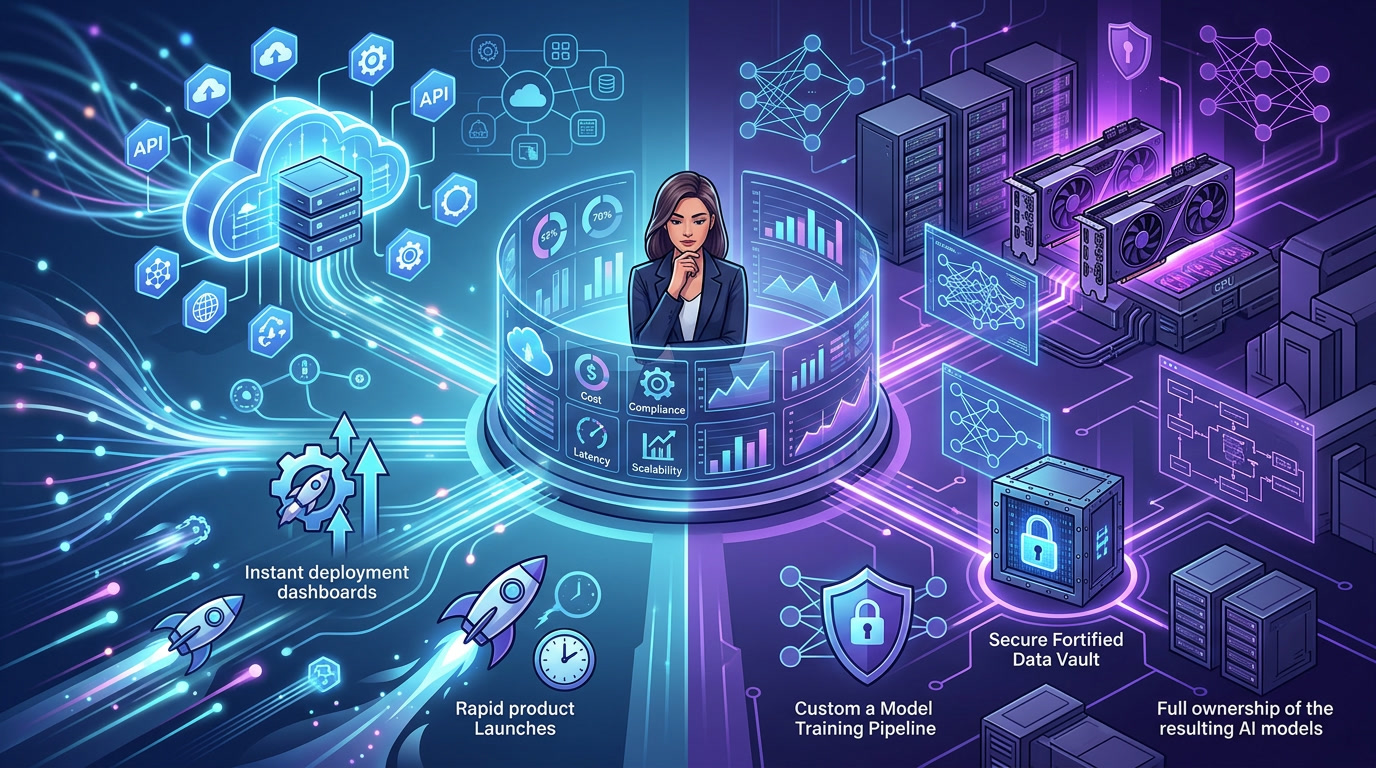
The decision is not binary — it is dimensional. “LLM integration” covers a wide spectrum: raw API calls to GPT-4o or Claude, retrieval-augmented generation (RAG) architectures bolted onto foundation models, and fine-tuned variants of open-source models like Llama 3 or Mistral that you host yourself. “Custom AI models” likewise ranges from fine-tuned transformers trained on proprietary corpora to fully bespoke architectures — convolutional networks, gradient-boosted ensembles, or domain-specific neural nets built from scratch with no LLM ancestry at all.
The fault line that actually matters is inference ownership. Who controls the weights, the serving infrastructure, and the training data pipeline determines your cost trajectory, latency floor, compliance posture, and competitive moat. Everything else — UX sophistication, feature velocity, model accuracy — follows from that foundational architectural choice.
[User Request / Product Trigger] | v [LLM Integration Path] [Custom Model Path] | | [API Gateway / RAG Layer] [Internal Data Pipeline] | | [Third-Party Model (GPT-4o, [Training Infrastructure] Claude, Gemini, Mistral)] [(GPU Cluster / Cloud ML)] | | [Response Post-Processing] [Model Registry & Versioning] | | [Product Layer / UI] [Inference Serving (vLLM, TGI)] | | +——————-> [End User Output] <–+
The left branch is fast to deploy and carries third-party model risk. The right branch is slower to production but creates owned capability that compounds over time.
When LLM Integration Wins on First Principles
Foundation models trained on internet-scale corpora carry an enormous prior — general reasoning, code generation, multilingual fluency, structured output parsing. Accessing that prior via API is, in effect, amortizing the compute cost of training across millions of customers. For most early-stage products and for use cases where general language understanding is genuinely sufficient, this is an economically rational choice.
LLM integration delivers structural advantage in these conditions:
- Time-to-market pressure is dominant. A well-structured prompt pipeline with GPT-4o or Claude 3.5 Sonnet can ship a functional AI feature in days. A fine-tuned custom model requires labeled training data, experimentation cycles, evaluation infrastructure, and MLOps tooling — typically six to sixteen weeks minimum.
- Use case breadth exceeds depth. General-purpose summarization, intent classification across diverse input types, code assistance, and customer-facing chat are all tasks where a frontier model’s generalization capability outperforms a narrowly trained custom model.
- Data volume is insufficient for meaningful fine-tuning. Most custom model training for domain-specific text tasks requires a minimum of ten to fifty thousand high-quality labeled examples to measurably outperform a well-prompted foundation model. Below that threshold, prompt engineering and RAG are more cost-effective.
- Team lacks MLOps infrastructure. Serving a custom model requires a model registry, A/B testing harness, drift monitoring, retraining pipelines, and GPU serving infrastructure. The operational overhead is non-trivial.
The economic logic of LLM APIs also favors smaller product teams. At one million tokens per day — a moderate SaaS workload — GPT-4o Turbo costs roughly $1,500–$3,000/month depending on input/output ratio. That is a predictable, low-capital-commitment number for most product budgets.
The Point at Which LLM API Dependency Becomes an Engineering Liability
At scale, the economics invert. Token costs that appeared negligible during development become material line items at production workloads. At fifty million tokens per day — achievable for a mid-market SaaS product with AI-heavy features — monthly API costs can reach $75,000–$150,000 before infrastructure, latency optimization, and retry logic are accounted for. That figure, annualized, often exceeds the total cost of training and serving a capable custom model.
Beyond cost, four structural risks accumulate with continued API dependency:
- Latency ceiling. Third-party API round-trips, even with streaming, introduce baseline latency of 500ms–3s for complex completions. Use cases requiring sub-100ms inference — real-time fraud scoring, high-frequency recommendation systems, low-latency document processing — cannot be architecturally satisfied by API-mediated LLMs.
- Data residency and compliance exposure. Sending user data to a third-party model endpoint — even with a data processing agreement — creates compliance surface area under GDPR Article 28, HIPAA Business Associate requirements, and emerging EU AI Act obligations. For regulated industries, this is not a risk that contracts fully mitigate.
- Model behavior drift. Foundation model providers update their models silently or with limited deprecation windows. A prompt that produced consistent, deterministic output on GPT-4 may behave differently after a version update, breaking downstream parsing logic without any change to your codebase.
- No proprietary signal. Every inference call to a third-party LLM generates zero owned training signal. The model does not improve on your users’ interaction patterns, your domain vocabulary, or your edge cases. Your competitor using the same API has access to the same model capability.
Mapping the Decision Framework: A Scoring Matrix for Technical Leaders

Rather than defaulting to either approach, engineering leaders need a structured evaluation across five dimensions. The following matrix scores each dimension from 1 (strongly favors LLM integration) to 5 (strongly favors custom model development).
| Evaluation Dimension | Score 1 — Favors LLM Integration | Score 5 — Favors Custom Model | Key Threshold |
|---|---|---|---|
| Training Data Volume | < 10K labeled examples | > 500K domain-specific examples | 50K–100K examples typically justifies fine-tuning |
| Inference Latency SLA | > 1,000ms acceptable | < 100ms required | Sub-200ms requirements push toward owned serving |
| Daily Token Volume | < 5M tokens/day | > 100M tokens/day | Break-even typically occurs at 20M–50M tokens/day |
| Data Governance Risk | Low-sensitivity, non-regulated data | PII, PHI, financial records, IP | Any HIPAA/GDPR regulated data warrants custom evaluation |
| Domain Specialization | General language tasks | Narrow, high-precision domain | Specialty clinical, legal, or financial tasks favor custom |
| MLOps Maturity | No ML infrastructure | Full MLOps pipeline | Lack of infrastructure is a defeater for custom models |
| Competitive Differentiation | AI feature is table stakes | AI is core product differentiator | If AI is the moat, owned models are strategically necessary |
Score your product across these seven dimensions. A total below 15 points favors LLM integration, with or without RAG augmentation. A total of 20 or above represents a strong case for investing in custom model development or fine-tuning. Scores between 15 and 20 typically resolve to a hybrid architecture.
Fine-Tuning as the Middle Path: When and How It Changes the Calculus
Fine-tuning an open-source foundation model — Llama 3.1 70B, Mistral 7B, or Falcon 40B — occupies a strategically important middle ground that enterprise architects frequently underweight. It is neither the zero-capital commitment of API integration nor the full engineering investment of training from scratch, and it is often the highest-ROI option for products with 50K–500K domain-specific examples and clear latency or cost constraints.
Fine-tuning economics are materially different from pre-training. A Llama 3.1 8B fine-tuning run using LoRA (Low-Rank Adaptation) on a dataset of 100K examples requires approximately 4–8 A100 GPU-hours on cloud infrastructure — a one-time cost of $200–$800 depending on provider. The resulting model, served via vLLM or Text Generation Inference (TGI) on a single A100 or H100 instance, can handle throughput of 200–500 requests per second at inference cost that is one to two orders of magnitude below equivalent GPT-4o API calls at scale.
Key engineering considerations when evaluating fine-tuning:
- LoRA vs. full fine-tuning trade-off: LoRA (and QLoRA for quantized variants) updates only a small fraction of model weights — typically 0.1%–1% — making it feasible on single-GPU infrastructure. Full fine-tuning updates all weights and requires multi-GPU setups with gradient checkpointing, but may yield better task performance for complex domain shifts.
- Catastrophic forgetting risk: Fine-tuning on narrow domain data without careful regularization degrades general capability. Techniques like elastic weight consolidation (EWC) or replay buffers mitigate this, but add pipeline complexity.
- Evaluation infrastructure is non-negotiable: A fine-tuned model without a rigorous evaluation harness — held-out domain test sets, human preference scoring, automated regression benchmarks — will degrade unpredictably in production. RAGAS for RAG systems and LLM-as-judge pipelines using GPT-4 or Claude as evaluators have become the standard toolchain.
- Serving infrastructure baseline: vLLM with PagedAttention offers 10–20x throughput improvement over naive Hugging Face serving. TGI provides comparable performance with production-grade features including continuous batching and tensor parallelism. Both should be containerized with Kubernetes autoscaling to handle load variance.
The machine learning development services decision — API integration, fine-tuning, or custom training — should never be made purely on current workload. Model the 18-month token volume trajectory, the compliance exposure evolution as you enter new markets, and the competitive consequence of sharing model capability with every other API customer.
Infrastructure Cost Modeling: The Numbers That Change the Decision
Abstract architectural preferences collapse quickly when you model actual infrastructure costs. The following analysis benchmarks three architectural patterns against a representative mid-market SaaS workload: 30 million tokens per day, predominantly input-heavy (70/30 input/output ratio), with P95 latency SLA of 500ms.
| Architecture Pattern | Monthly Inference Cost | P95 Latency | Data Sovereignty | Customization Ceiling |
|---|---|---|---|---|
| GPT-4o via API | $42,000–$63,000 | 600ms–2,000ms | None | Prompt + RAG only |
| Claude 3.5 Sonnet via API | $27,000–$45,000 | 500ms–1,800ms | None | Prompt + RAG only |
| Fine-tuned Llama 3.1 70B (2× H100) | $5,500–$8,000 | 80ms–200ms | Full | LoRA layers, continued training |
| Fine-tuned Mistral 7B (1× A100) | $1,200–$2,500 | 30ms–80ms | Full | Full weight updates |
| Custom model from scratch | $2,000–$6,000 serving + $50K–$500K training amortized | 20ms–60ms | Full | Complete architectural control |
At this workload, fine-tuning a Llama 3.1 70B model on owned infrastructure reduces monthly inference costs by 85–90% versus GPT-4o API while meeting the latency SLA comfortably. The break-even on training and infrastructure setup investment — typically $40,000–$120,000 for a well-staffed team — occurs between months four and eight depending on data preparation complexity.
This math is why AI development decisions that appear straightforward at prototype scale become strategically significant by Series B. Teams that delay the infrastructure investment often face a painful architecture migration under growth pressure — migrating inference pipelines while maintaining uptime and output quality simultaneously.
Regulated Industry Constraints: FinTech, Healthcare, and Legal as Decision Accelerators
For teams building FinTech and financial software, clinical platforms, or legal-tech products, regulatory constraints frequently resolve the LLM-vs-custom debate faster than any cost model. The regulatory landscape across these verticals creates hard requirements that third-party API architectures structurally cannot satisfy without significant legal and contractual overhead.
Specific constraints by vertical:
Financial Services:
- MiFID II and SEC Rule 17a-4 require audit trails and explainability for AI-assisted trading or advisory outputs. Black-box third-party model responses are difficult to attribute and defend in enforcement proceedings.
- PCI DSS prohibits transmission of cardholder data to third-party processors without specific contractual controls that most LLM API providers do not offer as standard.
- Basel III model risk management guidelines (SR 11-7) require documentation of model logic, validation methodology, and ongoing performance monitoring — requirements that are substantially harder to satisfy when the model weights are inaccessible.
Healthcare:
- HIPAA’s minimum necessary standard requires that PHI transmitted to a business associate is strictly necessary for the intended function. Sending full clinical notes to a general-purpose LLM for summarization typically fails this test.
- FDA’s evolving Software as a Medical Device (SaMD) framework increasingly applies to AI clinical decision support tools, requiring reproducible model behavior that API-versioned models cannot guarantee.
Legal:
- Attorney-client privilege and work-product doctrine create ambiguity when legal analysis is processed through a third-party’s infrastructure, particularly for US counsel with international client bases.
Teams building in these verticals should evaluate AI software architecture through a compliance-first lens. The right question is not “can we get a DPA signed?” but “can we demonstrate to a regulator that our AI system’s behavior is auditable, reproducible, and confined to our infrastructure?”
The Hybrid Architecture: Routing Intelligence as the Production Standard
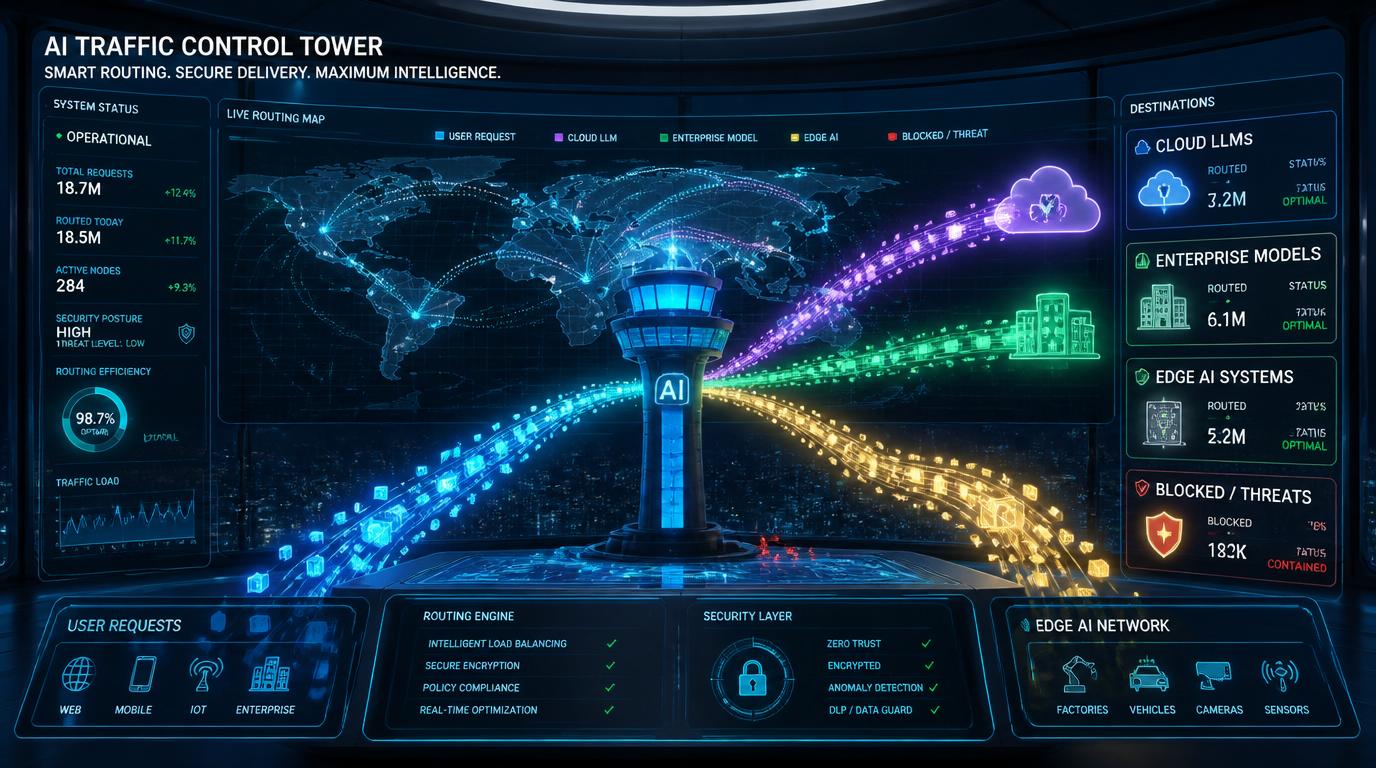
For most enterprise products at scale, the production architecture is neither pure LLM integration nor pure custom model deployment — it is a routing layer that dispatches requests to the appropriate model based on task classification, data sensitivity, latency requirements, and cost.
[Incoming Request] | v [Request Classifier / Router] | +—[Low Sensitivity, General Task]—-> [LLM API (GPT-4o / Claude)] | +—[Domain-Specific, High Volume]—–> [Fine-Tuned Open Source Model] | (vLLM / TGI Serving) | +—[Regulated Data / PII/PHI]———-> [On-Premise Custom Model] | (Air-Gapped Infrastructure) | +—[Ultra-Low Latency (<50ms)]———-> [Distilled Small Model] (ONNX / TensorRT)
This router-based architecture is what mature AI-powered automation platforms implement in production. The classifier itself is typically a lightweight BERT-class model or even a rules-based tagger that adds less than 5ms to the request path.
Key implementation requirements for a production routing layer:
- Task taxonomy definition: Every inference request must be classifiable into a finite set of task types with defined routing rules. Ambiguity in classification is the primary failure mode.
- Fallback logic: When the fine-tuned model confidence falls below a threshold (typically 0.7–0.85 depending on risk tolerance), the request should be routed to the frontier API with appropriate data masking applied.
- Cost accounting per route: Each route should be instrumented with per-request cost tracking so the unit economics of the routing decision are visible in real time.
- Shadow mode validation: New custom models should enter the routing layer in shadow mode — receiving live traffic but not serving responses — for a defined validation period before taking production load.
Genius Software’s engineering teams have implemented this pattern for clients operating across FinTech, hospitality, and SaaS verticals, where the combination of custom application development and deep MLOps instrumentation reduced inference costs by 60–75% compared to single-provider API architectures while maintaining or improving output quality on domain-specific tasks.
Data Strategy as the Compounding Asset: Why Custom Models Build Moats
The most underappreciated dimension of the LLM-vs-custom decision is the data flywheel. Every inference call your users make against a custom model is a potential training signal. With appropriate consent architecture and data pipeline instrumentation, user interactions become a continuously refreshed training corpus that makes your model better on exactly the tasks your users care about — a capability accumulation loop that API customers cannot access.
Building this flywheel requires deliberate engineering choices from day one:
- Interaction logging infrastructure: Every prompt, completion, user correction, thumbs-up/thumbs-down signal, and downstream action triggered by a model output should be captured in a structured event stream (Kafka or Kinesis) with full metadata.
- Human-in-the-loop labeling pipeline: A proportion of logged interactions — typically 1–5% depending on volume and error rate — should flow to a labeling queue for quality annotation. Tools like Label Studio, Scale AI, or Humanloop support this workflow at production scale.
- Scheduled retraining triggers: Model retraining should be triggered by drift detection (PSI > 0.2 on output distributions, reference-based metrics degrading by > 5%) rather than calendar schedules, ensuring the model responds to real-world signal changes.
- Evaluation-driven deployment gates: No retraining run should deploy to production without clearing a regression test suite covering task accuracy, safety filters, latency benchmarks, and business-metric proxies.
This is the infrastructure that separates AI features from AI products. An AI feature calls an API. An AI software development product owns a training data asset that compounds in value as the user base grows.
Vendor Lock-In, Portability, and the Strategic Risk of Foundation Model Dependency
The market structure of foundation model providers creates a concentration risk that enterprise architects should quantify explicitly. As of mid-2026, three providers — OpenAI, Anthropic, and Google — account for the majority of commercial LLM API consumption. This oligopoly structure creates several strategic risks:
Pricing power risk. Foundation model providers are currently pricing below long-run cost to capture market share. Historical precedent from cloud infrastructure pricing suggests that consolidation will eventually enable price increases. Teams that have engineered deep integration with a single provider’s API surface — specific function calling schemas, extended context handling patterns, proprietary embedding formats — face significant migration costs if pricing shifts.
Capability dependency risk. If a core product feature depends on a specific model capability (extended context, vision, code execution) that exists only in a single provider’s offering, any deprecation or access change directly impacts product functionality.
Mitigation architecture:
- Abstract all model calls behind an internal inference gateway (LiteLLM, PortKey, or a custom router) that decouples application logic from provider-specific APIs.
- Maintain provider-agnostic prompt formats and evaluate at least two frontier providers on your primary task taxonomy quarterly.
- For critical capabilities, always maintain a viable open-source fallback — a fine-tuned Llama or Mistral variant that can absorb production load within 48–72 hours if a primary provider becomes unavailable.
Teams building on SaaS development services platforms that incorporate AI should treat provider portability as a first-class architectural requirement, not an afterthought. The building scalable SaaS architectures discipline applies directly here: the same decoupling patterns that protect against cloud provider lock-in apply to model provider lock-in.
Evaluation Benchmarks: How to Test Before You Commit
Neither architectural path should be committed to without empirical evaluation on your specific task distribution. Generic benchmarks — MMLU, HumanEval, MT-Bench — measure general model capability, not performance on your domain, your user inputs, and your quality criteria. Building a domain-specific evaluation suite before making the architecture decision is not optional overhead; it is the only reliable signal.
A minimum viable evaluation framework for this decision:
Dataset requirements:
- 500–2,000 real production examples (or representative synthetic examples if production data is unavailable)
- Ground-truth labels generated by domain experts, not by a frontier model used as pseudo-labeler
- Coverage of tail cases, adversarial inputs, and distribution-shift scenarios
Metrics by task type:
| Task Type | Primary Metric | Secondary Metric | Failure Threshold |
|---|---|---|---|
| Text classification | F1 (macro) | Calibration (ECE) | F1 < 0.85 |
| Named entity recognition | Entity-level F1 | Boundary accuracy | F1 < 0.88 |
| Document summarization | ROUGE-L + BERTScore | Human preference rate | BERTScore < 0.88 |
| Code generation | Pass@1 (unit tests) | Cyclomatic complexity | Pass@1 < 0.70 |
| RAG retrieval quality | RAGAS faithfulness | Context recall | Faithfulness < 0.80 |
| Structured output (JSON) | Schema compliance rate | Semantic accuracy | Compliance < 0.95 |
Run your candidate architectures — prompted frontier model, RAG-augmented frontier model, and fine-tuned open-source model if feasible — against this evaluation suite before committing infrastructure investment. The results will frequently be counterintuitive: a well-prompted GPT-4o often underperforms a fine-tuned Mistral 7B on narrow domain tasks by 8–15 F1 points while costing significantly more per inference.
The data analytics infrastructure required for this evaluation — data versioning, experiment tracking with MLflow or Weights & Biases, statistical significance testing — is the same infrastructure you will need for ongoing model monitoring in production. Build it once, use it permanently.
Final Thoughts
The LLM integration versus custom model decision is, at its core, a question about what kind of AI company you are building. If AI is an accelerant — a feature that makes your core product more useful — LLM API integration with thoughtful RAG architecture and provider abstraction will serve you well through a significant growth phase. The capital efficiency, speed to market, and zero MLOps overhead are genuine advantages, not shortcuts.
If AI is the product — if the model’s performance on your domain is the primary reason customers choose you over alternatives — then the compounding economics of owned model weights, proprietary training data, and self-improving inference pipelines are not optional. They are the mechanism by which your product becomes defensible. Every month you delay building that infrastructure is a month your competitors are accumulating a training data advantage you cannot buy back.
The hybrid routing architecture described in this article is not a compromise position — it is the production standard that sophisticated teams converge on at scale. Start with API integration where it is sufficient, instrument everything from day one, and treat the transition to custom model serving as a planned infrastructure milestone rather than an emergency migration. The teams that navigate this transition without disruption are those that built the evaluation harness, the data pipeline, and the provider abstraction layer before they needed them.
For organizations looking to accelerate this trajectory, Genius Software’s AI development practice provides end-to-end architecture, from initial LLM integration and agentic AI systems to fine-tuning pipelines and production model serving — with particular depth in regulated-industry deployments where data sovereignty is a hard constraint, not a preference.
FAQ
What is the primary technical difference between LLM integration and a custom AI model?
LLM integration accesses pre-trained weights via an API endpoint — you send tokens, receive tokens, and have no control over the underlying model parameters. A custom AI model means you own the weights, control the architecture, and can update the model on your own data. The distinction matters because it determines your inference cost trajectory, latency floor, compliance posture, data privacy guarantees, and the degree to which the model’s performance improves with your specific user base over time. Fine-tuned open-source models occupy a middle position: you start with pre-trained weights from a public model (Llama, Mistral, Falcon) and adapt them on your domain data, gaining weight ownership and serving control without the pre-training cost.
At what token volume does self-hosted model serving become cost-effective versus API calls?
The break-even point depends heavily on the model tier and infrastructure choices, but a useful benchmark: for GPT-4o-class capability at 30M tokens/day, a fine-tuned Llama 3.1 70B served on two H100 instances typically breaks even against API costs within four to eight months, including the one-time training and infrastructure setup cost. For GPT-3.5-Turbo-class capability at the same volume, a fine-tuned Mistral 7B or Llama 3.1 8B on a single A100 breaks even within two to four months. Below 5M tokens per day, the operational overhead of self-hosted serving typically outweighs the cost savings unless data sovereignty requirements make API usage infeasible regardless of cost.
How does RAG (Retrieval-Augmented Generation) change the decision framework?
RAG significantly extends the viable use case range of LLM API integration by allowing the model to reason over current, domain-specific knowledge without fine-tuning. For many enterprise use cases — internal knowledge bases, product documentation search, policy interpretation — a well-architected RAG pipeline over a frontier model outperforms a fine-tuned model at lower total cost and faster time-to-market. However, RAG does not resolve latency constraints (retrieval adds 50–200ms to the request path), data residency concerns (the retrieved context is still sent to a third-party model), or the unit economics problem at high token volumes. RAG is best understood as a capability extension layer for LLM integration, not a substitute for the infrastructure investment that high-scale or regulated-industry use cases require.
What MLOps capabilities must be in place before investing in custom model development?
At minimum: a data versioning system (DVC or Delta Lake), an experiment tracking platform (MLflow or Weights & Biases), a model registry with stage transitions (staging/production/archived), an automated evaluation harness with domain-specific test sets, a feature store or data pipeline with reproducible preprocessing, GPU serving infrastructure (vLLM or TGI on Kubernetes), and a drift monitoring system with retraining triggers. Without these components, a custom model will degrade in production without detection, and retraining will not be reproducible. The MLOps infrastructure is frequently the longest lead-time item in the custom model investment — teams should assess this capability gap honestly before committing to a custom model timeline.
How should regulated-industry companies (FinTech, healthcare) approach this decision?
The compliance requirements in regulated industries should be evaluated first, before cost or capability. The key questions are: Does your data contain PII, PHI, or financial records that are subject to data residency requirements? Do your regulatory obligations (HIPAA, GDPR, PCI DSS, MiFID II) require audit trails, model explainability, or output reproducibility that a versioned third-party API cannot provide? Is your AI system subject to FDA SaMD guidelines or SEC model risk management requirements that necessitate documented model validation? If any of these answers is yes, the architecture should default to self-hosted model serving — either fine-tuned open-source models or fully custom models — with all data processing occurring within your controlled infrastructure perimeter. The DPA-plus-API approach is a legal risk mitigation strategy, not a technical data governance solution.