



Agentic AI readiness is not about having a ChatGPT subscription. It requires clean, API-accessible data, documented business processes, and clear ownership for AI outcomes. Companies that skip a structured readiness assessment often face integration failures, compliance gaps, and runaway inference costs. Before you build your first AI agent, validate four pillars: data readiness, process clarity, technical integration capacity, and organizational accountability. The checklist below gives you a concrete self-assessment framework.
What “Agentic AI Readiness” Actually Means
There is a gap between using generative AI and deploying agentic AI. A generative model produces content. An agent plans, acts, and iterates toward a goal with limited human supervision. That difference changes what your company needs before anything goes into production.
According to Gartner, 40% of enterprise applications will feature task-specific AI agents by 2026, up from less than 5% in 2025. At the same time, the same analyst firm predicts that over 40% of agentic AI projects will be canceled by the end of 2027 due to escalating costs, unclear business value, or inadequate risk control.
Those two numbers tell the story: demand is real, but failure is common. Readiness is what separates the two groups.
In our experience at Genius Software, readiness means three specific things:
- Your data is reachable and understandable. An agent cannot reason over information that lives in spreadsheets on local drives, undocumented tables, or systems without API access.
- Your process is defined enough to automate. If human operators consistently disagree on what the “correct” next step is, an agent will not magically resolve that ambiguity.
- Someone internally owns the outcome. AI agents are not self-managing infrastructure. They need monitoring, retraining, and policy updates, just like any business-critical system.
Which Business Processes Are Good Candidates for AI Agents
Not every workflow benefits from agentic automation. The best candidates share four traits: high repetition, clear decision criteria, existing digital data, and tolerable error margins.
Here are the processes we typically evaluate during AI agent consulting engagements:
Customer support triage
A mid-sized SaaS company receives 4,000 support tickets per week. Roughly 60% are password resets, billing inquiries, or feature requests that follow predictable patterns. An agent can classify tickets, pull relevant account data from a CRM, draft a response, and escalate only exceptions to human agents. The business case is strong because the data is structured and the resolution path is documented.
Invoice processing and accounts payable validation
A manufacturing distributor processes 12,000 invoices monthly from 800 vendors. Formats vary: PDFs, scanned images, XML, and email attachments. A well-designed agent extracts line items, matches them against purchase orders, flags discrepancies, and routes approvals. This works because the validation rules are explicit, even if the input formats are not.
KYC and onboarding checks
A fintech client we advised needed to verify identity documents, cross-reference watchlists, and validate proof-of-address files. The agent does not replace compliance officers; it handles document collection, preliminary risk scoring, and case packaging so human reviewers focus on edge cases. Regulatory constraints make this a high-stakes domain, which is exactly why readiness assessment matters here.
Internal IT helpdesk
Password resets, access requests, and software provisioning follow repeatable patterns. An agent integrated with Active Directory, Slack, and the ITSM platform can resolve tier-1 requests without waking an engineer at midnight. The limitation is security: the permission model must be airtight before an autonomous system touches identity infrastructure.
What these examples have in common is not novelty. It is operational clarity. The company already knows what “done” looks like. The agent simply executes the loop faster.
Data & Integration Requirements
Agents live or die by their environment. You can build a brilliant reasoning layer, but if it cannot read from your ERP or write back to your CRM, it becomes a very expensive chatbot.
Agents need more than “big data.” They need boundary data: the specific fields, documents, and status flags that define a business event. In practice, we see three recurring data problems:
- Fragmented sources. Customer records split across Salesforce, HubSpot, and three custom databases mean the agent must reconcile identity before acting.
- Unstructured without schema. A folder of contracts is not usable until someone defines what “termination clause,” “liability cap,” and “governing law” actually mean in your document set.
- Stale or unversioned data. An agent that books inventory based on yesterday’s warehouse sync will create real-world fulfillment errors.
API availability and documentation
Your existing systems must expose programmable interfaces. If your legacy ERP only supports CSV via SFTP, the agent cannot respond in real time. You will need middleware, and it’s a project in its own right. During AI agent strategy consulting engagements, we map the integration surface before recommending any model architecture. Is it that important?
Security and permission model
An agent should never have blanket admin access. It needs scoped credentials: read access to billing data, write access to ticket status, and no access to HR records. Role-based access control (RBAC) must be enforced at the API level, not just in the agent’s prompt instructions. According to the NIST AI Risk Management Framework, governing access and authorization is a core function of responsible AI deployment.
Structured vs. unstructured data
Structured data (tables, forms, databases) is easier for agents to reason over. Unstructured data (emails, PDFs, images) requires parsing, chunking, and often retrieval-augmented generation (RAG) pipelines. If 80% of your critical process data lives in scanned documents, your readiness timeline just doubled.
Organizational and Technical Constraints to Watch
Even with perfect data, agents fail when the surrounding organization is not ready.
Legacy system drag
A company running a 2012 monolith on a managed instance with no REST API cannot plug in a modern agent stack in a sprint. The integration cost often exceeds the agent build cost. In our experience, legacy modernization and agent deployment should be planned together, not sequenced as afterthoughts.
Ownership and governance gaps
McKinsey ‘s 2025 research found that nearly eight in ten companies report using generative AI, yet just as many report no significant bottom-line impact. One reason is that no one internally owns the outcome. AI projects become shared experiments without budgets, milestones, or consequences.
Before deploying agents, assign a named product owner. Not a committee. A person who wakes up if the agent misclassifies high-value orders or leaks sensitive data in a log file.
Compliance and explainability
In regulated industries, “the agent decided” is not an acceptable audit answer. You need decision logs, confidence scores, and human-in-the-loop checkpoints. The NIST Generative AI Profile, published in July 2024, emphasizes risk mapping and measurement for exactly this reason.
Change resistance
Agents alter job roles. A support team that fears automation will find ways to prove the agent “does not understand our customers.” Change management is not a soft skill here; it is a technical dependency. If the team that knows the process refuses to validate agent outputs, your project stalls.
Budget reality
Agents incur ongoing costs: model inference, vector storage, integration maintenance, monitoring, and retraining. A proof of concept that costs $3,000 can become a $15,000-per-month production system once it handles real volume. Companies that skip the LLMOps budget line item discover this the hard way.
AI Agent Readiness Checklist
Use this framework to score your organization before engaging an AI agent development partner. Rate each item as Ready, Partial, or Not Ready.
Data Readiness
- Critical process data is stored in systems with API or query access, not locked in local files.
- Data schemas are documented and maintained; field meanings are consistent across teams.
- Data quality issues (duplicates, nulls, stale records) are measured and below an agreed threshold.
- Sensitive data is classified, and access controls are enforced at the system level.
- Unstructured documents have defined extraction targets and validation samples.
Process Readiness
- The target workflow is documented with decision trees, not tribal knowledge.
- Edge cases and exception handling are written down, not handled ad hoc.
- Success metrics are defined (time to resolution, error rate, cost per transaction).
- Human reviewers know how to validate and override agent decisions safely.
Tech Stack Readiness
- Source and target systems expose stable APIs or accessible integration points.
- Event streaming or webhook infrastructure exists for real-time triggers.
- A sandbox environment is available for agent testing without touching production data.
- Observability tooling (logs, traces, metrics) is in place for AI-specific monitoring.
- Infrastructure can scale inference workloads without breaking the budget.
Org Readiness
- A named internal owner is assigned budget and delivery accountability.
- Legal, security, and compliance teams have reviewed AI use cases and risks.
- A rollback plan exists if agent behavior degrades in production.
- The business case includes ongoing LLMOps and maintenance costs, not just build costs.
- Frontline teams have been consulted and trained on how the agent changes their workflow.
If more than three items in any category are Not Ready, pause deployment and fix the foundation first. Partial scores mean you can start with a narrow pilot, but not a company-wide rollout.
Common Mistakes Companies Make Before Going Agentic
We have reviewed enough AI agent architectures to see the same failures repeat. Here are the ones that cost the most.
Mistake 1: Automating a broken process
One logistics client wanted an agent to reroute shipments based on "business intuition" encoded in email threads. There was no consistent rule set. We stopped the project and mapped the decision logic first. Six weeks later, the agent had a real foundation. Without that pause, they would have automated chaos.
Mistake 2: Underestimating data cleaning
A retail brand assumed their CRM was "pretty clean." In reality, 23% of customer records had duplicate emails, and segment tags were applied inconsistently by different teams. The agent generated personalized campaigns that addressed existing customers as prospects. The error was embarrassing and avoidable.
Mistake 3: Treating the agent like a black box
When an agent misprices a quote or miscategorizes a claim, you need to know why. Companies that skip observability spend weeks debugging prompt behavior instead of minutes reading trace logs. LLM Multi-Agent Orchestration makes this even more critical: when 3 agents interact, identifying the failure point requires structured tracing from day one.
Mistake 4: Ignoring the human handoff
Agents fail at the edges. The moment a customer says, "I already tried that three times," the conversation needs a human with full context. Companies that design agents without escalation paths create dead ends that frustrate users and damage trust.
Limitations - When You're Not Ready Yet
Agentic AI is not a universal upgrade. There are situations where deployment is premature or inappropriate.

High-Stakes Decisions with Low Explainability
If a wrong decision means regulatory fines, safety incidents, or major financial loss, and you cannot produce a clear audit trail of how the agent reached its conclusion, you are not ready. Full stop.

No internal technical owner
If your IT team is fully consumed keeping legacy systems alive, adding AI agent maintenance will break something. Agents need feeding: prompt updates, model version migrations, and integration repairs when upstream APIs change.

Data under active remediation
If your company is in the middle of a data lake migration, master data management initiative, or ERP swap, this is the wrong time to add an autonomous reasoning layer. Stabilize the foundation first.
Culture of ungoverned shadow AI
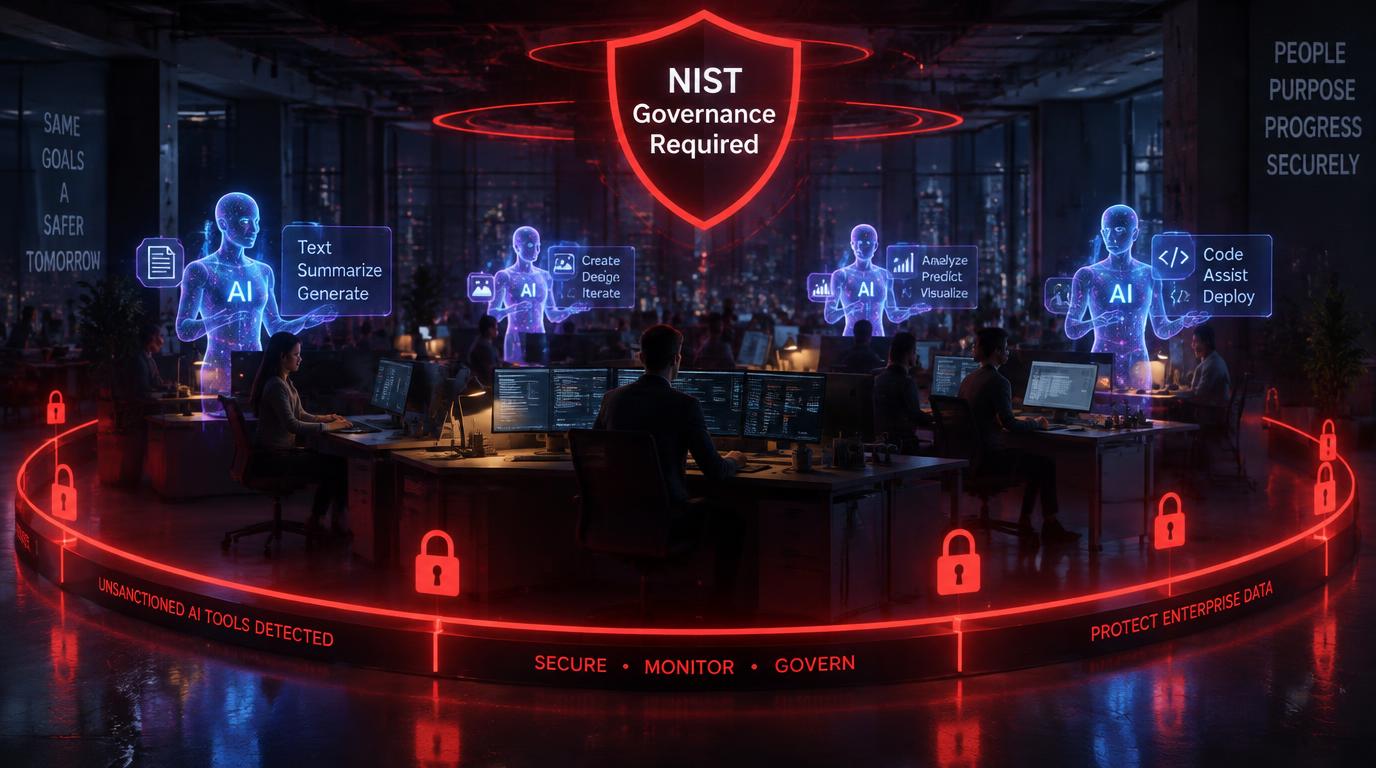
If teams already run unsanctioned AI tools on confidential data, adding official agents without governance will amplify the risk. NIST's AI RMF Core emphasizes govern and map functions precisely because ungoverned AI adoption creates compounding liabilities.
FAQ
For a single business unit with documented processes, two to three weeks is typical. For enterprise-wide evaluation across multiple systems and compliance domains, expect four to six weeks. The output should be a scored assessment, a priority roadmap, and a clear go/no-go boundary.
You do not need perfect data, but you need known data. “Known” means you can quantify error rates, identify root causes, and define acceptance criteria. If you have never measured data quality, cleaning is your first milestone, not a background task.
Yes, but choose a pilot that touches systems with the most stable integration paths. Sometimes that means automating a process that uses a modern SaaS tool rather than the oldest mainframe. Use the pilot to prove value and fund legacy integration separately.
Workflow tools like Zapier or traditional RPA follow fixed rules: if A happens, do B. Agents handle variability. They can reinterpret a request, ask clarifying questions, and choose between multiple paths based on context. That flexibility requires more sophisticated data, governance, and monitoring.
A common rule of thumb is to allocate 30% to 50% of the initial build budget annually for LLMOps, monitoring, model updates, and integration maintenance. Agents are not deploy-and-forget software. They are evolving systems that need care.