


Most enterprises will not choose purely between building or buying AI agents. The real decision is where to draw the line. Off-the-shelf platforms ship faster and reduce engineering risk, but they limit control over model choice, data flow, and compliance boundaries. Custom-built agents offer full ownership but require ML engineering talent, LLMOps infrastructure, and ongoing maintenance that most companies underestimate.
The hybrid approach—buying the orchestration layer and building the domain-specific logic—is increasingly the pragmatic default for mid-market and enterprise teams. The framework below will help you decide which path fits your constraints.
Three Paths: Off-the-Shelf Platforms, Custom-Built Agents, and Hybrid
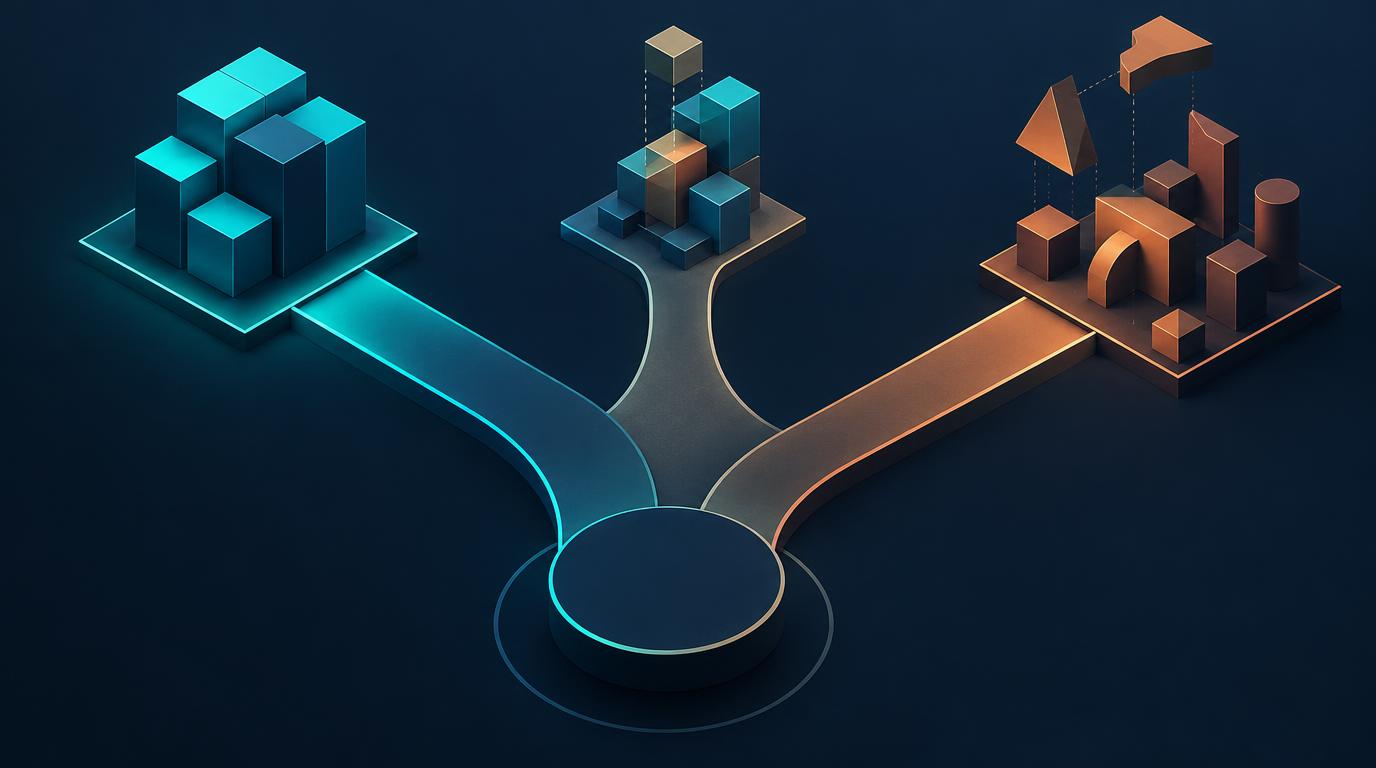
Before comparing costs and trade-offs, it helps to define what each path actually means in practice.
Off-the-Shelf AI Agent Platform
A vendor-managed service that provides pre-built agent templates, tool integrations, monitoring dashboards, and hosting. Examples include Microsoft Copilot Studio, Salesforce Agentforce, and emerging agent-native platforms. You configure the agent, connect it to approved APIs, and deploy within the vendor’s ecosystem. The vendor owns the infrastructure, model serving, and often the security boundary.
Custom-Built AI Agent
Software that your engineering team designs, trains if needed, deploys, and maintains. You choose the model, write the tool definitions, manage the vector store, build the evaluation pipeline, and own the security architecture. This path is not simply “using OpenAI API.” It is building a production system around that API with retries, observability, guardrails, and cost controls. Our AI Agent Development services cover exactly this end-to-end process, from architecture through deployment.
Hybrid Approach
Combines both. You buy the orchestration, authentication, and monitoring layer from a platform vendor, but you build custom tools, domain-specific prompts, and proprietary evaluation logic on top of it. This is the model behind many enterprise agent deployments that actually reach production.
Comparison Table
| Criterion | Off-the-Shelf Platform | Custom-Built Agent | Hybrid Approach |
|---|---|---|---|
| Time-to-market | Weeks | 3 to 9 months | 1 to 3 months |
| Model choice | Limited to vendor-approved models | Full control; swap models as needed | Moderate; platform constrains but custom layer adapts |
| Data flow | Passes through vendor systems | Fully self-hosted or private cloud | Mixed; orchestration via vendor, logic on-premise |
| Total cost of ownership | Predictable subscription, scaling fees hidden | High upfront, lower marginal at scale | Moderate upfront, balanced ongoing |
| Security and compliance | Depends on vendor certifications | Fully auditable, customizable | Segmented; sensitive data stays internal |
| Scalability | Auto within vendor limits | Needs dedicated infra planning | Platform handles elastic load; custom layer needs tuning |
| Vendor lock-in | High; rebuild to migrate | None | Moderate; replaceable with effort |
| Best for | Standard use cases, fast pilots, limited AI engineering staff | Unique workflows, strict compliance, proprietary models | Most enterprise production deployments |
When an Off-the-Shelf Platform Is the Right Choice
Buy when speed matters more than differentiation. If your use case is a standard customer support triage agent, a sales qualification bot, or an internal HR helpdesk assistant, the odds are high that a platform vendor has already solved 80% of your problem.
Gartner predicts that 40% of enterprise applications will feature task-specific AI agents by 2026 (up from less than 5% in 2025), which means the platform ecosystem is maturing quickly.
Off-the-shelf platforms also make sense when your internal AI engineering capacity is thin. Building a production agent requires more than a developer who knows Python. You need prompt engineers, ML ops specialists, security reviewers, and product managers who understand probabilistic systems. If you do not have that team in place, a platform lets you start learning without building the foundation from scratch.
Another reason to buy is when your data residency and compliance requirements align with what major vendors already offer. If your industry accepts SOC 2, ISO 27001, and GDPR-compliant cloud hosting, a platform like Microsoft or Salesforce may already meet your needs. You gain auditability without building it yourself.
The risk is assumption creep. A platform that works for a simple FAQ agent may not handle multi-step procurement approval with conditional routing across three internal systems. When your workflow starts to look more like a custom application than a chatbot, platform limitations show up as workarounds, not features.
When Custom-Built Agents Make Sense
Build when the agent is a competitive differentiator, not a utility. If your trading desk uses a proprietary risk model, if your pharmaceutical company runs drug interaction checks against internal research data, or if your legal team operates under jurisdiction-specific precedent rules that no public model was trained on, then an off-the-shelf platform will give you generic answers where you need precise ones.
Custom building is also the right choice when compliance boundaries are non-negotiable. Financial services, healthcare, and defense contractors often cannot send sensitive data to third-party LLM providers, even under enterprise contracts. AWS documentation on agentic AI security explicitly warns that autonomous tool invocations and data-rich prompt engineering create new attack surfaces that traditional application security models were not designed to handle. A custom deployment lets you keep prompts, context, and model weights entirely within your network perimeter.
Control over model selection is another build driver. Platform vendors typically offer a narrow menu of models. If you need to run a fine-tuned Llama 3 behind your firewall, or if you want to A/B test Claude, GPT-4, and a domain-specific small model in parallel, a custom architecture is the only path. Our LLM development services help teams select, fine-tune, and deploy models that match their data and latency constraints rather than accepting whatever a platform default provides.
The downside is maintenance. Forrester’s Total Economic Impact research on Microsoft’s agentic AI solutions shows that the hidden cost of custom automation is not the build; it is the ongoing engineering required to keep systems current. When OpenAI releases a new API version, when your vector database vendor changes pricing, or when your security team mandates a new key rotation policy, your custom agent needs immediate attention. Platforms absorb some of that shock for you.
When a Hybrid Approach Wins
In our experience, the hybrid model is the most common path to production for enterprises that have moved past the pilot stage. You buy the orchestration layer, the authentication framework, the audit logging, and the monitoring dashboard from a platform. Then you build the parts that matter: the custom tools that call your internal APIs, the proprietary prompts that encode your business logic, and the evaluation suite that proves the agent behaves correctly on your data.
A healthcare technology company we worked with used this approach for a clinical documentation agent. They bought an orchestration platform for session management, user authentication, and audit trails because those are solved problems. Then they built a custom retrieval layer over their internal medical ontology, a fine-tuned summarization model trained on their own physician notes, and a set of compliance guardrails that no generic platform offered. The result was faster time-to-market than a fully custom build, with the domain precision that an off-the-shelf product could not provide.
The hybrid approach also reduces vendor lock-in. If your custom logic is cleanly separated from the platform’s orchestration layer, you can migrate to a different orchestrator without rebuilding your tools or retraining your evaluation suite. Our AI model integration services focus on exactly this separation: connecting the models you have chosen into your infrastructure while keeping the domain layer portable.
Decision Framework: Five Questions to Choose Your Path
Use this sequence to narrow down the right approach for your organization.
Q1: Is your use case standard enough that a vendor has already built a template for it?
- Yes → Start with an off-the-shelf platform.
- No → Go to Q2.
Q2: Does sensitive data need to stay entirely within your infrastructure?
- Yes → Custom build or hybrid with self-hosted models.
- No → Go to Q3.
Q3: Do you have ML engineering and LLMOps talent in-house?
- Yes → Custom build or hybrid is feasible.
- No → Buy a platform or engage a development partner.
Q4: Is the agent a core differentiator or a support utility?
- Core differentiator → Custom build or hybrid.
- Support utility → Buy a platform.
Q5: Do you need to launch within 60 days?
- Yes → Buy a platform or use a hybrid approach with heavy platform reliance.
- No → Custom build becomes realistic.
Interpreting the Results
If you answered “buy” to three or more questions, an off-the-shelf platform is the pragmatic starting point. If you answered “custom” to three or more, the long-term benefits of ownership likely outweigh the build cost. If your answers were mixed, the hybrid approach is almost certainly your best fit.
If you are unsure whether your organization is ready to support any of these paths, start with our AI agent readiness assessment to evaluate your data, integration, and organizational foundations first.
Hidden Costs and Risks to Watch in Each Approach
Every path has costs that do not appear in the initial vendor quote or the first sprint estimate.
Off-the-Shelf Platform Risks
Vendor lock-in is the most obvious. When your agent logic, tool configurations, and conversation history live inside a proprietary platform, migrating away means rebuilding from scratch. Pricing surprises are another issue. Many platforms charge per conversation, per tool call, or per token. A pilot that handles 1,000 interactions per month may look affordable. At 100,000 interactions, the same architecture can become a budget problem. Finally, platform agents inherit the vendor’s security model. If the vendor suffers a breach or changes its data handling policy, your compliance posture changes without your consent.
Custom-Built Agent Risks
The hidden cost is operational. AWS’s Well-Architected Agentic AI Lens notes that without proper logging and traceability, agent actions cannot be investigated or attributed, which creates compliance and liability gaps that only show up under audit. Custom agents also suffer from model drift. A prompt that works well in January may produce worse results in June as underlying models update. Without an evaluation pipeline, you will not know until users complain. Talent risk is real too. If your lead ML engineer leaves, a custom agent can become unmaintainable quickly.
Hybrid Approach Risks
The danger here is interface complexity. You now have two systems to monitor, two security models to audit, and two vendors to coordinate during incidents. When a tool call fails, is it the platform’s orchestration layer or your custom logic? Debugging across boundaries takes longer than debugging a single system. The hybrid approach also requires clear architectural ownership. Without it, teams blame the platform vendor for issues that are actually in the custom layer, and vice versa.
FAQ
Q: How long does it take to build a custom AI agent? A: A functional prototype can be ready in 4 to 6 weeks. A production-ready custom agent with observability, guardrails, security review, and integration testing typically takes 3 to 9 months, depending on the number of tools and the complexity of your data.
Q: What is the typical cost difference between buy and build? A: An off-the-shelf platform often starts at $2,000 to $5,000 per month for enterprise tiers. A custom-built agent may cost $150,000 to $400,000 in initial development, plus $5,000 to $15,000 per month in infrastructure and model costs. The crossover point usually happens at scale. If you process millions of interactions, custom can become cheaper per unit. At lower volumes, buying is almost always more cost-effective.
Q: Can I switch from a platform to a custom build later? A: Yes, but it is painful. The migration cost depends on how cleanly your business logic is separated from the platform’s configuration. If your prompts, tool definitions, and evaluation criteria are documented and portable, the transition is manageable. If they are buried in a vendor’s no-code interface, you are effectively rebuilding.
Q: Is a hybrid approach more secure? A: It can be, but only if architected correctly. The hybrid model lets you keep sensitive data and proprietary logic inside your perimeter while using a vendor for orchestration. However, every connection point between your system and the platform is a potential attack surface. Security is not automatic; it must be designed into the integration layer.
Q: When should I bring in an external partner? A: If you have a clear use case but lack the ML engineering, security, or product management capacity to execute it, a development partner can bridge the gap. This is especially true for hybrid approaches, where you need both platform expertise and custom engineering skill. Our technology consulting team helps enterprises make this decision before any code is written, so you do not discover a skills gap halfway through the project.