



API-first development used to be a nice-to-have, the kind of architectural ideal that got mentioned in planning meetings and then quietly abandoned once a deadline got close. Most teams still build APIs as an afterthought — they ship a working frontend, wire it to a backend that grew organically, and then bolt on an API layer when a partner or mobile app finally needs one. The result is a tightly coupled, brittle system where every new integration means renegotiating internal contracts that were never really contracts in the first place.
This guide is a blueprint for doing it the other way around: treating the API as the actual product, designing the machine-to-machine contract before a single line of backend logic exists, and building an architecture that supports parallel development velocity instead of fighting it. We’ll walk through OpenAPI contract design, the governance problems that come with scaling API-first across teams, the multi-protocol decisions every SaaS platform eventually has to make, and the authorization and testing frameworks that keep all of it from falling apart in production.
Deconstructing API-First Architecture: Contract as the Source of Truth
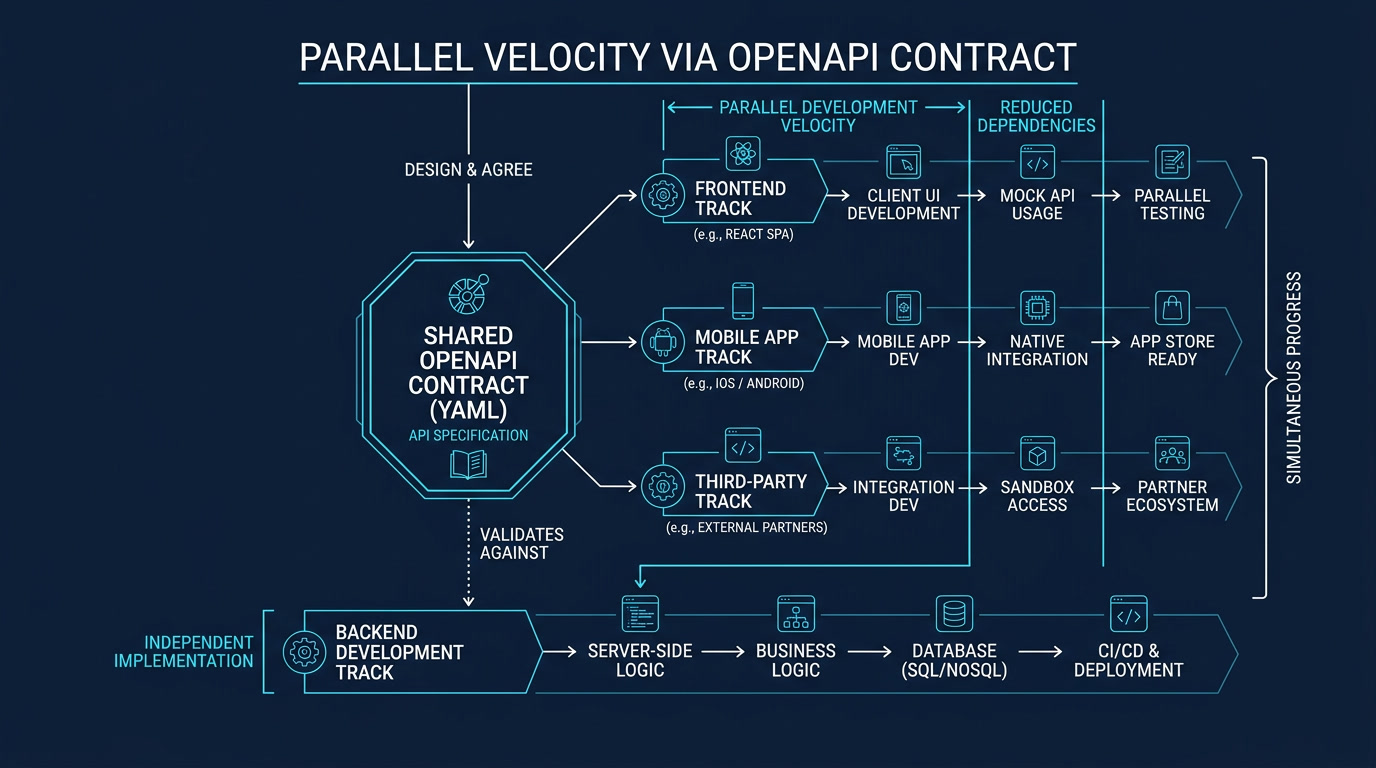
API-first doesn’t mean “we wrote OpenAPI docs after the fact so external partners would stop asking.” It means the interface definition is the first artifact your team produces, full stop. Before backend engineers open an IDE, before frontend developers pick a state management library, there’s an agreed-upon contract that describes every endpoint, every request and response shape, every error state.
In practice this happens through an OpenAPI 3.1.1 specification — the current version that finally aligns fully with JSON Schema, which matters more than it sounds like it should. Earlier OpenAPI versions used a JSON Schema dialect with enough quirks that tooling vendors had to write custom adapters. 3.1.1 means the same schema definition can drive request validation, generate a mock server, populate interactive documentation, and produce client SDKs, all from one source file instead of four slightly-out-of-sync ones.
That single source of truth is what unlocks real parallelism. Once the API contract design is locked, a mock server can be spun up from the spec in minutes (tools like Prism do this directly from an OpenAPI file). From that point forward:
- Frontend and mobile teams build against the mock server and ship real UI work without waiting for a single backend endpoint to exist
- Third-party integration partners start their implementation the same day the contract is published, rather than after a beta release
- Backend engineers implement the actual logic on their own timeline, constrained only by the contract they already agreed to
Nobody is blocked on anybody else. That’s the entire point, and it’s the reason teams pursuing this approach often pair it with a broader SaaS consulting engagement early on — getting the contract right before development starts is a much cheaper mistake to fix than catching it six sprints in.
The Business and Engineering Benefits of API-First SaaS
Time-to-market, without the backend bottleneck
The classic failure mode in API-last shops is the “waiting on the endpoint” Slack thread that drags on for two weeks. A frontend engineer needs a field the backend hasn’t exposed yet, files a ticket, and sits in a queue behind unrelated priorities. Multiply that across a team of any size and you get a development cycle where calendar time has almost nothing to do with actual engineering effort.
When the contract exists upfront, that bottleneck disappears structurally — there’s no endpoint to “wait on” because the shape of every endpoint was already agreed to before sprint planning started.
Future-proofing for AI agents
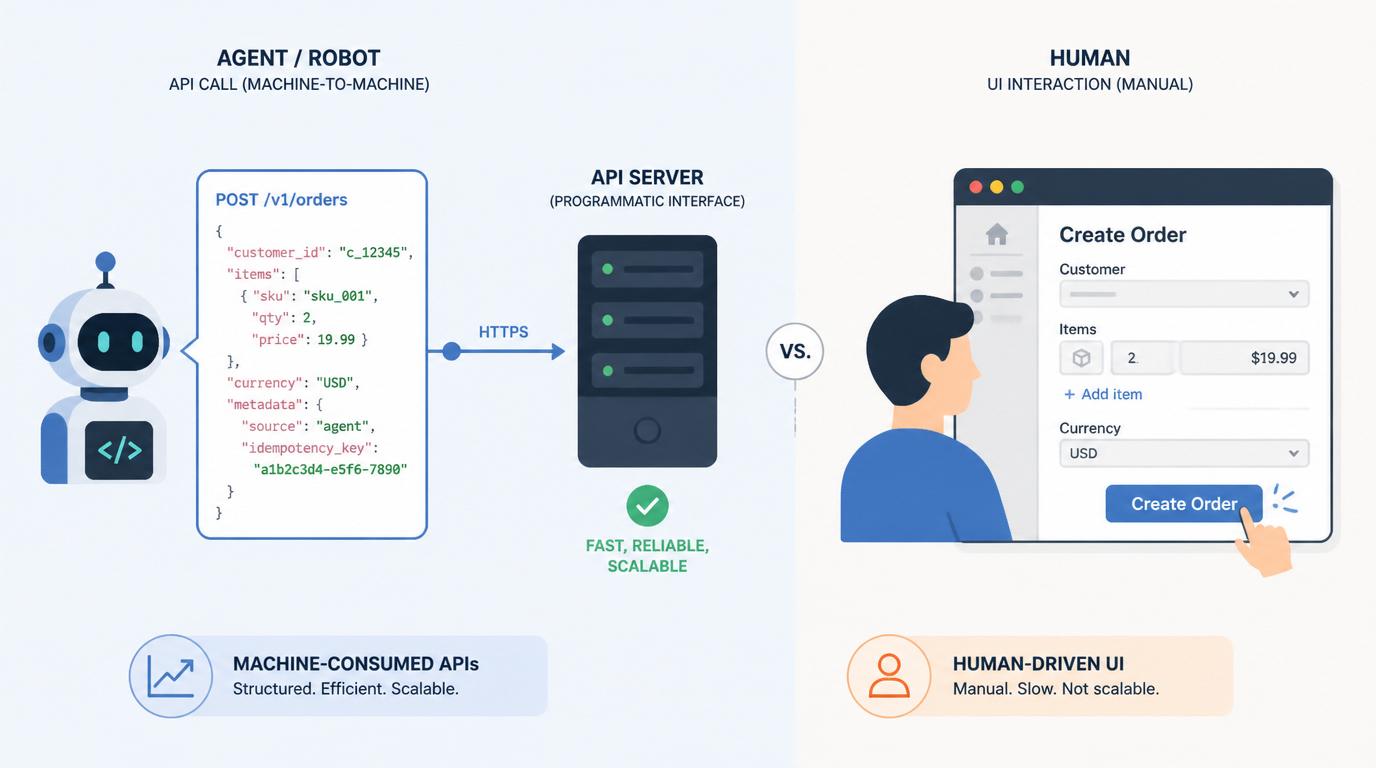
This is the part that’s become non-negotiable rather than optional over the last couple of years. Autonomous AI agents — the kind built on frameworks like LangChain, or anything doing tool-calling against your platform — don’t read your marketing copy or click through your UI. They consume your API directly, and they need it to be deterministic, well-documented, and predictable in a way human users tolerate poorly-documented systems for but machines simply cannot.
An agent trying to call an endpoint with an ambiguous parameter name, an undocumented required field, or inconsistent error formats will either fail outright or — worse — succeed in a way you didn’t intend. Clean OpenAPI contracts aren’t just developer experience anymore; they’re the only viable interface for an ecosystem where a growing share of your “users” are AI agents executing multi-step workflows. We’ve written more on this shift in AI agent development if you want to go deeper on the agent-tooling side specifically.
Designing for low TTFFC
Time to First Finished Call (TTFFC) is the metric that tells you whether your API is actually usable, as opposed to merely documented. It measures how long it takes a new developer — internal or external — to go from “I have an API key” to “I successfully made one real call and got the response I expected.”
High TTFFC kills developer adoption quietly. Nobody files a complaint; they just stop trying. Lowering it usually comes down to a short list of concrete fixes:
- An interactive sandbox where developers can fire test requests directly from the docs, no Postman setup required
- Auto-generated SDKs in the languages your developer base actually uses, kept in sync with the spec automatically
- Realistic example payloads in the docs instead of
{"foo": "bar"}placeholders that explain nothing - Clear, consistent error responses that tell a developer exactly what they got wrong on the first failed call
Overcoming the Friction: Key Architectural Challenges
API-first isn’t free. It trades one set of problems for a different, more manageable set.
Governance gets harder before it gets easier. Once five engineering teams are all designing endpoints against the same standard, you need someone — or some automated linting layer — enforcing naming conventions, pagination patterns, and error formats consistently. Without that, you end up with five dialects of REST that technically all conform to OpenAPI but disagree with each other constantly.
Versioning is where most of the real pain lives. Every schema change is a potential breaking change for someone downstream, and at SaaS scale “someone downstream” might mean dozens of partner integrations you don’t have visibility into. The common mitigations — semantic versioning on the API itself, path-based version isolation (/v1/, /v2/), and additive-only changes within a major version — all work, but they require discipline that’s easy to skip under deadline pressure.
Distributed debugging gets genuinely harder. A request that used to be a single function call inside a monolith now traces through three or four services, each with its own logs, each potentially on a different deploy cadence. Without proper distributed tracing in place, a five-minute bug investigation becomes a half-day archaeology project. This is one of the more common gaps we see when reviewing existing scalable SaaS architectures — teams adopt microservices for the scaling benefits and underinvest in the observability tooling that makes them debuggable.
Modern Protocol Selection: REST vs. GraphQL vs. gRPC
There isn’t a single correct protocol anymore, and pretending otherwise just means picking the wrong tool for half your use cases. Most mature SaaS platforms run a hybrid: REST for public-facing contracts, GraphQL where frontend flexibility matters most, and gRPC where internal latency is the binding constraint.
| Protocol | Primary Best Use Case | Performance / Latency | Serialization Strategy | Key Trade-off |
|---|---|---|---|---|
| REST (OpenAPI) | Public APIs, third-party integrations, AI-agent tool-calling | Moderate — HTTP/1.1 or 2 overhead | JSON (human-readable) | Simple and universally understood, but over/under-fetching is common |
| GraphQL (Federation) | Frontend data aggregation across multiple services | Moderate — single round trip, but resolver complexity adds latency | JSON, client-defined query shape | Huge frontend flexibility, but query complexity needs server-side guardrails |
| gRPC | Internal microservice-to-microservice calls | High — binary protocol over HTTP/2 | Protocol Buffers (binary) | Excellent performance, but not human-readable and harder to debug ad hoc |
The pattern we recommend most often: expose REST at the edge because it’s the protocol every external consumer (including AI agents) can reason about without custom tooling, use GraphQL Federation where a frontend team needs to stitch data from several internal services into one screen without making five separate calls, and keep gRPC strictly internal where the consumers are services you control and binary serialization’s debugging cost is worth the latency win.
Best Practices for Implementation and Production Hardening
Contract-first testing
The OpenAPI spec is worthless as a source of truth if the actual running code is allowed to drift from it. Contract-first testing closes that gap by wiring tools like Schemathesis or Prism directly into CI/CD — every pull request gets validated against the spec automatically, and a deploy that introduces an undocumented field or removes a documented one fails the build before it ever reaches staging. This is the mechanism that actually enforces everything discussed above; without it, “API-first” degrades back into “API-first for the first two sprints, then whatever happens, happens.”
Hardening authorization
OAuth 2.1 compliance has become the practical baseline for any SaaS platform handling sensitive data, and the headline change from 2.0 is that PKCE (Proof Key for Code Exchange) is now mandatory for all client types, not just mobile and SPA clients as a recommendation. Combine that with tiered, per-client rate limiting and you close off two of the most common API abuse vectors — token interception and brute-force endpoint hammering — without adding meaningful friction to legitimate developers. Teams handling regulated data often pair this work with a dedicated cybersecurity review before launch, particularly when the API surface touches financial or healthcare workflows.
Documentation that updates itself
Manually maintained API docs are stale within a month, every time, without exception. The fix isn’t more diligence — it’s automation: generate the developer portal directly from the OpenAPI spec on every deploy, so the documentation a developer reads is mechanically guaranteed to match the code that’s actually running. Anything less and you’re back to the support tickets where the docs say one thing and the API does another.
Conclusion: The Operational Checklist
Moving a team to API-first isn’t a single decision — it’s a sequence of smaller ones that compound. If you’re starting that transition, this is roughly the order that works:
- Draft the OpenAPI 3.1.1 contract before any backend code is written, and get sign-off from every consuming team (frontend, mobile, partner integrations)
- Stand up a mock server from that spec so parallel development can start immediately
- Wire contract-first testing into CI/CD so the spec and the implementation can never silently diverge
- Decide your protocol mix deliberately — REST at the edge, GraphQL for frontend aggregation, gRPC for internal calls — rather than defaulting to one protocol everywhere
- Move authorization to OAuth 2.1 with mandatory PKCE and tiered rate limiting before you have a security incident, not after
- Automate documentation generation so the developer portal is never the thing that’s out of date
None of this is exotic engineering. It’s mostly discipline, applied early, before the system has enough surface area for the shortcuts to become expensive. Teams that get this right end up with a platform that’s actually ready for where the industry is headed — including the growing share of API consumers that are AI agents rather than humans clicking through a UI. If you’re evaluating where your current architecture stands against this, our custom application development team has worked through this exact transition with several SaaS platforms and can point out where the gaps actually are.