



AI is redefining financial services by improving fraud detection, credit decisions, investment strategies, and customer experiences. Financial institutions that embrace AI are building faster, safer, and more personalized products.
Why AI Is Reshaping Financial Services

Four pressures are converging on banks, lenders, and wealth managers at the same time, and none of them are optional to respond to. Customer expectations have shifted toward instant decisions — a loan approval that takes three days feels broken to someone who just got a same-second checkout approval from a retailer. Operational cost pressure has pushed institutions to automate work that used to require entire underwriting or fraud-review teams. Regulators are demanding faster, more accurate AML and KYC screening without slowing down legitimate customers. And the sheer volume of financial data — transaction streams, alternative credit signals, unstructured market commentary — has outgrown what rules-based systems were ever built to process.
AI financial services sit at the intersection of these pressures. Digital banking platforms that once differentiated on interface design now compete on decision quality: who approves the right loan faster, who catches the fraudulent transaction without blocking the legitimate one, who builds the portfolio that actually matches a client’s stated risk tolerance. That shift from interface to intelligence is the throughline connecting payments, lending, and wealth management, even though each discipline applies AI differently — a pattern covered in more depth in this breakdown of current fintech app development trends.
AI in Modern Payment Systems
Payment fraud detection was rules-based for decades: if a transaction matched a known bad pattern, block it. That approach breaks down against fraud that evolves faster than a rules team can update a ruleset. AI payments infrastructure replaces static rules with models that learn continuously from new transaction data, catching patterns a human analyst would never think to write a rule for.
Three capabilities define this shift:
- Real-time fraud detection and risk scoring. Machine learning models evaluate hundreds or thousands of signals per transaction — device fingerprint, geolocation, purchase history, behavioral anomalies — and return a risk score before the transaction completes.
- Intelligent payment routing. Rather than sending every transaction through a single fixed path, routing models select the processing path most likely to result in approval, based on issuer behavior, network conditions, and historical success rates for similar transactions.
- Personalized payment experiences. Payment intelligence extends into checkout itself — surfacing the payment method most likely to convert for a given customer, or adjusting authentication friction based on real-time risk rather than applying the same static flow to every user.
Case in point: Stripe Radar evaluates over 1,000 signals about a transaction and returns a fraud decision in under 100 milliseconds, reaching the correct verdict on 99.9% of the billions of legitimate payments it processes. That level of precision matters because online payment fraud occurs in roughly 1 out of every 1,000 transactions — the model has to find a genuinely rare signal inside an overwhelming volume of normal activity, fast enough that it never becomes the reason a legitimate customer abandons checkout. Stripe pairs that fraud layer with intelligent routing designed specifically to maximize approval rates rather than just minimize fraud loss, treating the two as a single optimization problem instead of two separate systems fighting each other. Teams evaluating a fintech software development partner for a payments build should ask specifically how fraud scoring and routing logic are architected together, not as separate line items.
Payments AI Workflow Diagram
TRANSACTION INITIATED
|
v
+——————-+
| Signal Collection | (device, geo, history, behavior)
+——————-+
|
v
+——————-+
| ML Risk Scoring | (<100ms decision window)
+——————-+
|
+—–+—–+
| |
v v
LOW RISK HIGH RISK —–> Step-up auth / 3DS / decline
|
v
+———————+
| Intelligent Routing | (path selected for approval likelihood)
+———————+
|
v
TRANSACTION APPROVED
| Dimension | Traditional (Rules-Based) Payments | AI-Powered Payments |
|---|---|---|
| Fraud detection method | Static rule sets, manually updated | Continuously learning ML models |
| Decision speed | Often batch or near-real-time | Sub-100ms, in-line with checkout |
| Adaptability to new fraud patterns | Slow — requires manual rule authoring | Fast — retrains on new data automatically |
| False positive rate | Typically higher, blunter thresholds | Lower, precision-tuned scoring |
| Routing logic | Fixed processing path | Dynamic, approval-optimized routing |
| Personalization | Uniform experience for all users | Risk- and behavior-adjusted friction |
How AI Is Transforming Lending
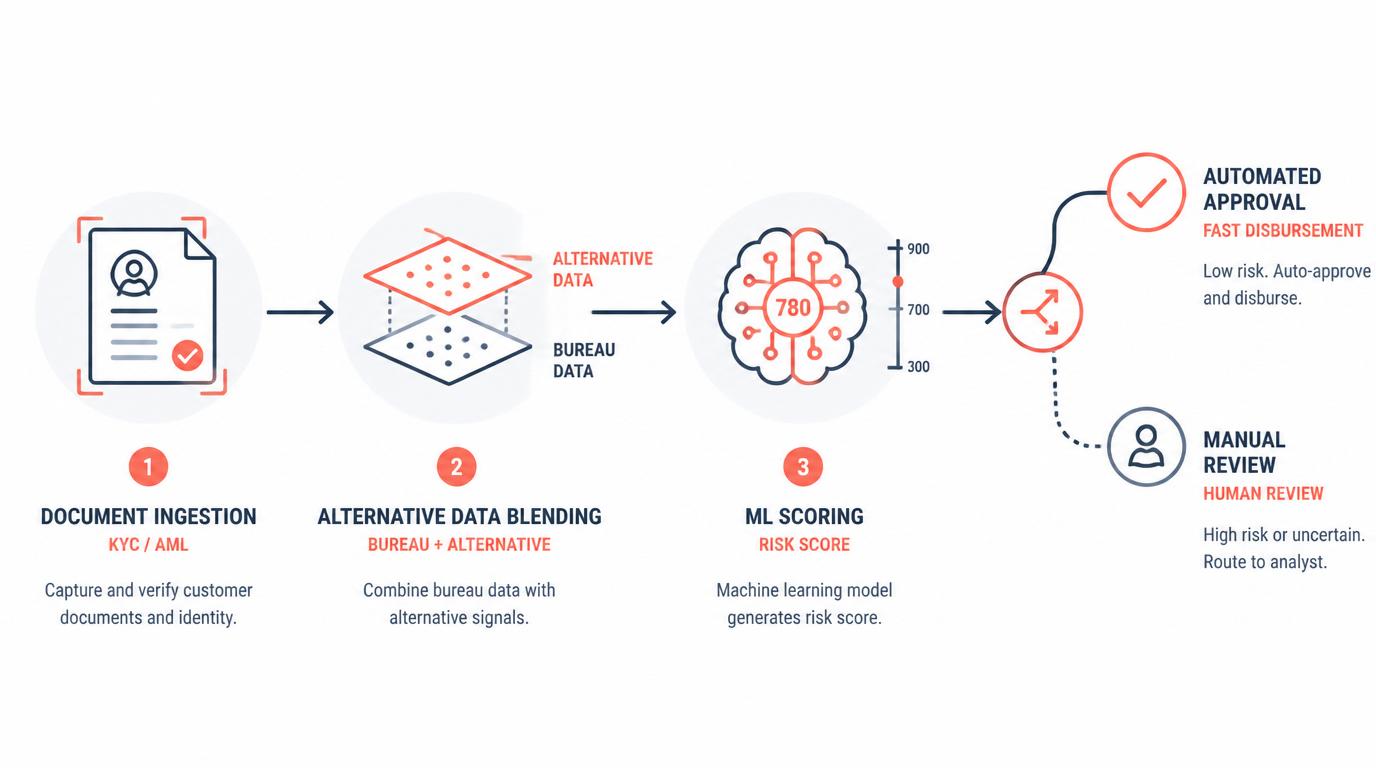
Traditional credit scoring leans almost entirely on a narrow band of inputs — credit bureau history, income verification, debt-to-income ratio. That model works reasonably well for borrowers with an established credit history and fails almost completely for the “thin file” population that has none. AI lending expands the input space dramatically, pulling in alternative data — transaction patterns, cash flow behavior, even SKU-level purchase data — to build a credit risk AI picture that’s both more inclusive and, done well, more accurate than the traditional model it replaces.
The core capabilities driving this shift:
- Alternative data credit scoring — incorporating cash flow, spending behavior, and transaction-level data rather than relying solely on bureau history.
- Automated underwriting — compressing what used to be a multi-day manual review into a real-time decision at the point of transaction.
- Default prediction modeling — continuously retrained models that flag deteriorating repayment risk before it shows up in a missed payment.
- Document automation for KYC/AML — using ML-driven document parsing and identity verification to cut manual review time without weakening compliance rigor.
Case in point: Klarna’s underwriting model illustrates what this shift looks like at scale. Klarna’s US credit losses fell from 9.6% in 2019 to just 1.1% in 2024, a reduction the company attributes directly to machine learning models built on a proprietary dataset that included more than 2.5 billion SKU-level data points collected in 2024 alone. Unlike a traditional card issuer that underwrites once at account opening, Klarna’s model makes a fresh, real-time underwriting decision on every individual transaction — a structurally different approach to credit risk AI than a single static credit-limit decision made months or years before the purchase in question. Lenders building this kind of real-time decisioning into a new digital product often face the same core-integration questions covered in this guide to building a neobank app.
Lending Decision Flow
LOAN APPLICATION SUBMITTED
|
v
+————————+
| Document Ingestion & |
| KYC/AML Automation |
+————————+
|
v
+————————+
| Alternative Data Pull | (cash flow, transaction history,
| + Bureau Data | behavioral signals)
+————————+
|
v
+————————+
| ML Risk Scoring Model |
+————————+
|
+—–+—–+
| |
v v
APPROVED REFERRED TO
| MANUAL REVIEW
v |
FUNDS RELEASED v
APPROVE / DECLINE
| Dimension | Traditional Scoring | AI-Driven Alternative Scoring |
|---|---|---|
| Primary data source | Credit bureau history | Bureau data + cash flow, transactions, behavioral signals |
| Underwriting cadence | Once, at account opening | Real-time, per transaction |
| Thin-file / no-history applicants | Frequently declined by default | Scorable via alternative signals |
| Model update frequency | Periodic, manual recalibration | Continuous retraining on new data |
| Default prediction | Reactive (post-delinquency) | Proactive (pre-delinquency signal detection) |
AI in Wealth Management
Portfolio construction has historically been a relationship-driven, manually intensive process — an advisor reviewing a client’s stated goals, running them through a model portfolio, and rebalancing on a quarterly cadence. AI wealth management doesn’t replace the advisor relationship so much as it compresses the analytical layer beneath it: portfolio optimization, predictive market analytics, and hyper-personalized insights now run continuously rather than quarterly, and increasingly extend into thematic index construction that used to require a team of analysts reading news for weeks.
Key capabilities reshaping WealthTech:
- Portfolio optimization — continuous, model-driven rebalancing informed by real-time market data rather than fixed review cycles.
- Predictive market analytics — pattern recognition across market and alternative data sources to surface risk and opportunity signals earlier than manual analysis would catch them.
- Hyper-personalized client insights — tailoring commentary, risk framing, and recommendations to an individual client’s actual portfolio and stated goals, rather than generic market commentary sent to an entire client base.
- Automated robo-advisory — end-to-end portfolio management for segments where a human advisor relationship isn’t cost-effective, without abandoning personalization entirely.
Case in point: JPMorgan Chase’s IndexGPT uses OpenAI’s GPT-4 model to generate keywords associated with an investment theme, which are then fed into a separate natural language processing model that scans news articles to identify companies actively involved in that space. Rather than building thematic indexes around traditional industry sectors or company fundamentals, IndexGPT identifies investments based on emerging trends like cloud computing or cybersecurity — a process that used to depend on analysts manually tracking which companies were meaningfully exposed to an emerging theme. The generative approach reportedly produces more than twice as many relevant keywords as the software JPMorgan used previously, surfacing lesser-known companies that a narrower, manually curated keyword list would have missed entirely. JPMorgan’s internal AI research budget can still capture a version of this capability by working with a partner offering AI integration services for financial institutions rather than building the NLP pipeline from scratch.
Wealth Management AI Architecture
+———————-+
| Data Ingestion | (market data, news, filings,
| | client portfolio data)
+———————-+
|
v
+———————-+
| Vector DB / RAG | (internal knowledge base +
| Retrieval Layer | real-time market context)
+———————-+
|
v
+———————-+
| LLM Personalization | (client-specific insight
| Engine | generation, thematic analysis)
+———————-+
|
v
+———————-+
| Client Portfolio | (recommendations, rebalancing,
| Output Layer | thematic basket construction)
+———————-+
| Dimension | Manual Portfolio Construction | AI-Optimized Portfolio |
|---|---|---|
| Rebalancing cadence | Quarterly or on-demand | Continuous, model-driven |
| Thematic research | Manual analyst tracking | NLP-driven keyword and news analysis |
| Personalization depth | Segment-level (client tiers) | Individual client-level |
| Client insight generation | Standardized commentary | LLM-generated, portfolio-specific |
| Scalability | Bound by advisor headcount | Scales independent of headcount |
AI Infrastructure Behind Financial Products
None of the capabilities above run on a single model. Financial AI infrastructure is a layered stack, and institutions that treat it as one monolithic “AI system” tend to under-invest in the pieces that make it reliable:
- Large language models (LLMs) handle natural language tasks — client communication, document summarization, thematic analysis — but need grounding to avoid hallucinating financial facts.
- Traditional machine learning models still do the heavy lifting for structured-data problems: fraud scoring, credit risk, default prediction. These remain more explainable and auditable than LLM-based approaches for regulated decisions.
- Retrieval-Augmented Generation (RAG) connects LLMs to an institution’s actual internal knowledge base — policy documents, product terms, historical case data — so generated output is grounded in verified, current information rather than the model’s training data alone.
- Real-time analytics pipelines feed both the ML scoring models and the RAG retrieval layer with current data, since a fraud model or a market-analytics engine is only as good as its most recent data point.
- Secure cloud data platforms underpin all of the above, since financial data governance requirements apply regardless of which model consumes the data. Getting this layered stack right from the start is largely a software architecture problem before it’s a model-selection problem.
Security, Compliance, and Responsible AI
AI compliance in financial services isn’t a separate workstream from the AI build itself — it has to be architected in from the start. Four requirements come up in nearly every regulated deployment:
- Automated AML/KYC systems need documented accuracy benchmarks, not just a vendor’s marketing claim, since regulators will ask for evidence during examination.
- Model governance requires a documented lifecycle — who approved the model, what data trained it, how often it’s retrained, and who’s accountable when it’s wrong.
- Explainable AI (XAI) matters most for credit and lending decisions specifically, where a declined applicant has a legal right to understand why, and “the model said so” isn’t an acceptable answer under existing fair-lending regulation.
- Data privacy regulation compliance has to account for how training data, RAG retrieval sources, and generated outputs each carry their own data handling obligations — treating them as a single compliance surface tends to miss gaps.
Responsible AI in this context isn’t a marketing position. It’s the difference between a model that survives a regulatory examination and one that triggers a consent order.
Challenges of AI Adoption
The gap between a proof-of-concept model and a production financial AI system is where most projects stall. The recurring obstacles:
- Legacy core banking systems that weren’t built to expose the real-time data feeds modern ML models need, forcing institutions to build translation layers before the AI work can even start.
- Poor data quality and silos — a model is only as good as the data it trains on, and financial institutions frequently discover that their transaction data, customer records, and risk data live in systems that were never designed to talk to each other.
- Complex API integrations connecting AI systems to core banking, payment rails, and third-party data sources, each with its own authentication and data format requirements.
- Vendor lock-in risk when an institution builds critical decisioning logic entirely inside a single vendor’s proprietary platform, with no clear exit path if pricing or capability needs change. Pairing the build with independent cybersecurity consulting review early tends to surface this kind of lock-in risk before a contract is signed, not after.
- The specialized AI/FinTech talent gap — engineers who understand both modern ML architecture and financial services regulation are a genuinely scarce combination, and institutions competing against tech companies for that talent pool don’t always win.
AI implementation succeeds or fails on these unglamorous operational problems far more often than on model architecture choice.
The Future of AI in Financial Services
The next phase of AI in financial services moves past single-purpose models toward orchestrated systems that act with more autonomy. A few directions are already visible:
- Agentic AI workflows — systems that don’t just score a transaction but take the next action (initiating a fraud investigation, requesting additional documentation, adjusting a credit line) without waiting for a human to trigger each step.
- Increasingly autonomous finance operations — reconciliation, reporting, and routine compliance monitoring shifting from human-reviewed to AI-executed with human oversight at exception points only.
- Predictive operations — shifting from reactive monitoring (something broke, now fix it) to predictive intervention (this is about to break, act now).
- Highly specialized, industry-specific models — replacing general-purpose LLMs with models fine-tuned specifically on financial services data, regulatory text, and institution-specific policy, trading some general capability for materially better domain accuracy.
The future of fintech isn’t a single dramatic leap to full autonomy. It’s a steady expansion of the scope AI systems are trusted to act on without a human in the loop for every decision.
How Financial Institutions Should Prepare (The Action Plan)
Institutions that succeed with AI adoption tend to follow a broadly consistent sequence rather than trying to deploy everything simultaneously:
- Modernize enterprise data before investing heavily in models — a sophisticated model trained on fragmented, low-quality data underperforms a simple model trained on clean data almost every time.
- Build AI governance early, not after the first model is already in production, since retrofitting governance onto an existing deployment is materially harder than designing it in from the start.
- Prioritize high-value use cases — fraud detection and credit underwriting tend to deliver measurable ROI faster than more exploratory applications like generative client communication, and early wins fund the next phase of investment. A data analytics foundation built alongside the first pilot makes every subsequent use case faster to stand up.
- Scale incrementally while measuring ROI at each stage, rather than committing to an enterprise-wide rollout before the first use case has proven its value in production.
AI Maturity Roadmap
| Stage | Focus | Typical Duration |
|---|---|---|
| 1. Foundational Data Modernization | Consolidate data sources, resolve silos, establish data quality baselines | 3–9 months |
| 2. Pilot Use Case Deployment | Deploy AI on one high-value, well-scoped use case (e.g., fraud scoring) | 3–6 months |
| 3. Governance & Compliance Integration | Formalize model governance, XAI documentation, audit trails | Ongoing, starting in parallel with Stage 2 |
| 4. Cross-Functional Scaling | Extend proven models across lending, payments, or wealth management | 6–18 months |
| 5. Agentic & Autonomous Operations | Introduce AI-driven action-taking with human oversight at exceptions | 18+ months |
10-Question Checklist: Questions Before Investing in Financial AI
- Is the underlying data clean, consolidated, and accessible in real time?
- Does the use case have a clear, measurable ROI metric defined before deployment?
- Is there a documented model governance process, including retraining cadence?
- Can the model’s decisions be explained to a regulator or an affected customer?
- Has the compliance team reviewed the use case against applicable fair-lending and data privacy regulation?
- Does the institution have (or is it acquiring) the specialized talent needed to maintain the model, not just build it?
- Is there a fallback process if the AI system fails or produces a low-confidence output?
- Has vendor lock-in risk been assessed, including data portability and exit costs?
- Does the core banking and API infrastructure actually support the real-time data flow the model needs?
- Is there executive sponsorship to fund the project past the pilot stage if early results are promising?
Final Thoughts
AI in financial services has moved past being a competitive differentiator that early adopters could point to as an edge. It’s becoming foundational infrastructure — the layer payments, lending, and wealth management all run on rather than a bolt-on feature attached to legacy systems. Winning from here depends far less on which model an institution picks and far more on execution: clean data pipelines, governance built in from the start, and technical architecture — including the API integration layer connecting these AI systems to core banking — designed to scale past the first successful pilot. Institutions still treating AI as a series of isolated experiments are going to find themselves competing against ones that treated it as infrastructure from day one.
Frequently Asked Questions
How is AI used in payment systems? AI evaluates hundreds to thousands of transaction signals in real time to score fraud risk, route payments through the path most likely to be approved, and adjust authentication friction dynamically — replacing static rule sets that can’t adapt as fraud patterns evolve.
How does AI improve lending decisions? AI lending models incorporate alternative data — cash flow, transaction history, behavioral signals — alongside traditional bureau data, enabling real-time, per-transaction underwriting decisions and materially reducing default rates compared to static, bureau-only scoring models.
What is AI-powered wealth management? AI wealth management applies continuous portfolio optimization, predictive market analytics, and LLM-driven personalization to deliver insights and rebalancing that used to require manual, periodic advisor review — including generative approaches to thematic index construction.
Can AI reduce financial fraud? Yes. Modern fraud-detection models process far more signals than rules-based systems and adapt continuously to new fraud patterns, reducing both fraud losses and false-positive declines on legitimate transactions.
What are the risks of AI in financial services? The primary risks are poor model governance, lack of explainability for regulated decisions like credit denials, data privacy gaps across training and retrieval layers, and vendor lock-in on critical decisioning infrastructure.
How should banks prepare for AI adoption? Start with data modernization, pick a high-value pilot use case with a measurable ROI target, build governance in parallel rather than retrofitting it later, and scale incrementally based on proven results rather than an enterprise-wide rollout.
Will AI replace financial advisors? Not entirely. AI compresses the analytical and administrative layer beneath advisory relationships — continuous portfolio monitoring, personalized insight generation — but the relationship, judgment, and trust components of advisory work remain difficult to automate fully, particularly for complex or high-net-worth client relationships.