



Most banking executives will tell you they’ve “already done” open banking because their institution ships APIs to partners. That claim usually collapses under one follow-up question: who governs consent, and can a customer revoke it from a dashboard without calling a relationship manager? Having banking APIs and running an Open Banking program are not the same commitment, and conflating the two is how compliance teams get blindsided eighteen months into a PSD3 readiness project.
This guide draws the line precisely. It walks through the architectural, security, and regulatory differences that separate a proprietary, bilaterally-negotiated banking API from a regulated, standardized Open Banking interface — and where each one is still the right tool. What follows compares both models across the metrics that actually matter to a deployment decision, maps a standard consent and authorization flow end to end, unpacks the compliance landscape shaped by PSD3, the PSR, and FIDA, and closes with a decision framework enterprise buyers can apply without hiring an outside consultancy to translate it.
Why APIs Are Reshaping Financial Services

The API has quietly become the connective tissue of the financial sector. A decade ago, integrating a bank’s core system with an external partner meant a bespoke, multi-month project involving flat-file batch transfers, SFTP drops, and a small army of systems integrators. Today, that same integration is a REST or JSON-RPC call behind an API gateway, versioned, rate-limited, and monitored in near real time.
Three forces are driving this shift simultaneously:
- Customer expectations have moved past single-institution thinking. People increasingly want a single, consolidated view of checking, savings, brokerage, and credit accounts held across multiple providers — not four separate logins and four separate apps.
- Embedded finance has turned non-bank platforms into distribution channels. E-commerce checkouts, payroll platforms, and vertical SaaS tools now originate lending, payments, and account-opening flows that used to live exclusively inside a bank’s own app.
- Legacy core banking architecture can’t keep pace on its own. Mainframe-era cores were built for batch processing and internal consistency, not for exposing granular, low-latency, externally-consumable data streams.
The result is what’s commonly called the API Economy in financial services: a layered stack where APIs sit between rigid legacy cores and an expanding universe of consumer-facing and B2B applications. But “API Economy” is a description of the plumbing, not a strategy. The strategic question — who gets access, under what consent, and governed by which rulebook — is where traditional APIs and Open Banking APIs diverge sharply.
What Traditional APIs Are
A traditional API in a banking context is a private, bilaterally negotiated integration. One institution builds an interface, a specific partner integrates against it, and the terms — data scope, rate limits, liability, pricing — are settled contractually between two parties rather than dictated by a regulator or an industry standard body.
Characteristics that define this category:
- Custom by design. Each partner integration is its own project, often with partner-specific field mappings, authentication schemes, and error-handling conventions.
- Closed by default. Access is granted through a business development relationship and a signed agreement, not through self-service developer onboarding.
- Manual onboarding. Adding a new partner typically means a new technical review, a new security assessment, and a new contract cycle — weeks or months of lead time before the first API call goes live.
- No standardized consent layer. Data sharing permissions are usually governed by the underlying commercial contract rather than a customer-facing, revocable consent mechanism.
- Full architectural control. The issuing bank decides the schema, the versioning cadence, and the SLA — there’s no external standards body enforcing conformance.
This isn’t a legacy pattern destined for extinction. Traditional APIs remain the backbone of core-to-core integrations, internal microservices, and strategic partnerships — a co-branded credit card program with a single retail partner, for instance, or a payroll integration with one specific HR platform. The tradeoff is that every new relationship starts the integration clock from zero, which is a large part of why teams building a banking app from scratch tend to budget partner integration time separately from core product development.
What Open Banking APIs Are
Open Banking inverts that model. Rather than a bilateral contract, it’s a regulated, standardized interface that any authorized third party can connect to, gated not by a business development relationship but by regulatory authorization and explicit, revocable customer consent.
The regulatory architecture assigns roles precisely:
- ASPSP (Account Servicing Payment Service Provider): the bank or institution that holds the customer’s account and exposes the regulated interface.
- AISP (Account Information Service Provider): a third party authorized to read account data — balances, transaction history — with customer consent, typically to power aggregation, budgeting, or credit-risk tools.
- PISP (Payment Initiation Service Provider): a third party authorized to initiate a payment directly from the customer’s account, bypassing card rails entirely.
The regulatory foundation for this in the EU is shifting under everyone’s feet in 2026. PSD2 has governed the market since roughly 2018, following the Commission’s June 2023 proposal of a payment services package aimed at addressing PSD2’s shortcomings, including imperfect open banking functioning and continued fraud risk. That package produced two successor instruments rather than one. The new framework splits PSD2 into PSD3, a Directive governing authorization, governance, and supervision of payment institutions, and the PSR, a Regulation that applies directly and uniformly across all Member States without requiring national transposition. As of mid-2026, the Council and Parliament have agreed final texts, with Official Journal publication anticipated for June or July 2026, and the new rules generally applying around 21 months after that publication.
Open Banking’s next expansion — into full Open Finance — is the Financial Data Access framework, or FIDA. FIDA extends the open-banking model beyond payment accounts into savings, investments, pensions, insurance, and credit, introducing a new regulated category called the Financial Information Service Provider, or FISP. Unlike PSD3 and the PSR, FIDA is not yet finalized. As of April 2026, FIDA remains in trilogue negotiations, with its adoption timeline notably less certain than PSD3 and the PSR, and a realistic operational scenario places FIDA’s obligations coming into force sometime around 2029, though outcomes range from a faster best case to a scope-narrowed pessimistic case. Institutions building toward Open Finance readiness right now are, in effect, building against a moving regulatory target — which is precisely why the architectural decisions covered later in this guide favor modularity over hard-coded compliance logic. This is also the exact pressure point that shapes how a neobank platform gets architected from day one, since a digital-first bank has no legacy core to hide behind while these regulations settle.
Side-by-Side Comparison: Open Banking vs. Traditional APIs
| Dimension | Traditional APIs | Open Banking APIs |
|---|---|---|
| Governance / Standardization | Bank-defined; no external standards body | Regulator-mandated technical standards (e.g., Berlin Group NextGenPSD2, UK Open Banking Standard) |
| Authentication & Security | Varies by partner; often API keys or bilateral OAuth | Mandated OAuth 2.0 / OIDC with FAPI-grade security profiles and Strong Customer Authentication |
| Data Access Scope | Whatever the contract specifies, often broad | Narrowly scoped by consent, purpose-limited, time-bound |
| Interoperability | Low; each integration is bespoke | High; a single AISP/PISP integration can reach every ASPSP in scope |
| Regulatory Compliance | Governed by general data protection and contract law | Subject to sector-specific regimes: PSD2/PSD3, PSR, and (pending) FIDA |
| Scalability / Time-to-Market | Slow per new partner; fast once a relationship exists | Fast to reach new customers at scale; slower initial certification |
| Business Model / Monetization | Direct commercial negotiation, often flat fee or revenue share | Baseline access is typically free under regulatory mandate; monetization shifts to premium, value-added APIs (SPAA-style schemes) |
Enterprise buyers evaluating a fintech software development partner should walk through every row of this table with prospective vendors before signing a statement of work — a partner fluent in only one column tends to under-scope the other.
The monetization row deserves a second look, because it’s the one most CFOs get wrong first. Regulatory-mandate access — the data a bank is legally obligated to expose — generates no direct revenue by design. The commercial opportunity sits above that baseline, in premium APIs offering richer data, guaranteed uptime SLAs, or faster settlement than the regulatory minimum requires.
Security, Compliance, and the Consent Architecture
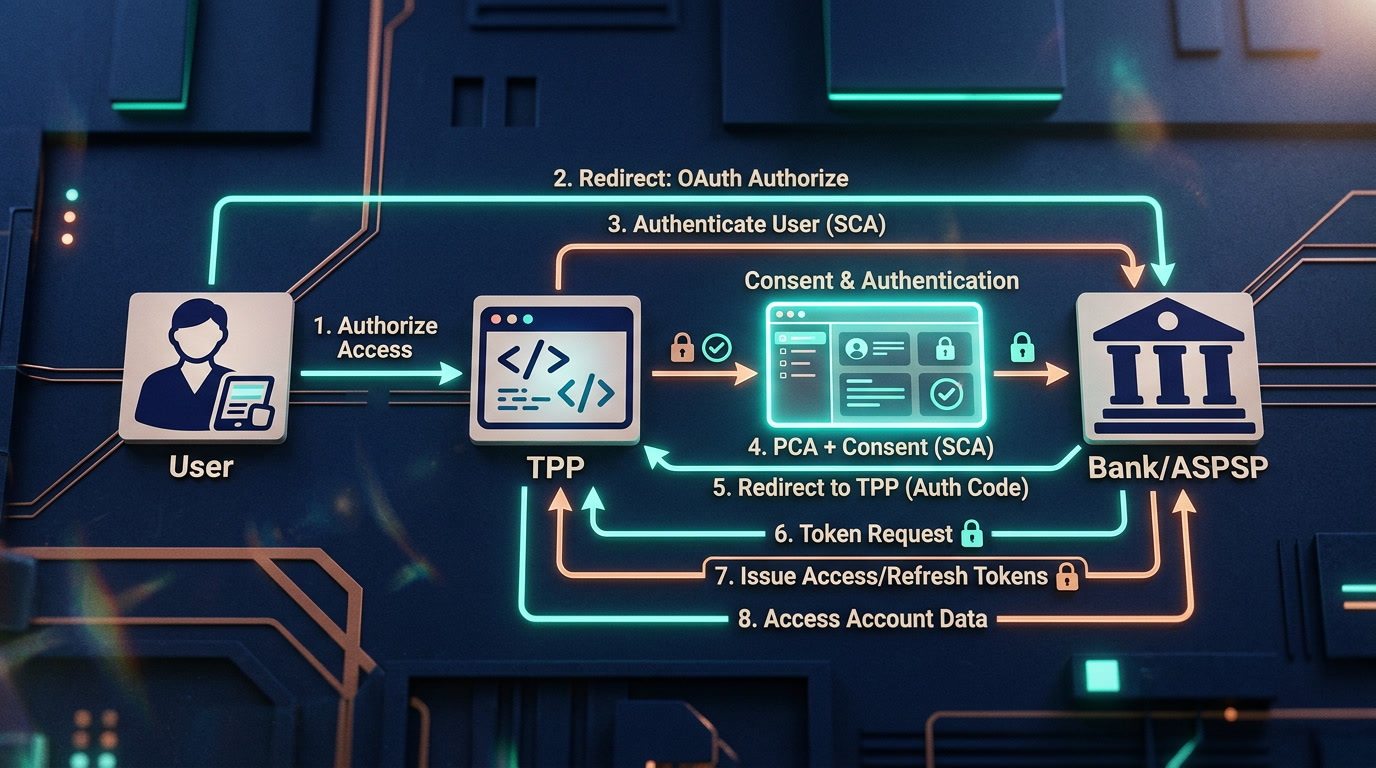
Open Banking’s credibility rests on having replaced a genuinely dangerous practice: screen scraping. Before regulated APIs existed, account aggregation tools obtained a customer’s actual online banking username and password, logged in as if they were the customer, and parsed the HTML response to extract balances and transactions. That approach handed a third party the customer’s full credentials, offered no way to scope access, and broke every time the bank changed its front-end markup.
Tokenized authentication replaced that model entirely. Instead of sharing credentials, the customer authenticates directly with their own bank, which then issues a scoped, revocable access token to the requesting third party. The bank never exposes the customer’s actual login credentials to anyone downstream.
Three technical layers make this work at banking-grade assurance:
- OAuth 2.0 handles the authorization delegation itself — the mechanism by which a customer grants a third party limited access without sharing a password.
- OpenID Connect (OIDC) sits on top of OAuth 2.0 to add a standardized identity layer, so the relying party can verify who the customer actually is, not just that some token was issued.
- Financial-grade API (FAPI) security profiles harden both of the above specifically for financial services, mandating stronger cryptographic requirements, mutual TLS or signed request objects, and tighter token lifetimes than a generic OAuth deployment would use.
On top of that authentication stack, regulators layer three operational requirements:
- Strong Customer Authentication (SCA) — multi-factor authentication is mandatory at key points in the consent and payment flow, not optional.
- Consent Management Dashboards — customers need a visible, self-service place to see exactly which third parties hold access to their data and revoke that access unilaterally, without contacting the bank.
- Auditability — every consent grant, token issuance, and data access event needs to be logged in a way that satisfies a regulator’s after-the-fact review, not just the bank’s own internal monitoring.
Getting this stack right the first time is generally cheaper than remediating it after a conformance audit fails, which is why most institutions bring in cybersecurity consulting expertise before the first FAPI-profiled endpoint goes live rather than after.
Here’s how those pieces fit together in a standard authorization flow:
USER TPP (AISP/PISP) BANK (ASPSP)
| | |
| 1. Requests service | |
|———————————>| |
| | 2. Redirect to bank auth |
| |———————————>|
| 3. Bank login + SCA (MFA) |
|<——————————————————————–|
| 4. Reviews consent scope (accounts, data, duration) |
|<——————————————————————–|
| 5. Approves consent | |
|—————————————————————->|
| | 6. Issues OAuth 2.0 token |
| |<———————————|
| | 7. Calls API with token |
| |———————————>|
| | 8. Returns scoped data/executes |
| | payment |
| |<———————————|
| 9. TPP delivers service | |
|<———————————| |
| | |
| Anytime: user opens Consent Dashboard at bank to view/revoke |
|<——————————————————————–|
The step that trips up the most implementations is step 4. A consent screen that just says “Allow access to your account?” doesn’t meet the bar — the customer needs to see which specific data categories, over what time window, and for what stated purpose, before approving.
The Pros and Cons Matrix
| Traditional APIs | Open Banking APIs | |
|---|---|---|
| Pros | Full control over schema and versioning; no regulator-imposed timelines; can be as broad or narrow in scope as the contract allows; ideal for high-trust, high-value single partnerships | Reach every authorized third party without a new contract per relationship; standardized security reduces integration risk; consent-driven model builds customer trust; regulatory mandate accelerates market-wide adoption |
| Cons | Every new partner requires fresh onboarding, security review, and contract negotiation; no network effect — value doesn’t compound across partners; inconsistent security posture across different bilateral deals | Certification and conformance testing add lead time before go-live; baseline access is typically non-monetizable; institutions have less control over how TPPs present their own data; regulatory scope keeps shifting (FIDA in particular is not yet final) |
Business Benefits and Strategic Opportunities
The commercial case for Open Banking rarely comes from the mandated baseline layer — it comes from what gets built on top of it. Three patterns show up repeatedly across institutions that have moved past pure compliance:
- Premium API monetization. Once the regulatory minimum is satisfied, banks can offer enhanced tiers — richer transaction categorization, guaranteed low-latency SLAs, or extended historical data — under commercial terms that go beyond what PSD2/PSD3 mandates. The SEPA Payment Account Access (SPAA) scheme in Europe is the clearest example of this shift from compliance to commercialization.
- Pay-by-Bank / A2A payments. Payment Initiation Service Providers can trigger direct account-to-account transfers, letting merchants bypass card network interchange fees entirely. TrueLayer’s 2025 payment index found that one in eight UK e-commerce transactions already run on open banking payment rails rather than cards — a meaningful shift in checkout economics for merchants who adopt it.
- Faster product iteration. With standardized authentication and data schemas already in place, product teams spend less engineering time on integration plumbing and more on the actual feature — a materially shorter path from concept to shipped product than negotiating a bespoke bilateral API from scratch.
These same consent and tokenization principles are increasingly relevant outside pure fiat banking too — teams navigating decentralized wallet development run into a parallel version of the custody and authorization questions Open Banking already solved for traditional accounts. And on the data side, institutions layering AI integration services onto an Open Banking data feed get a materially richer training signal than one built on fragmented, partner-specific traditional API exports.
The market sizing around this shift varies by research firm — estimates for 2026 global open banking market value range from roughly USD 30 billion to over USD 50 billion depending on methodology and scope definition, with most forecasts agreeing on a compound annual growth rate somewhere between 15% and 28% through the early 2030s. One widely cited estimate places the market at USD 42.10 billion in 2026, growing toward USD 190.94 billion by 2034. Treat any single figure as directional rather than precise; the variance across research houses reflects real differences in what each one counts as “open banking” revenue.
Implementation Roadmaps & Challenges
None of this is a weekend integration. The engineering hurdles that actually slow enterprise Open Banking programs down tend to cluster in a few predictable places:
- Legacy core banking rigidity. Mainframe-era cores weren’t designed to expose granular, low-latency data — a modern API layer often has to sit on top of batch-oriented systems and simulate real-time behavior the core itself can’t natively provide.
- API gateway management at scale. Rate limiting, request throttling, and traffic shaping need to hold up under both regulatory-mandated free-tier traffic and commercial premium-tier traffic simultaneously, without one starving the other.
- Latency and uptime SLAs. Regulators increasingly hold ASPSPs to measurable API performance standards — this isn’t just a customer experience concern anymore, it’s a compliance metric that gets reported.
- Consent lifecycle management. Tracking which consents are active, which have expired, which were explicitly revoked, and reconciling that state across every connected TPP is a genuinely hard distributed-systems problem, not a checkbox feature.
A structured rollout typically moves through four phases:
- Discovery — inventory existing data sources, map core banking constraints, and scope which regulatory regime(s) apply to the institution’s specific footprint.
- Security & Consent Layer — build or integrate the OAuth 2.0/OIDC/FAPI stack, the SCA flow, and the customer-facing consent dashboard before any data API goes live.
- API Integration — expose the actual account information and payment initiation endpoints, following the relevant technical standard (Berlin Group, UK Open Banking Standard, or an equivalent regional spec).
- Performance Monitoring — instrument latency, uptime, and error-rate dashboards, since regulators will ask for this data during supervisory review and TPPs will abandon a poorly performing interface regardless of what the mandate says.
A retail banking platform build that runs this sequence in order rarely needs to backtrack on architecture later; the projects that struggle are usually the ones that started exposing data APIs before the consent layer was production-ready.
When Traditional APIs Are Still the Right Choice
Open Banking doesn’t retire traditional APIs — it narrows their job description. Three scenarios still call for a bilateral, non-regulated integration:
- Internal enterprise microservices. Communication between a bank’s own core, its risk engine, and its mobile backend has no business going through a regulated third-party consent flow; it’s internal architecture, not external data sharing.
- Closed partner ecosystems. A co-branded credit card program or a single strategic distribution deal is a contractual relationship with one counterparty — standardizing it under an open, multi-party regulatory scheme adds overhead without adding reach.
- Non-regulated core-to-core integrations. Data exchanges that fall outside the regulatory definition of payment or account information services — certain B2B settlement flows, for instance — aren’t obligated to run through an Open Banking interface at all.
The Decision Framework & Readiness Checklist
Use this as a quick binary filter before committing engineering time to either path:
- Is the counterparty a single, known, contractually bound partner? → Traditional API is likely sufficient.
- Does the use case require reaching an open, growing set of third parties without individual negotiation? → Open Banking is the better fit.
- Is the data being shared classified as regulated payment or account information under PSD2/PSD3/PSR? → Open Banking compliance obligations apply regardless of preference.
- Does the institution already have an OAuth 2.0/OIDC/FAPI stack in production? → Open Banking implementation timeline shortens considerably; if not, budget for that layer first.
- Is the target market outside the EU/UK regulatory perimeter, in a jurisdiction without an equivalent mandate? → Traditional APIs may remain the only practical near-term option, though CFPB Section 1033 in the US and comparable regimes elsewhere are narrowing this gap.
- Does the roadmap eventually need to cover investments, pensions, or insurance data, not just payment accounts? → Design the consent and data architecture with FIDA’s broader Open Finance scope in mind now, even though FIDA itself isn’t finalized, since retrofitting a payments-only architecture later is more expensive than building modularly from the start.
Final Thoughts
Neither model wins outright. A resilient digital banking strategy runs both in parallel — standardized Open Banking APIs to reach the broad, regulated market at scale, and traditional APIs for the private, high-trust partnerships where bespoke terms still make sense. The institutions getting this right in 2026 aren’t the ones picking a side; they’re the ones building an API gateway architecture flexible enough to serve a regulated AISP consumer and a strategic bilateral partner from the same underlying platform, with security posture and consent governance treated as first-class infrastructure rather than a compliance afterthought bolted on before an audit. Pairing that architecture with solid data analytics capabilities is what turns a compliance-driven Open Banking rollout into a genuine competitive asset rather than a cost center.
Frequently Asked Questions
What is Open Banking?
Open Banking is a regulated framework that requires banks to expose customer account data and payment initiation capabilities through standardized, secure APIs to authorized third parties, gated by explicit, revocable customer consent rather than a private business agreement.
How is Open Banking different from traditional APIs?
Traditional APIs are private, bilaterally negotiated integrations built for a specific partner under a specific contract. Open Banking APIs follow a regulator-mandated technical standard, use standardized authentication (OAuth 2.0/OIDC/FAPI), and are accessible to any authorized third party once the customer grants consent — no individual negotiation required.
Are Open Banking APIs more secure than traditional integrations?
Open Banking mandates tokenized authentication, Strong Customer Authentication, and FAPI-grade security profiles as a baseline requirement, which eliminates the credential-sharing risk of legacy screen scraping. Traditional APIs can be built to an equally high security standard, but there’s no external body enforcing that they are — security quality varies by how rigorously each bilateral partnership was engineered.
When should banks adopt Open Banking?
As soon as any part of the institution’s data falls within the regulatory scope of PSD2/PSD3, PSR, or an equivalent regime in the operating jurisdiction, adoption isn’t really optional. Beyond the compliance floor, institutions should move early if they want to capture premium API monetization and A2A payment volume before competitors establish that market position.
What regulations apply to Open Banking? I
n the EU, the current baseline is PSD2, transitioning to PSD3 and the PSR — with final texts agreed and Official Journal publication expected in mid-2026, applying roughly 21 months after publication. FIDA extends the same consent-driven model beyond payment accounts into investments, pensions, insurance, and credit, but remains in trilogue negotiation as of mid-2026 with a realistic operational timeline stretching toward the end of the decade.
Can traditional APIs coexist with Open Banking?
Yes, and in practice they have to. Internal microservices, closed co-branded partnerships, and non-regulated core-to-core data exchanges sit outside Open Banking’s regulatory scope entirely and are better served by a traditional, contractually governed integration.
What are the biggest implementation challenges for legacy financial institutions?
Rigid, batch-oriented core banking systems that weren’t designed for real-time data exposure; API gateway management under mixed regulatory and commercial traffic; meeting regulator-mandated latency and uptime thresholds; and building a consent lifecycle management system that can track grants, expirations, and revocations accurately across every connected third party.