


The wealth management industry is going through a quiet revolution — and the firms that recognize it early are pulling ahead. Clients who once accepted quarterly paper statements and yearly advisor check-ins now expect real-time portfolio visibility, personalized financial insights, and seamless mobile access. At the same time, the rise of hybrid advisory models, self-directed investing, and next-generation investors has made one thing clear: legacy platforms are a strategic liability.
The numbers tell the story. Global assets under management in wealth management are projected to reach $158.70 trillion by 2028, growing at a compounded rate of 5.34% annually. Yet firms that have adopted digital-first strategies are already capturing a disproportionate share of that growth — McKinsey research shows that digital-direct wealth managers captured 41% of total industry net flows between 2016 and 2021, with their share of client assets jumping from 21% to 27% in that period. Meanwhile, venture capitalists invested $6.5 billion in WealthTechs in 2024, up from $4.3 billion the year before — a signal that the market is still accelerating, not plateauing.
What separates the firms gaining ground from those losing clients to nimbler competitors is not just technology — it’s the right technology, built specifically for the complexity of investment management. That’s what investment software development services are designed to deliver.
What Are Investment Software Development Services?
Investment software development services encompass the end-to-end process of designing, building, and scaling digital platforms for wealth management, asset management, and investment operations. This is not generic fintech work. It requires a specific combination of financial domain expertise, regulatory awareness, and technical depth.
A mature investment software development engagement typically covers:
- Product discovery and requirements scoping — translating business goals and compliance needs into a buildable roadmap
- Advisor and investor UX design — designing interfaces for two distinct audiences with very different needs and mental models; see our UI/UX Design Services for how we approach this distinction
- Web and mobile application development — building production-grade platforms that work across devices and contexts
- Portfolio management systems — holding, transaction, and position data structured for accuracy and performance
- Third-party data integrations — connecting to custodians, market data providers, and financial data APIs
- Compliance and regulatory tooling — automating KYC, AML, audit trails, and data residency requirements
- Analytics and reporting platforms — giving advisors and clients meaningful visibility into performance
- Post-launch scaling and product iteration — growing the platform as client volumes and product complexity increase
Firms that approach this as a technology project alone tend to struggle. The ones that treat it as a product strategy problem — with software as the execution vehicle — build platforms people actually use.
“In wealth management, technology is no longer optional — it’s foundational.” — McKinsey & Company
That framing matters when scoping a development engagement. You’re not building a system of record. You’re building a competitive instrument.
Types of Investment Platforms in Demand
The term “investment platform” covers a wide spectrum. Understanding which category you’re building helps define scope, architecture, and the right development approach.
| Platform Type | Primary Users | Core Capability |
|---|---|---|
| Wealth Management Portals | HNW/UHNW clients | Portfolio overview, documents, advisor communication |
| Robo Advisors | Retail/mass affluent investors | Automated goal-based investing, rebalancing |
| Trading Applications | Active traders, self-directed investors | Order execution, real-time data, charting |
| Private Banking Apps | Private bank clients | Personalized service, credit, structured products |
| Family Office Dashboards | Multi-generational wealth holders | Consolidated reporting across entities and custodians |
| Client Reporting Platforms | Advisors, compliance teams | Automated performance and attribution reporting |
| Alternative Investment Portals | Accredited investors | Deal discovery, subscription workflows, K-1 delivery |
| Advisor CRM Systems | Wealth advisors, relationship managers | Client data, tasks, pipeline, and compliance tracking |
The robo advisor segment is worth particular attention. Millennials are twice as likely as Baby Boomers to use robo advisors, and the market is expected to manage over $1.2 trillion in AUM. Separately, 73% of surveyed investors globally now express strong interest in digital assets — a signal that alternative investment portals are moving from niche to mainstream faster than many firms anticipated.
Each of these platform types has distinct data models, user experience requirements, and regulatory considerations. Conflating them — or trying to build a single platform that does all of them from day one — is one of the most common and costly mistakes in WealthTech product development. Our team at Genius Software has worked across this full spectrum; the FinTech Software Development practice documents the range of platforms we’ve built.
Core Features Modern Wealth Platforms Need
Secure Client Onboarding
Onboarding is where you either earn trust or lose a prospect permanently. Modern investment platforms need digital-first onboarding flows that complete KYC verification, risk profiling, account opening, and funding — without requiring the client to visit a branch or sign paper forms. This means integrating identity verification services, electronic signature providers, and custodian APIs, all within a workflow that feels simple from the client’s perspective.
Worth noting: 40% of investors now actively prefer digital access to their accounts, and 89% of wealth managers prefer using mobile apps to manage investments and engage with clients. Onboarding experiences that don’t reflect that expectation are filtering out the clients firms most need to retain.
Portfolio Dashboards
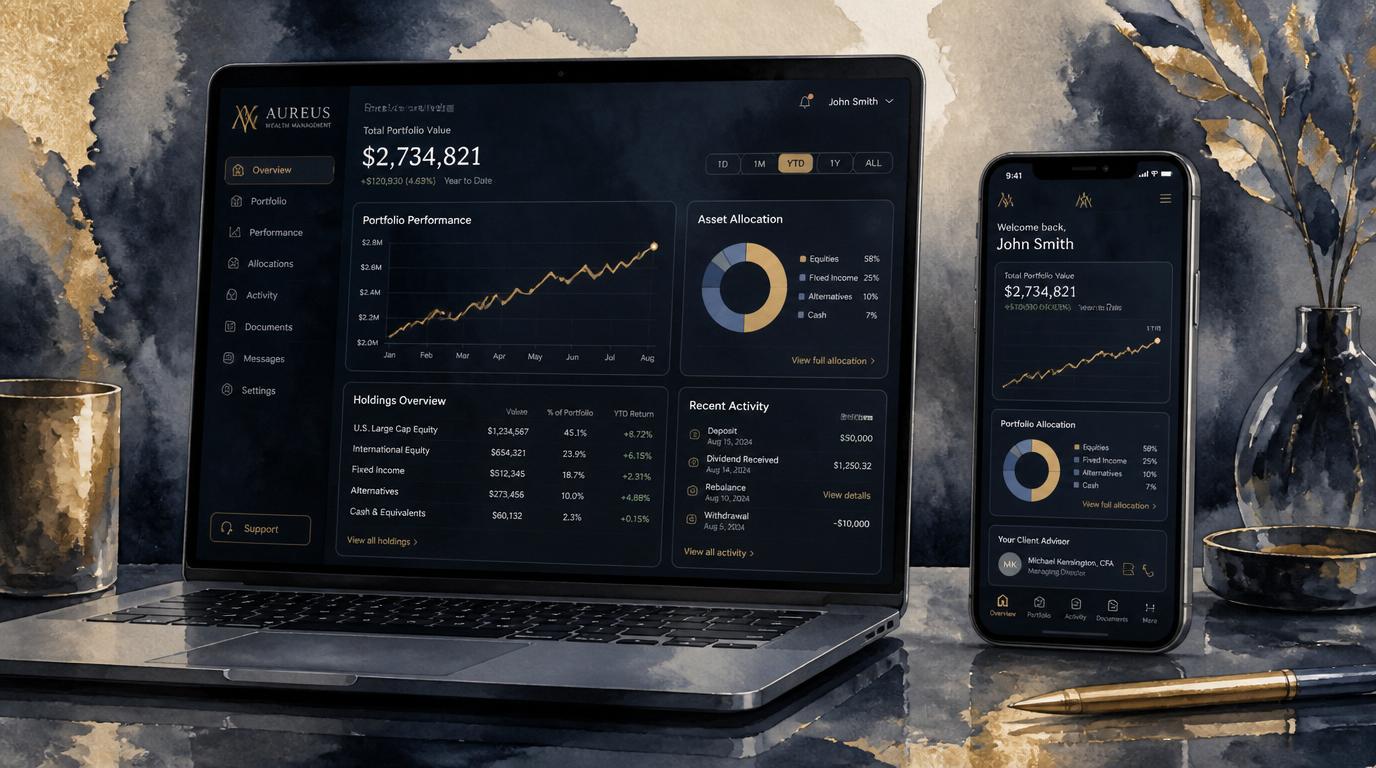
The portfolio dashboard is the heart of the client experience. It needs to present complex holding data — across asset classes, accounts, and geographies — in a way that’s immediately understandable. Good dashboards show what the client owns, how it’s performing against their goals, and what’s changed since their last visit. The challenge is making this feel intuitive for a non-expert while providing the depth a sophisticated investor also expects.
Performance Reporting
Performance reporting separates institutional-grade platforms from consumer-grade ones. This includes time-weighted and money-weighted return calculations, benchmark comparisons, attribution analysis by sector and geography, and fee impact reporting. Getting the math right — and presenting it clearly — requires both financial expertise and careful data engineering.
Goal-Based Planning Tools
A growing segment of investors, particularly those under 50, engage better with goals than with portfolio returns. Platforms that connect investments to outcomes — retirement security, college funding, home purchase, charitable giving — create stronger client engagement and lower churn than those that show only holdings and performance. Capgemini research shows that 72% of high-net-worth individuals now expect personalized products and services — goal-based tools are the primary mechanism for delivering that personalization at scale.
Advisor Messaging and Collaboration
Clients expect secure, in-app communication with their advisors. But advisor teams also need internal collaboration tools — shared task management, client notes, approval workflows, and escalation paths. Building this properly means thinking about both the client-facing and advisor-facing experience as distinct but connected products.
Document Vaults
Tax documents, account statements, trade confirmations, estate planning documents, and compliance records all need to live somewhere secure and accessible. A purpose-built document vault — with versioning, access controls, and expiry tracking — is no longer optional for serious wealth platforms.
Multi-Account Aggregation
High-net-worth clients rarely have all their assets in one place. A platform that only shows what you custody is showing an incomplete picture of the client’s financial life. Multi-account aggregation — pulling in data from held-away accounts, 401(k)s, real estate, and alternative investments — creates the consolidated view that advisors need to deliver genuine advice.
Mobile Access
Mobile is no longer a secondary channel. A growing share of client interactions happen on a phone, particularly for younger clients and in markets where mobile-first behavior is the norm. Our Mobile App Development team builds investment-grade mobile experiences — not responsive web apps repurposed for smaller screens. Investment platforms that treat mobile as an afterthought are leaving engagement and retention on the table.
AI Features Transforming Wealth Management

Artificial intelligence is moving from experimental to operational in investment platforms. The firms implementing it well are not bolting on chatbots — they’re embedding intelligence into workflows where it genuinely reduces friction or improves decisions.
According to PwC’s 2025 Asset and Wealth Management outlook, 45% of AWM firms expect AI to help them achieve new revenue streams within 12 months, while nearly as many expect it to speed up time to market. Deloitte found that 50% of investment management firms have now fully or almost fully realized the benefits of digital transformation — and the firms leading that group are predominantly the ones that have embedded AI into core workflows, not bolted it on as a feature.
The most impactful AI applications in wealth management software currently include:
- Personalized portfolio insights — surfacing relevant observations about a client’s holdings based on their risk profile, goals, and recent market events, without requiring an advisor to manually review each account
- Churn prediction — identifying engagement patterns that historically precede client departures, giving relationship managers time to intervene before the relationship deteriorates
- Risk alerts — monitoring portfolio exposures in real time and flagging concentration risks, drawdowns, or drift from the investment policy statement
- Intelligent support assistants — handling routine client inquiries about statements, account balances, and transaction history without advisor involvement
- Recommendation engines — suggesting rebalancing actions, tax-loss harvesting opportunities, or next investment steps based on the client’s full financial picture
- Reporting automation — generating narrative commentary on portfolio performance and market context, ready for advisor review rather than starting from a blank page
- Next best action prompts — helping advisors prioritize which clients to contact, what to discuss, and when, based on life events, portfolio changes, and engagement data
Our AI Software Development practice works specifically on embedding these capabilities into investment platforms — not as standalone AI tools, but as features woven into the advisor and client workflow.
“Generative AI is paving the way for new client experiences, from conversational portfolio tools to personalised digital interactions.” — McKinsey, Outlook 2025: A Brave New World in Wealth Management
AI in investment software development works best when it’s designed with the advisor’s workflow in mind — reducing cognitive load rather than creating new interfaces to manage.
Compliance and Security Priorities
Compliance is not a feature you add at the end. It’s a design constraint that shapes every architectural decision from the first line of code. Investment platforms operating in regulated markets need to address:
Regulatory frameworks your platform must be designed around:
- KYC (Know Your Customer) — identity verification, beneficial ownership, watchlist screening
- AML (Anti-Money Laundering) — transaction monitoring, suspicious activity reporting, risk scoring
- GDPR and data privacy laws — consent management, data residency, right to erasure
- SOC 2 Type II — operational security controls for SaaS platforms handling client data
- Regional requirements — MiFID II (EU), FCA regulations (UK), SEC/FINRA rules (US), DORA (EU operational resilience), among others
The cost of getting this wrong is measurable. IBM’s 2025 data puts the average cost of a financial services data breach at $4.44 million. Separately, major financial institutions have collectively faced over $2 billion in fines tied to recordkeeping and compliance failures around digital communications — an area that only grows more complex as client interactions move to in-app messaging. Regulators are paying close attention.
Technical security requirements every investment platform needs:
- End-to-end encryption for data in transit and at rest
- Role-based access controls with the principle of least privilege
- Comprehensive audit trails for all data access and system actions
- Immutable record retention aligned with regulatory holding periods
- Penetration testing and vulnerability management programs
- Multi-factor authentication for all user-facing and admin access
Broadridge’s 2024 Digital Transformation Study found that 88% of wealth management firms are making moderate or large cybersecurity investments this year, with 44% saying cybersecurity assurance is the single most important thing they expect from a technology vendor. Compliance failures in wealth management are not just regulatory problems — they’re reputational ones that permanently damage client trust. Our SaaS Development Services include compliance-first architecture design as a standard component.
Architecture Trends for Investment Platforms
API-First Ecosystems
Modern investment platforms are not monolithic systems that do everything internally. They’re orchestration layers that connect custodians, market data providers, payment processors, identity verification services, and analytics tools through well-designed APIs. An API-first architecture makes this integration strategy sustainable and adaptable as the ecosystem evolves. See our overview of open banking API integration for how this plays out in financial services contexts.
Microservices
Decomposing platform functionality into independently deployable services — portfolio calculations, reporting, notifications, user management — allows teams to scale, update, and maintain specific capabilities without affecting the entire system. This matters particularly in investment platforms, where regulatory changes or new financial products may require rapid updates to one component while the rest remains stable.
Real-Time Data Feeds
The expectation for real-time portfolio data has moved from trading platforms into wealth management broadly. Clients expect to see current valuations, not yesterday’s closing prices. This requires thoughtful data pipeline architecture using streaming technologies like Apache Kafka, combined with careful caching strategies to maintain performance at scale.
Hybrid Cloud Security Models
Few regulated investment firms are comfortable with purely public cloud architectures for sensitive client data. Hybrid models — where sensitive data processing and storage sits in private or dedicated infrastructure while less sensitive workloads run on public cloud — are increasingly the practical standard for enterprise wealth platforms.
Analytics Warehouses
Investment platforms generate rich behavioral and financial data that has compounding value over time — for compliance, product decisions, advisor coaching, and AI model training. Building a proper analytics warehouse from the start, using tools like Snowflake or BigQuery, prevents the painful migration projects that typically occur when firms realize their operational database cannot support analytical queries at scale.
Mobile-First Delivery
Mobile-first does not mean mobile-only. It means designing the core client experience around mobile interaction patterns and then expanding to web — rather than the opposite. Platforms built this way tend to have better performance, cleaner information architecture, and higher client engagement than those where mobile is a later adaptation.
Product Roadmap for WealthTech Launches
Getting to market without over-engineering the first version is one of the defining skills in investment platform development. Here’s a phased approach that balances speed with the depth institutional clients expect:
Phase 1 — MVP Investor Portal (Months 1–5)
The first version focuses on the core investor experience: account overview, portfolio holdings, performance data, document access, and secure onboarding. The goal is a production-grade client-facing experience — not a prototype — that can support real clients while the broader platform is built.
Key deliverables:
- Investor authentication and digital onboarding flow
- Real-time portfolio dashboard
- Holdings and transaction history
- Document vault
- Basic client-advisor messaging
Phase 2 — Reporting and Advisor Tools (Months 5–9)
With the investor experience in place, Phase 2 builds the advisor-facing layer: CRM integration, client management workflows, automated reporting, and compliance tooling.
Key deliverables:
- Advisor dashboard and client management
- Automated performance and attribution reports
- KYC/AML workflow automation
- Audit trail and compliance reporting
- Multi-account aggregation
Phase 3 — AI Personalization (Months 9–14)
With sufficient data from live client interactions, Phase 3 introduces AI-driven capabilities that differentiate the platform in a crowded market.
Key deliverables:
- Personalized portfolio insights engine
- Churn prediction and engagement scoring
- Next best action prompts for advisors
- Intelligent client support assistant
- Risk alert and rebalancing recommendations
Phase 4 — New Asset Classes and Scale (Month 14+)
Phase 4 expands the platform’s asset class coverage — alternatives, crypto, structured products, private equity — and prepares the infrastructure for significant client volume growth. McKinsey notes that $700 billion in personal financial assets are projected to transition to digital wealth platforms over the next four years, making scalability a first-order architectural concern, not a future problem.
Key deliverables:
- Alternative investment portal and subscription workflows
- Multi-currency and multi-jurisdiction support
- Performance at scale — architecture review and optimization
- Third-party advisor and white-label access model
Common Mistakes Firms Make
Most WealthTech product failures are predictable. The patterns repeat across firms of different sizes, markets, and investment strategies. The mistakes most worth avoiding:
- Replicating the legacy client experience digitally — scanning paper forms and calling them “digital onboarding” is not transformation. Clients notice immediately, and the firms who built something genuinely digital are only one recommendation away from taking that client.
- Building advisor tools as an afterthought — the advisor experience often receives far less design attention than the client experience, which creates adoption problems and limits the ROI of the entire platform. Advisors who don’t use the platform don’t drive the outcomes the platform was built to enable.
- Weak mobile UX — deploying a responsive web app and calling it a mobile strategy is no longer sufficient. With 89% of wealth managers preferring mobile apps for client engagement, the bar for mobile quality has moved decisively upward.
- Slow reporting cycles — generating reports manually or overnight, when clients and regulators expect real-time data, creates credibility problems that are hard to recover from.
- Poor data integration strategy — treating custodian data feeds as a secondary concern until post-launch is one of the most expensive mistakes in investment platform development, because it affects every feature downstream.
- Ignoring younger investor expectations — HNW millennials and Gen X investors have digital-first expectations shaped by consumer fintech. Platforms that don’t meet those expectations face accelerating attrition, and the generational wealth transfer underway makes this a compounding problem.
- No retention mechanisms — building an investment platform without goal tracking, engagement nudges, or in-app education means acquiring clients expensively and watching them disengage slowly.
How to Choose an Investment Software Development Partner
Not every software firm has the depth to build serious investment platforms. Here’s what to assess when evaluating a WealthTech development partner:
What to look for:
- Direct experience building regulated financial software — not just adjacent fintech work
- Security maturity demonstrated by certifications, not claimed through marketing
- Demonstrated capability with complex financial data integrations, including custodian APIs and market data providers
- Portfolio of wealth management or investment platform work with referenceable clients
- Product design capability — can they design a compelling advisor and investor UX, or just implement wireframes?
- A delivery model built for enterprise clients — clear communication, structured QA, and documentation standards
- Long-term support commitment — investment platforms need ongoing development, not just a handoff
Red flags:
- Teams with no financial services experience selling deep fintech expertise
- Proposals that skip discovery and go straight to development estimates
- No demonstrated approach to compliance engineering
- Inability to explain their data security architecture clearly
The right partner thinks like a product co-founder, not just a development vendor. They push back on scope, flag risks early, and bring strategic perspective alongside technical execution. Explore our investment software development expertise and our fintech and financial software development services to understand what that looks like in practice.
Technology Stack for Investment Platforms
| Layer | Recommended Technologies | Purpose |
|---|---|---|
| Frontend (Web) | React, TypeScript, Next.js | Performant, maintainable investor and advisor interfaces |
| Frontend (Mobile) | React Native, Swift (iOS), Kotlin (Android) | Native-quality mobile experience |
| Backend | Java, .NET, Node.js, Python | Core business logic, APIs, integrations |
| Cloud Infrastructure | AWS, Azure, GCP | Scalable, secure hosting with financial-grade SLAs |
| Database (Relational) | PostgreSQL, Microsoft SQL Server | Transactional data, portfolio records |
| Data Warehouse | Snowflake, BigQuery | Analytics, reporting, AI model training |
| Event Streaming | Apache Kafka | Real-time data feeds, event-driven architecture |
| Security Layer | IAM, SIEM tools, encryption services | Access control, monitoring, data protection |
| AI/ML | Python, PyTorch, scikit-learn, cloud ML services | Prediction models, recommendation engines |
Technology choices should be driven by the team’s expertise, the firm’s cloud commitments, and the regulatory environment — not by trend. A well-architected platform built on proven technologies consistently outperforms one built on fashionable ones without the engineering depth to support them. Our full-stack development services cover this entire layer, from frontend to data infrastructure.
Final Thoughts
The wealth management firms gaining ground today are not necessarily the largest or the most recognized. They’re the ones that made a strategic decision to meet clients where they are — digitally, personally, and in real time.
“Piecemeal transformation efforts are no longer effective in asset and wealth management. Firms are now wrestling with the twin challenges of expanding into the unfamiliar markets that investors are demanding… while facing more competition for control of a slower-growing pie of assets.” — PwC, Next in Asset and Wealth Management 2025
Custom investment software development is the mechanism for that transformation. Off-the-shelf platforms can get a firm to a baseline; they rarely differentiate. The firms that build proprietary client experiences, integrate AI at the workflow level, and make compliance invisible to the end user are creating durable competitive advantages — and they’re doing it now, not waiting for the market to force the issue.
The next generation of wealth management belongs to firms that combine the trust they’ve built over years with the digital convenience clients now expect as a baseline. The right technology partner doesn’t just build that platform — they help you think clearly about what it needs to be.
Frequently Asked Questions
How much does investment software development cost?
The range is wide — from $150,000–$300,000 for a focused MVP investor portal, to $1M+ for a full-featured wealth management platform with AI capabilities, custodian integrations, and compliance tooling. The primary drivers are feature scope, number of integrations, compliance requirements, and whether you’re building web-only or web and mobile. Our software cost estimation guide covers how to think through this before you engage a vendor. A credible development partner will provide phased estimates after a discovery engagement, not off the back of a first conversation.
How long does it take to build an investment platform?
A production-ready MVP for an investor portal typically takes 4–6 months with a focused team. A full-featured platform — advisor tools, AI capabilities, reporting, and multi-custodian support — is more realistically an 18–24 month journey from discovery to scale. Firms that try to compress this timeline by skipping phases typically pay the cost in technical debt, rework, or compliance remediation.
What features do wealth management apps need?
At minimum: secure client onboarding, portfolio dashboards, performance reporting, document access, and advisor communication. Competitive platforms add goal-based planning, multi-account aggregation, mobile access, AI-powered insights, and automated compliance workflows. See the Core Features section above for a detailed breakdown of each.
Can you build robo advisor software?
Yes. Robo advisor development is a well-defined product category that includes goal capture and risk profiling, model portfolio assignment, automated rebalancing, tax-loss harvesting, and a digital-first client experience. The complexity depends on the sophistication of the underlying investment logic and the number of asset classes supported. Our fintech software development team has built automated advisory products across multiple markets.
What compliance requirements apply to investment platforms?
This depends on your market and client type. Most investment platforms need to address KYC, AML, data privacy (GDPR or US state equivalents), and record retention. Platforms serving institutional clients or registered investment advisors in the US face additional SEC and FINRA requirements. EU-based platforms must also align with DORA’s operational resilience framework by 2025. Building compliance tooling into the platform from the start is significantly more cost-effective than retrofitting it.
How do investment apps secure user data?
Through layered security controls: end-to-end encryption for data in transit and at rest, multi-factor authentication, role-based access controls, comprehensive audit logging, intrusion detection, and regular penetration testing. SOC 2 Type II certification demonstrates that these controls are operational and consistent, not just claimed. IBM puts the average cost of a financial services data breach at $4.44 million in 2025 — security architecture is not an area to economize on.
What is the best architecture for wealth platforms?
API-first, microservices-based architectures with real-time data streaming capabilities are the current standard for new investment platform builds. This gives you integration flexibility, independent scaling of components, and the ability to add new asset classes or features without rebuilding the core. Hybrid cloud models are common for regulated firms that need to balance performance and data sovereignty. See our building scalable SaaS architectures article for a deeper technical treatment.
How do firms choose the right investment software development partner?
Look for demonstrated fintech domain experience, a proven approach to compliance engineering, strong financial data integration capability, and a track record of building production platforms — not just proof-of-concept work. Ask for references from clients in investment management, and evaluate whether the partner’s team asks strategic questions or just takes requirements at face value. Review their case studies to understand the types of platforms they’ve shipped and the problems they’ve solved for clients in regulated industries.