



Every SaaS team eventually discovers that their pricing model is also their architecture. Not metaphorically — literally. The decision to shift from per-seat billing to consumption-based pricing, or to introduce a hybrid tier with included credits and overage charges, reaches directly into your database schema, your caching topology, your event ingestion pipeline, and your rate-limiting implementation. Teams that treat pricing as a business operations concern and architecture as a separate discipline find out the hard way: a pricing model change in Q3 can trigger a multi-month platform rewrite if the entitlement layer was built assuming a single pricing shape.
This guide delivers an architectural roadmap for building pricing-agnostic SaaS engines — systems where pricing models can evolve without cascading infrastructure rework. We will analyze the specific latency traps embedded in per-seat RBAC schemas, build out a high-throughput usage metering engine for consumption pricing, implement quota guardrails using Redis-backed token bucket algorithms, and design a normalized SQL schema that supports concurrent historical pricing catalogs across a heterogeneous tenant population. The through-line is engineering discipline: every pricing model has a specific set of system design consequences, and understanding them in advance is the difference between a clean migration and an incident.
Per-Seat Pricing: The Auth and Entitlement Latency Trap
Database Implications of User-Centric Pricing
Per-seat pricing appears simple at the data model level — count users per tenant, compare to the purchased seat count, allow or deny provisioning. In practice, the access control schema that implements this logic becomes a read-heavy performance bottleneck at scale in ways that aren’t obvious until you’re debugging p99 latency spikes at 9 AM Monday morning when every user logs in simultaneously.
A typical per-seat implementation embeds seat validation inside the authentication flow. When a user requests an access token, the auth service checks active seat count against the tenant’s purchased license. This check touches a join across at minimum three tables: users (to find the requesting user), tenant_seats (to count active provisioned users for the tenant), and tenant_subscriptions (to retrieve the seat limit from the active plan). Under concurrent login load, this pattern generates read contention on the tenant_seats table for large tenants — particularly in B2B SaaS where enterprise customers may have thousands of users authenticating against a single tenant record.
The compounding problem is that per-seat plans typically layer on feature entitlements — different seat types (Admin, Editor, Viewer) have different feature access rights managed through Role-Based Access Control (RBAC). Every API request from an authenticated user that touches a gated feature requires a permissions check, which means another database read. In a naive implementation, a single user session generating 50 API calls per minute produces 50 entitlement lookups against your permissions store. At 10,000 concurrent users, that’s 500,000 database reads per minute from entitlement checks alone — before a single line of application business logic executes.
Caching Entitlements with Redis Distributed Cache
The correct architecture decouples entitlement resolution from the request path via a Redis distributed cache. After initial authentication, the user’s resolved entitlement set — their seat type, feature permissions, and tenant plan limits — is serialized to a Redis key with a TTL calibrated to your acceptable entitlement staleness window (typically 5–15 minutes for most B2B SaaS).
Cache key schema:
entitlements:{tenant_id}:{user_id} → JSON blob{
“seat_type”: “editor”,
“features”: [“data_export”, “api_access”, “team_management”],
“seat_limit”: 250,
“active_seats”: 187,
“plan_version_id”: “plan_v3_enterprise_2024”,
“cached_at”: “2026-06-29T08:14:00Z”,
“ttl_seconds”: 600
}
On subsequent API requests within the TTL window, the auth middleware reads from Redis rather than hitting the relational database. Cache miss rate on a warmed cache for an active user population is typically below 2% — meaning 98% of entitlement checks resolve from memory in sub-millisecond latency rather than executing a multi-table join.
The invalidation strategy matters as much as the caching strategy. When a tenant admin revokes a seat, provisions a new user, or upgrades a plan, the entitlement cache for the affected tenant must be invalidated immediately — not at TTL expiry. Implement this through a targeted cache invalidation event: the Entitlement Service publishes a tenant.entitlements.invalidated event to an internal message bus, and a cache invalidation consumer purges the affected Redis keys using a SCAN with pattern matching on entitlements:{tenant_id}:*. This gives you the performance benefit of aggressive caching with correctness guarantees when seat state changes.
Feature Gating: Decoupling Toggles from Billing Logic
The most dangerous architectural coupling in per-seat SaaS is embedding feature gate logic directly in billing code. When your canUserExportData() function queries the billing service to determine if the user’s plan includes data export, you have created a dependency between your product’s runtime behavior and your billing infrastructure’s availability. Billing services go down. They have maintenance windows. A Stripe API timeout should never prevent a paying customer from using a feature they’ve already purchased.
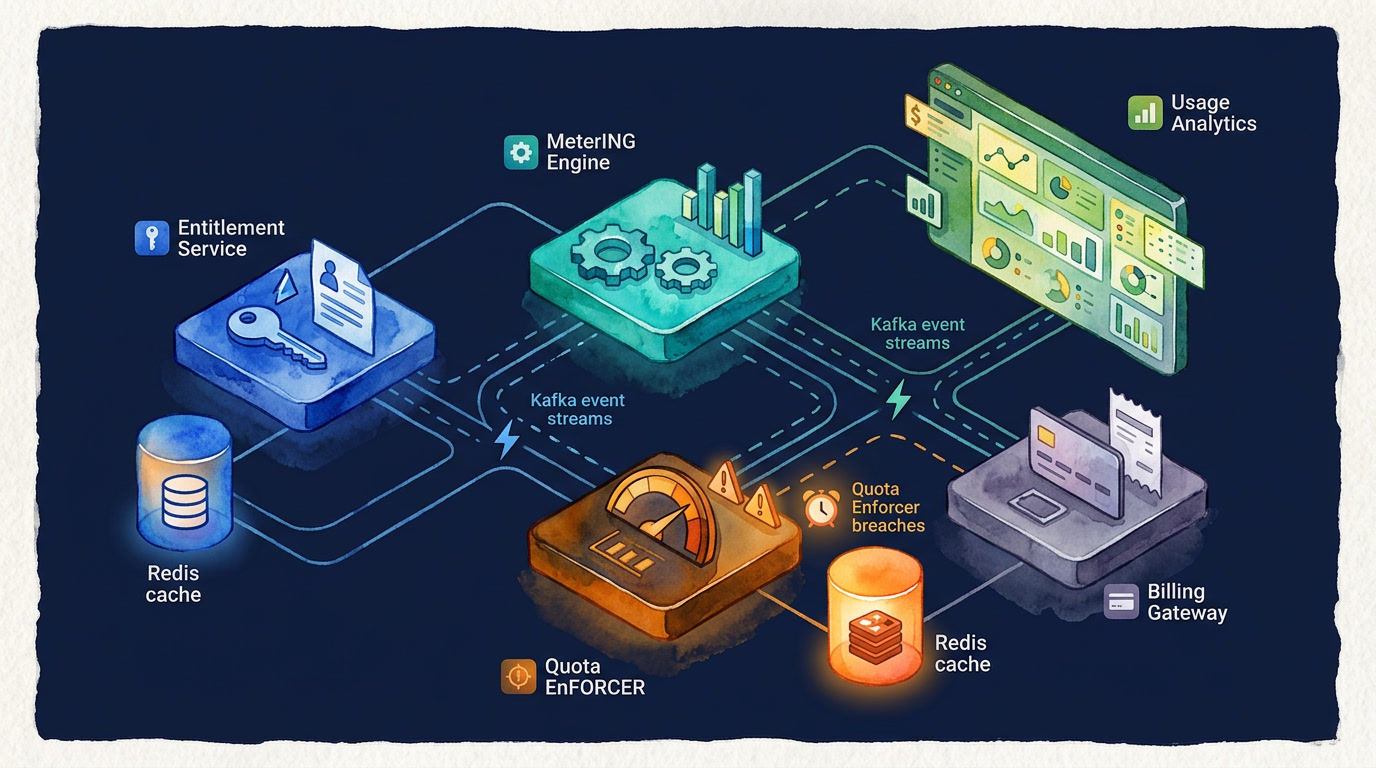
The solution is a dedicated Entitlement Service that owns the authoritative, cached resolution of what each tenant and user is permitted to do. Billing events (plan upgrades, downgrades, seat additions) write to the Entitlement Service’s database. The Entitlement Service exposes a low-latency read API that features gates call — and it is backed by the Redis cache described above, not by live billing API calls. The billing system and the entitlement system are decoupled: billing owns the commercial relationship, entitlements own the runtime access decisions.
This architecture also enables feature flag rollouts decoupled from plan changes. You can grant early access to a new feature for a specific tenant cohort — by writing a targeted entitlement override — without modifying their billing plan. The Entitlement Service supports this through an entitlement_overrides table with higher precedence than plan-derived entitlements, enabling clean experimentation and beta programs without billing system side effects.
The SaaS development services architecture and building scalable SaaS architectures guide both address the entitlement layer design in the context of multi-tenant platform scaling.
Usage-Based Pricing: Building an Event-Driven Metering Engine
The Architectural Shock of Consumption Pricing
Shifting from per-seat to usage-based pricing — or adding a consumption layer on top of seat pricing — is one of the most architecturally disruptive changes a SaaS platform can make. In a per-seat model, your billing system needs to know one number per tenant per billing cycle: how many seats. In a consumption model, it needs to know the cumulative aggregate of potentially billions of discrete usage events — API calls, tokens consumed, gigabytes processed, compute minutes used, AI agent invocations — with sufficient granularity to bill accurately, sufficient speed to enforce quotas in near-real time, and sufficient auditability that customers can verify their bill.
This is not a billing feature addition. It is a data engineering problem at a different order of magnitude.
Ingestion Layer: Stateless Event Producers
The first architectural requirement is that usage event generation must never block the application’s critical path. When a user makes an API call or an AI agent consumes tokens, the usage event must be fired asynchronously — a synchronous write to a metering database on every API call would add unacceptable latency and create a hard dependency between your product’s availability and your billing infrastructure’s write throughput.
The correct pattern uses stateless event producer endpoints that accept usage event payloads and immediately enqueue them to a message broker without waiting for persistence confirmation. Apache Kafka is the standard choice for high-throughput usage event ingestion; AWS Kinesis is a viable managed alternative. The producer endpoint:
POST /internal/usage-events
{
“event_id”: “evt_01J8XKZP4QN3M7V2R5T6Y9W0”, // UUID for idempotency
“tenant_id”: “ten_f8a3c2”,
“user_id”: “usr_b91d4e”,
“event_type”: “api.call”,
“resource”: “inference.tokens”,
“quantity”: 4096,
“unit”: “tokens”,
“timestamp”: “2026-06-29T10:47:23.814Z”,
“metadata”: { “model”: “claude-sonnet-4-6”, “endpoint”: “/v1/messages” }
}
The endpoint publishes this payload to a Kafka topic (usage.events.raw) and returns HTTP 202 immediately. No synchronous database write. No billing calculation. The application’s request latency is decoupled from metering infrastructure performance entirely.
Kafka topics for usage metering should be partitioned by tenant_id. This ensures that all usage events for a given tenant land in the same partition, which is a prerequisite for correct ordered aggregation downstream. With tenant-partitioned topics, a stream processing job calculating a tenant’s running usage total sees events in arrival order — critical for accurate quota enforcement.
Stream Processing and Idempotent Aggregation
Raw usage events arrive in Kafka at potentially millions per second across the platform. The metering engine’s job is to aggregate these into per-tenant, per-metric, per-time-window totals that can be queried for quota enforcement and billing calculation.
Apache Flink is the preferred stream processing framework for this workload due to its stateful stream processing primitives, exactly-once semantics, and support for event-time windowing. A Flink metering job consumes from usage.events.raw, maintains per-tenant aggregate state in Flink’s managed state backend (RocksDB), and emits aggregated usage snapshots to a downstream topic and a time-series database on configurable flush intervals (typically 15–60 seconds for near-real-time quota enforcement).
The idempotency layer is where most metering implementations fail. In a distributed system, the same usage event can arrive more than once — a network retry from the producer, a Kafka consumer group rebalance, or an at-least-once delivery guarantee in the message broker can all produce duplicate events. If your metering engine counts duplicates, customers get overbilled. If discovered post-billing, this is a trust-destroying event.
Idempotency in the metering pipeline requires deduplication at the stream processing layer using the event_id UUID present in every event payload. The Flink job maintains a deduplication state store (backed by RocksDB with a configurable deduplication window — typically 24 hours) that tracks processed event IDs. Before counting an event, the job checks whether the event_id has already been seen in the current window. Duplicate events are discarded without incrementing aggregates.
Metering Pipeline Flow:
Kafka: usage.events.raw
→ Flink: Deduplication filter (event_id state store, 24h window)
→ Flink: Tenant aggregate state (running totals per tenant/metric/billing_period)
→ Flink: Window emission (every 30s → Kafka: usage.aggregates.snapshot)
→ ClickHouse / TimescaleDB: Persisted aggregate snapshots for query
→ Redis: Hot quota counters (per tenant, per metric, TTL = billing period end)
The Redis hot quota counters serve a specific purpose: they allow the quota enforcement layer to evaluate current usage in sub-millisecond latency without querying the time-series database. Flink’s aggregate emission job writes the running total to Redis on each snapshot emission, using SET with the aggregate value rather than INCR — this ensures that if a Flink job restarts and reprocesses events (with deduplication), the Redis counter is overwritten to the correct deduplicated total rather than being incremented again.
Preventing Bill Shock: Real-Time Quota Guardrails
Token Bucket Rate Limiting in Redis
Quota enforcement at usage-based billing boundaries requires a rate limiting implementation that is both accurate under concurrent load and fast enough to evaluate inline with API request processing. The Token Bucket algorithm implemented in Redis satisfies both requirements.
Each tenant’s quota bucket is represented as a Redis hash:
HSET quota:{tenant_id}:{metric} \
capacity 1000000 \
remaining 847293 \
refill_rate 0 \
period_end 1751328000 \
last_updated 1751241600
When a usage event is about to be processed, the API gateway or usage enforcement middleware executes a Redis Lua script (atomic evaluation, no race conditions) that:
- Checks
remainingagainst the requestedquantity. - If sufficient capacity exists, decrements
remainingbyquantityand returnsALLOWED. - If insufficient capacity, returns
QUOTA_EXCEEDEDwith the remaining balance.
The Lua script’s atomicity is critical — a non-atomic read-then-write sequence would produce race conditions under concurrent load where multiple requests simultaneously read a positive remaining balance and all proceed, collectively overdrawing the quota. Redis Lua scripts execute atomically within the Redis single-threaded execution model, eliminating this race.
Threshold Webhooks and Hard-Stop Enforcement
Billing surprise is a retention risk. Customers who receive an unexpected overage bill frequently churn or dispute. The engineering solution is a proactive threshold notification pipeline that delivers usage warnings well before quota exhaustion.
The quota monitoring service evaluates tenant usage against configurable threshold levels: 50%, 80%, 95%, and 100% of the included quota. When a threshold is crossed — detected by comparing the Flink-emitted aggregate snapshot against the tenant’s plan entitlement — a quota.threshold.crossed event is published to the internal event bus. A notification service consumes this event and:
- At 80%: Sends an email and in-app notification to tenant admins; optionally fires a webhook to the tenant’s configured endpoint.
- At 95%: Escalates notification urgency; surfaces a banner in the product UI via the Entitlement Service entitlement override mechanism.
- At 100%: Depending on the tenant’s configured hard-stop preference, either blocks further usage (quota enforcement returns
QUOTA_EXCEEDED) or allows overage accumulation and switches the tenant to per-unit overage billing.
The hard-stop vs. overage decision must be a tenant-configurable preference stored in the tenant_subscriptions record — not a platform-wide policy. Enterprise customers may require hard stops to manage cost predictability; growth-stage companies may prefer uncapped overage to avoid service interruption. Your enforcement engine must respect this per-tenant configuration when evaluating quota breach responses.
Database Schema Patterns for Plan Versioning and Grandfathering
The Engineering Dilemma
Pricing catalogs change. You launch at $49/month for 10 seats, then move to $79/month for 15 seats six months later. Existing customers on the original plan are grandfathered — they keep their $49/10-seat terms indefinitely or until they voluntarily upgrade. Your database schema must simultaneously support the old plan’s entitlement calculations and the new plan’s entitlement calculations, applied to different tenants, possibly forever.
The naive implementation — updating the pricing_plans table row to reflect the new pricing — retroactively breaks the entitlement logic for grandfathered tenants. Every schema pattern that avoids this failure mode requires some form of plan version immutability: once a pricing plan version is published and assigned to active tenants, its terms cannot be modified. New pricing requires a new plan version.
Normalized Schema for Multi-Version Pricing
— Immutable plan catalog versions
CREATE TABLE pricing_plans (
id UUID PRIMARY KEY DEFAULT gen_random_uuid(),
plan_name VARCHAR(100) NOT NULL,
plan_version VARCHAR(50) NOT NULL, — e.g. ‘v1.0’, ‘v2.3’
pricing_model VARCHAR(50) NOT NULL, — ‘per_seat’ | ‘usage_based’ | ‘hybrid’
base_price_cents BIGINT NOT NULL,
billing_interval VARCHAR(20) NOT NULL, — ‘monthly’ | ‘annual’
is_active BOOLEAN NOT NULL DEFAULT TRUE, — FALSE = soft-deleted, grandfathered tenants unaffected
valid_from TIMESTAMPTZ NOT NULL,
valid_to TIMESTAMPTZ, — NULL = currently active
created_at TIMESTAMPTZ NOT NULL DEFAULT NOW(),
UNIQUE (plan_name, plan_version)
);— Feature/resource entitlements per plan version
CREATE TABLE entitlements (
id UUID PRIMARY KEY DEFAULT gen_random_uuid(),
plan_id UUID NOT NULL REFERENCES pricing_plans(id),
feature_key VARCHAR(100) NOT NULL, — e.g. ‘api_calls’, ‘seats’, ‘data_export’
limit_type VARCHAR(20) NOT NULL, — ‘hard_cap’ | ‘soft_cap’ | ‘unlimited’
limit_value BIGINT, — NULL if unlimited
overage_unit_price BIGINT, — Cents per unit above limit; NULL if no overage
created_at TIMESTAMPTZ NOT NULL DEFAULT NOW()
);— Tenant-to-plan binding, preserving historical version
CREATE TABLE tenant_subscriptions (
id UUID PRIMARY KEY DEFAULT gen_random_uuid(),
tenant_id UUID NOT NULL REFERENCES tenants(id),
plan_version_id UUID NOT NULL REFERENCES pricing_plans(id),
seat_count INT, — For per-seat plans; NULL for pure usage plans
status VARCHAR(30) NOT NULL, — ‘active’ | ‘cancelled’ | ‘past_due’
current_period_start TIMESTAMPTZ NOT NULL,
current_period_end TIMESTAMPTZ NOT NULL,
created_at TIMESTAMPTZ NOT NULL DEFAULT NOW(),
cancelled_at TIMESTAMPTZ
);— Append-only usage event log (source of truth for billing)
CREATE TABLE metered_usage_logs (
id UUID PRIMARY KEY DEFAULT gen_random_uuid(),
event_id UUID NOT NULL UNIQUE, — Idempotency key, from producer
tenant_id UUID NOT NULL REFERENCES tenants(id),
subscription_id UUID NOT NULL REFERENCES tenant_subscriptions(id),
feature_key VARCHAR(100) NOT NULL,
quantity BIGINT NOT NULL,
event_timestamp TIMESTAMPTZ NOT NULL,
ingested_at TIMESTAMPTZ NOT NULL DEFAULT NOW(),
billing_period_start TIMESTAMPTZ NOT NULL,
billing_period_end TIMESTAMPTZ NOT NULL
);— Tenants table (abbreviated)
CREATE TABLE tenants (
id UUID PRIMARY KEY DEFAULT gen_random_uuid(),
name VARCHAR(255) NOT NULL,
hard_stop_enabled BOOLEAN NOT NULL DEFAULT FALSE,
quota_webhook_url VARCHAR(500),
created_at TIMESTAMPTZ NOT NULL DEFAULT NOW()
);
The critical design decision in this schema is the plan_version_id foreign key on tenant_subscriptions. Each subscription record points to the exact pricing plan version that was active at the time of subscription. When billing logic resolves a tenant’s entitlements, it always joins through the subscription’s plan_version_id — never through a lookup of the “current” plan by name. This means grandfathered tenants perpetually resolve against their historical plan terms, regardless of how many new pricing catalog versions are published afterward.
Soft-deleting old plan versions (is_active = FALSE) removes them from the new-subscription flow while leaving all existing tenant_subscriptions references intact. No grandfathered tenant’s entitlements are disturbed by deprecating a plan version.
The metered_usage_logs table is append-only by convention and policy. No UPDATE or DELETE operations should be permitted on this table from application code — enforce this through database-level column grants that allow only INSERT to the application role. At billing period close, a billing calculation job reads all metered_usage_logs records for the period, resolves the applicable plan entitlements via tenant_subscriptions.plan_version_id, calculates the billable amount (included quota vs. measured usage, plus overage at the plan’s overage_unit_price), and produces an invoice record. This calculation is idempotent: running it twice on the same dataset produces the same invoice.
Build vs. Buy: Engineering the Billing Layer
The build-vs-buy decision for SaaS metering and billing is more nuanced than it appears. The question is not “is billing complex?” — it is — but rather “which parts of billing complexity are commodity problems and which are competitive differentiators for your platform?”
The commodity problems that purpose-built billing platforms (Orb, Lago, Chargebee, Stripe Billing, Maxio) solve well include: invoice generation, payment collection, dunning management, tax calculation, and basic usage aggregation for simple event types. If your pricing model fits within the event schemas these platforms support, using one of them eliminates months of engineering work on billing infrastructure that does not differentiate your product.
The scenarios where custom metering infrastructure becomes necessary:
- Sub-second quota enforcement: Hosted billing APIs introduce network round-trip latency into the quota evaluation path. If your API must enforce token or compute quotas inline with each request, a Redis-backed local quota store (fed by your own metering pipeline) is the only architecture that achieves the required latency.
- Complex aggregation logic: If your billing formula involves multi-dimensional aggregation (e.g., billing on the 99th percentile of peak concurrent connections, not total volume), most billing platforms cannot express this natively. Custom Flink aggregation jobs can implement arbitrary formulas.
- Data sovereignty constraints: If your usage data cannot leave your infrastructure region (common for regulated FinTech and healthcare SaaS), third-party billing platforms that require event data to be sent to their infrastructure may be non-starters.
Security boundaries between your application and any billing system — whether custom or third-party — require strict PCI isolation. Your application should never pass raw card data to a billing API; all payment method collection should use hosted fields or a client-side SDK that tokenizes card data before it touches your network. Usage event data flowing to a third-party billing platform should be scrubbed of any PII not strictly necessary for billing calculation before transmission. Treat the billing system as an external, untrusted boundary — even if it’s operated by a reputable vendor — and apply the same defense-in-depth controls you would for any third-party API integration.
For SaaS platforms built on Genius Software’s SaaS consulting and AI-powered automation infrastructure, these billing architecture patterns integrate directly with the multi-tenant service mesh designs covered in the AI for SaaS platforms guide.
Conclusion: Architectural Checklist for a Pricing-Resilient SaaS Platform
The SaaS platforms that handle pricing model evolution without platform rework are those that engineered the separation of concerns correctly from the beginning: billing logic does not live in feature code, entitlement resolution does not live in the billing system, and pricing plan terms are immutable once published. These are not complex ideas, but they require deliberate structural decisions that most teams don’t make until a pricing change forces them to.
Per-Seat and Entitlement Layer:
- Entitlement Service deployed as an independent service, owning entitlement resolution separate from billing
- Redis distributed cache for entitlement resolution with targeted invalidation on seat state changes
- RBAC permissions stored as resolved feature key sets, not raw role lookups at request time
- Feature gate implementations calling Entitlement Service API, never Billing Service API
-
entitlement_overridestable supporting tenant-specific exceptions without plan changes
Metering and Usage Ingestion:
- Usage event producers are stateless and async — HTTP 202 returned immediately; no synchronous billing writes
- Kafka topics partitioned by
tenant_idfor ordered per-tenant aggregation - Flink metering job with exactly-once semantics and event-time windowing
- Deduplication state store (RocksDB, 24h window) filtering duplicate
event_idvalues before aggregate increment - Redis hot quota counters updated by Flink snapshot emission (SET, not INCR, to survive reprocessing)
Quota Enforcement and Notifications:
- Token Bucket quota evaluation implemented as Redis Lua script for atomic concurrent-safe execution
- Threshold monitoring at 50/80/95/100% with per-tenant configurable notification channels
- Hard-stop vs. overage preference stored as a per-tenant configuration, not a platform policy
- Quota webhook delivery with exponential backoff retry and dead-letter queue
Schema and Plan Versioning:
-
pricing_plansrecords are immutable after publication — new pricing = new version row -
tenant_subscriptions.plan_version_idFK preserving each tenant’s historical plan terms -
metered_usage_logstable is INSERT-only — application role has no UPDATE or DELETE grants - Billing calculation job is idempotent: same input period always produces same invoice output
- Soft-delete mechanism for deprecated plan versions that preserves existing subscription references
Build vs. Buy:
- Third-party billing platform evaluated against sub-second quota latency, aggregation complexity, and data sovereignty requirements
- PCI isolation enforced at billing API boundary — no raw card data in application-to-billing event streams
- Usage event data scrubbed of unnecessary PII before transmission to third-party billing platforms
Pricing model changes are inevitable. The architecture you build today either absorbs that change cleanly or fights it. The patterns in this guide — entitlement decoupling, async event metering, idempotent aggregation, and immutable plan versioning — are what make the difference between a two-sprint configuration update and a six-month platform refactor.