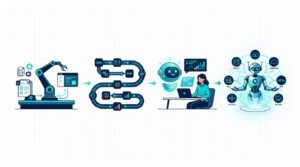


Every week, another software agency adds “AI” to its homepage. Some of them genuinely know what they’re doing. Most don’t. The gap between a compelling demo and a system that holds up in production — under real users, real data volumes, and real business pressure — is enormous. And when you’re betting budget, time, and competitive positioning on a technical partner, that gap matters.
This guide is written for decision-makers: CEOs evaluating transformation investments, CTOs who need a reliable engineering partner, and procurement teams conducting vendor due diligence. It covers what separates serious AI software development companies from consultancies dressed in AI clothes.
Why Choosing the Right AI Partner Matters
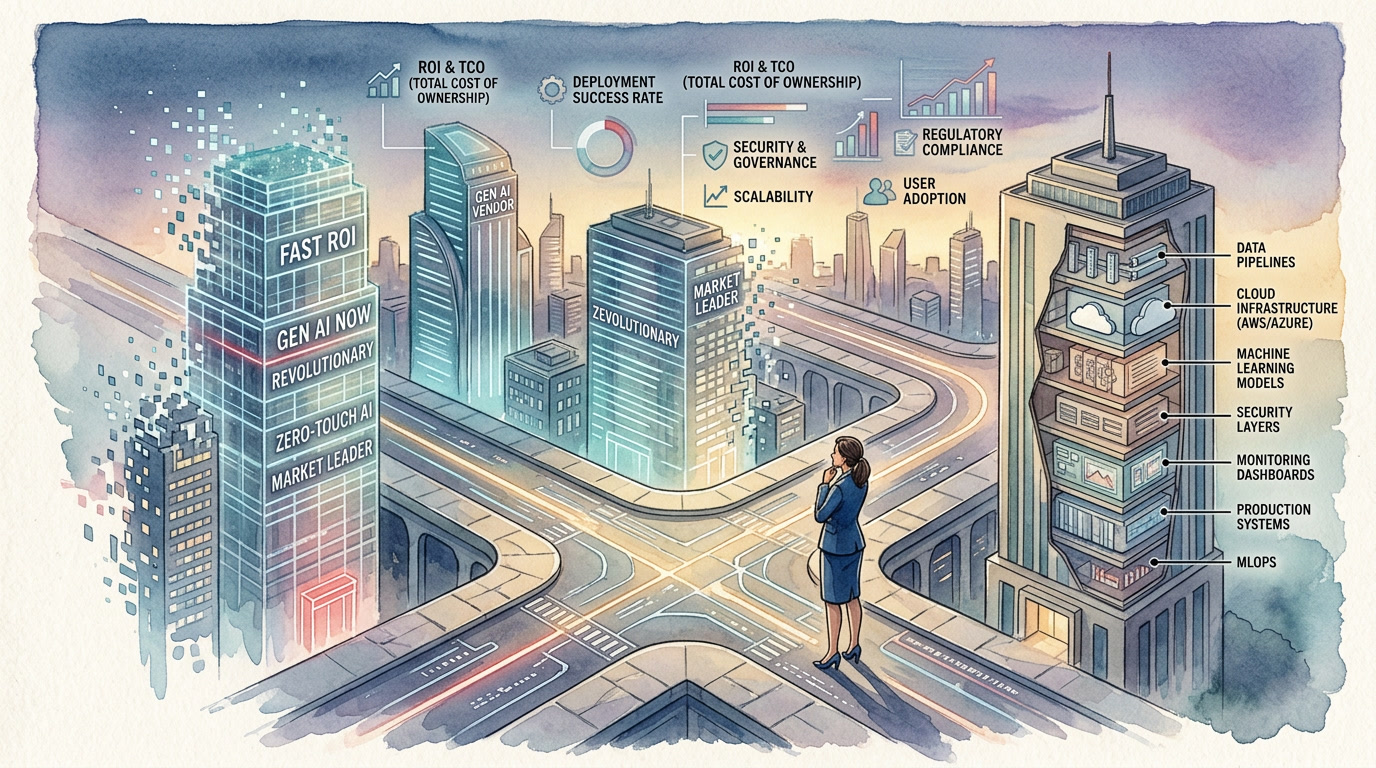
The wrong partner doesn’t just slow you down — it can actively set you back. A failed AI initiative burns internal goodwill, locks you into brittle systems, and makes the next attempt harder to fund and staff.
The right AI development company delivers:
- Faster time to value — they know where the real work lives and scope accordingly
- Lower implementation risk — they’ve navigated the failure modes before you
- Stronger security posture — they build compliance in, not bolted on later
- Better ROI outcomes — they measure what matters, not what’s easy to demo
- Smoother team adoption — they build for people, not just benchmarks
- Scalable long-term systems — they architect for where you’re going, not just where you are
The cost of choosing wrong is rarely just the project budget. It’s the 6–12 months you don’t get back.
Worth knowing: According to McKinsey, only about 54% of AI pilots make it into production. The organizations that consistently cross that line share one trait — a partner with real deployment experience, not just model fluency.
The Real Reason Most AI Projects Fail (It’s Not the Technology)
Before getting into what to look for, it helps to understand the actual failure distribution. Based on patterns from enterprise AI implementations, projects most commonly break down at three points:
- Discovery–build handoff — the business problem was never properly translated into a technical scope, so the system solves the wrong thing well
- Staging-to-production gap — the system worked in controlled conditions and broke under real traffic, messy data, or edge-case inputs
- Adoption — the system shipped but teams reverted to spreadsheets because the UX didn’t fit their actual workflow
Most vendor evaluation frameworks focus on point 2. This guide covers all three.
1. Real Business Understanding, Not Just Models
The AI field is full of engineers who are excellent at building models but have limited interest in business outcomes. That’s fine in a research context. It’s a problem when you’re trying to move revenue.
A strong AI software development company asks business-first questions before they open a notebook:
- Where is revenue currently constrained by manual processes?
- What decisions are you making with bad data today?
- What would 20% faster customer resolution actually be worth?
They map AI capability to business outcomes — specifically to revenue growth, cost reduction, automation potential, customer retention, and operational speed. If a vendor jumps straight to architecture without understanding your P&L, that’s a signal.
This is especially important in regulated or complex domains. A team that has built fintech software thinks differently about compliance constraints than one that hasn’t. A team with healthcare platform experience understands data sensitivity at a different level than a generalist agency.
Ask early: “What business problem have you solved with AI, and how did you measure it?” The answer tells you everything.
2. Proven Engineering Capability
AI doesn’t exist in a vacuum. The model is often the least complicated part. What breaks production systems is everything around it: unreliable data pipelines, slow APIs, infrastructure that wasn’t designed for inference-scale workloads, or a frontend that makes powerful outputs unusable.
When evaluating an AI development company’s engineering depth, look for demonstrated capability across the full stack:
| Engineering Layer | What to Verify |
|---|---|
| Backend systems | API design, microservices, async processing |
| Cloud architecture | AWS / Azure / GCP — multi-cloud fluency preferred |
| Data pipelines | ETL, streaming, data quality controls |
| Scalable infrastructure | Kubernetes, autoscaling, cost-per-request management |
| Frontend delivery | Clean interfaces users actually adopt |
| AI/ML integration | Model serving, vector databases, embedding management |
Full-stack development capability matters here more than most buyers realize. A team that can only own one layer — model engineering, say, or frontend — will require you to stitch together multiple vendors. That introduces coordination overhead, unclear accountability, and integration risk that compounds over time.
Ask for case studies that include the full stack, not just the AI component. Any company can wire up an OpenAI API. Fewer can build the surrounding system to production standard.
3. Ability to Deploy to Production
This is the single biggest differentiator between vendors who can do a proof of concept and vendors who can actually run a business. Production AI is not proof-of-concept AI made bigger — it’s a fundamentally different engineering discipline.
MLOps Workflows
Does the team have real MLOps practice? That means version-controlled models, reproducible training pipelines, automated deployment, and structured rollback procedures. Without this, every model update becomes a manual, high-risk event. A capable machine learning development company treats model lifecycle management the same way a mature engineering team treats software releases — with tooling, audit history, and automated gates.
Monitoring & Logging
AI systems fail silently in ways that traditional software doesn’t. A model can degrade for weeks before anyone notices — outputs become subtly less accurate, edge cases accumulate, latency creeps up. A well-run team instruments for output quality, drift, latency, and error rates and alerts on degradation before users notice. Good DevOps practice applied to AI systems is non-negotiable in production.
Cost Controls
Inference costs are real and variable. LLM API calls, vector search at scale, real-time embeddings — these add up quickly. A serious partner thinks about cost-per-transaction from day one and builds levers to control it. Ask specifically: “What was your highest inference cost project and how did you optimize it?”
Reliability & SLAs
What uptime guarantees come with the system? What’s the incident response process? What are the degradation paths when a model service goes down? These aren’t afterthoughts for a mature team — they’re part of the original design.
Human Review Layers
Most production AI systems need a human-in-the-loop somewhere. Whether it’s flagging low-confidence outputs, reviewing edge cases, or handling escalations, a responsible team builds those interfaces and workflows in, not as an afterthought.
4. Experience With the AI Technologies Your Use Case Requires
“AI development” covers a wide surface area. The specific capabilities that matter depend heavily on what you’re building. When evaluating an AI app development company, verify their demonstrated experience with the technologies your project actually requires — not just what they list on their website:
- LLM applications — building on GPT-4, Claude, Mistral, Llama, or domain-specific fine-tuned models
- RAG systems — retrieval-augmented generation for knowledge-intensive use cases like internal search, compliance Q&A, or customer support
- Recommendation engines — collaborative filtering, content-based, and hybrid systems at scale
- Predictive analytics — forecasting, churn prediction, demand modeling; see how this applies in marketing analytics
- OCR and vision AI — document processing, image classification, multimodal inputs
- Automation agents — multi-step AI workflows that take action, not just output text
- Prompt engineering — systematic approaches to instruction design, testing, and iteration (not just “we write good prompts”)
A team that has shipped an AI-powered self-learning chatbot in a real production environment carries different depth than one that has only built internal demos. Ask for architecture overviews from comparable past projects. Ask what went wrong and how they fixed it.
5. Security, Governance & Compliance
Enterprise AI deployments carry real security and regulatory risk. Data residency, PII handling, model access controls, audit trails, output toxicity — these aren’t compliance checkbox items, they’re operational realities that get organizations into serious trouble when mishandled.
A trustworthy AI software company will have clear, specific answers to the following:
Access and data controls:
- How is training data isolated between clients?
- How is PII handled within prompts and completions?
- What access controls exist at the model and API level?
Output integrity:
- How do you mitigate hallucinations in production?
- What guardrails are in place for high-stakes outputs?
- How are outputs logged and auditable?
Regulatory readiness:
- Do you support GDPR / HIPAA / SOC 2 requirements as needed?
- Can you accommodate data residency restrictions?
- How do you manage third-party model vendor risk?
For organizations in sensitive industries, cybersecurity consulting should be part of the AI engagement — not a separate conversation that happens after launch. The same applies to data analytics governance: what data is the model trained on, how is it processed, and who has access to what?
If a vendor waves off these questions as “we’ll figure that out later,” walk away. Retrofitting security onto AI systems is costly, painful, and often incomplete.
6. Product & UX Mindset
Technically strong AI outputs that nobody uses are not a success. This is one of the most overlooked failure modes in enterprise AI projects — organizations invest heavily in model quality and neglect the workflows that determine whether teams actually adopt the system.
Strong AI development partners understand:
- Onboarding design — users need to build trust in AI outputs before they’ll act on them
- Human + AI collaboration UX — where does the human stay in control? Where does AI accelerate?
- Trust design — how does the interface communicate confidence levels and uncertainty?
- Retention mechanics — what keeps users returning to the tool rather than reverting to old workflows?
- Usability testing — real users, real workflows, iteration based on observed behavior
This is why UI/UX design expertise should be part of any AI development engagement. A vendor with only model and backend capability will build something technically impressive that sits unused. The AI-powered fitness app case study is a good example of how UX thinking shapes whether an AI product actually changes user behavior.
If a vendor’s proposal has no UX or product design component, their AI outputs will likely collect dust inside a technically impressive system.
7. Clear Commercial Thinking
The best AI implementation companies don’t just ship features — they think about your investment like a business outcome. That means being explicit about:
- Roadmap phases — what gets built in what order, and why
- MVP scope — what’s the minimum system that validates the core hypothesis?
- ROI metrics — how will success be measured, and by when?
- Total cost of ownership — build cost, inference cost, maintenance, iteration
- Scaling economics — does the cost model hold at 10x usage?
- Internal adoption plans — how do we get the team actually using this?
A partner who won’t discuss ROI metrics or gives vague answers about costs is either inexperienced with enterprise delivery or avoiding accountability. Neither is acceptable.
Tip for CTOs: Ask vendors to walk through the unit economics of a production AI system they’ve built — specifically inference cost per transaction at scale. If they can’t, they’ve never shipped one at scale.
Vendor Scoring Framework
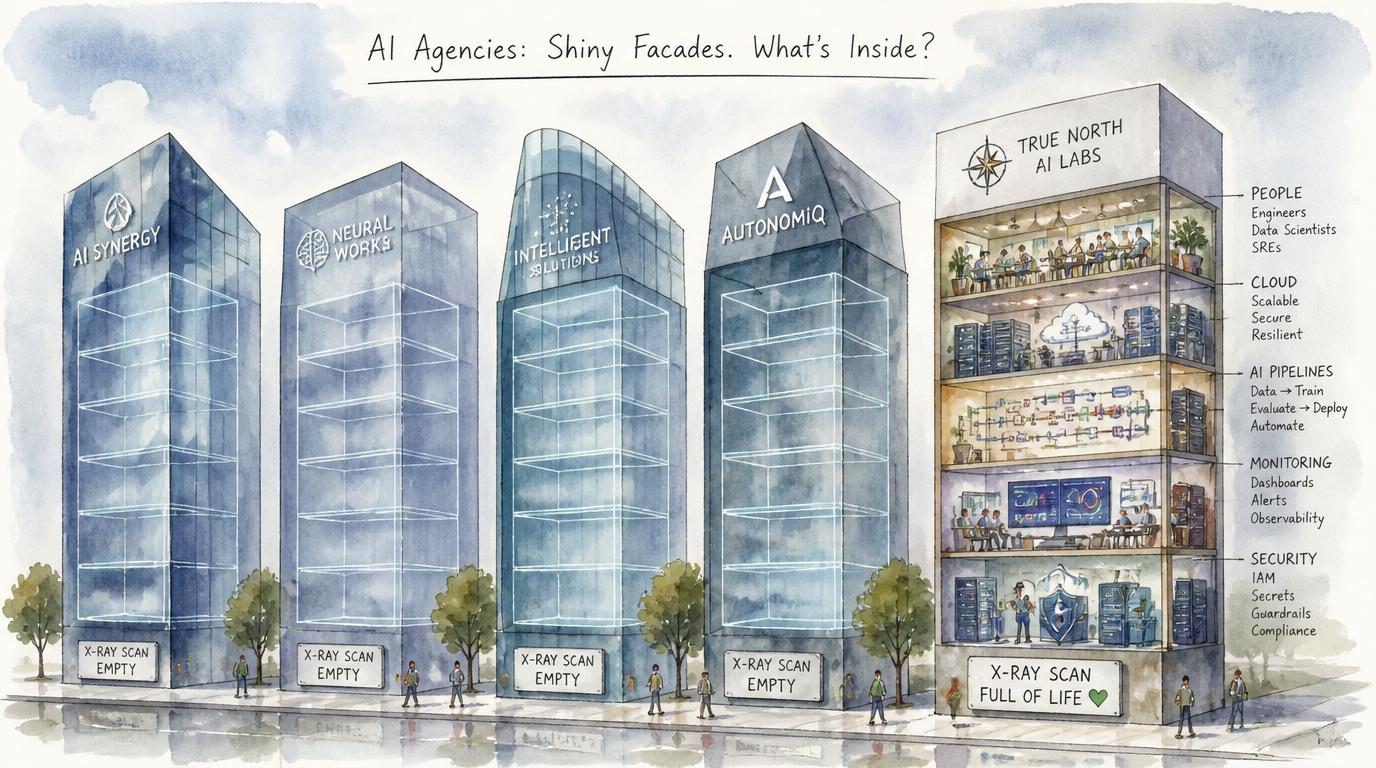
When you’re evaluating multiple AI development companies in parallel, gut feel doesn’t scale. Use a structured scoring approach. Here’s a simple framework you can run in a spreadsheet:
| Evaluation Dimension | Weight | Score 1–5 | Weighted Score |
|---|---|---|---|
| Production deployments (verified) | 20% | — | — |
| Full-stack engineering capability | 15% | — | — |
| Security and compliance answers | 15% | — | — |
| Domain/industry experience | 15% | — | — |
| MLOps and deployment maturity | 15% | — | — |
| UX / product mindset | 10% | — | — |
| Commercial clarity (ROI, TCO) | 10% | — | — |
Run the same framework across all shortlisted vendors after a 60-minute technical call. The scores don’t make the decision for you, but they surface where your gut response might be filling in gaps that actual evidence should fill.
Questions to Ask Before Hiring an AI Company
Use these directly in vendor conversations. The quality and specificity of the answers will tell you more than any marketing material.
| Question | What You’re Evaluating |
|---|---|
| What production AI systems have you launched? | Deployment maturity, not just PoC experience |
| How do you measure ROI on AI projects? | Commercial thinking and accountability |
| How do you handle PII and model security? | Security posture and compliance readiness |
| Can you integrate with our CRM / ERP / data stack? | Enterprise integration experience |
| What does post-launch support include? | Long-term commitment vs. ship-and-leave |
| How do you control inference costs at scale? | Operational cost management |
| Who specifically would work on our project? | Team quality, not just sales team quality |
That last question matters more than it sounds. The team that wins the pitch is often not the team that builds the product. Know who’s actually doing the work before you sign.
Red Flags to Avoid
Some of these appear in vendor conversations, some in proposals. All of them should slow you down:
- Only demo projects in their portfolio — lots of impressive screenshots, no production deployments you can verify
- Vague AI claims — “we use AI to enhance outcomes” with no specifics on what was built or how it worked
- No deployment experience — strong on research, weak on production engineering
- Security deflection — answering compliance questions with “that’s your responsibility” or “we follow best practices”
- No commercial ownership — unwilling to discuss ROI, TCO, or adoption metrics
- Overpromising timelines — AI projects have genuine uncertainty; teams that don’t acknowledge this are either naive or dishonest
- No maintenance model — delivering the initial build and disappearing is a known failure pattern in AI
- One-size engagement model — a vendor who offers only a fixed-price project with no discovery phase has probably never built something complex enough to require one
Delivery Model Examples
Reputable AI software companies will offer engagement structures that match where you are in your AI journey:
- AI strategy sprint — 2–4 weeks to map business use cases, assess data readiness, and define a prioritized roadmap
- Proof of concept — 4–8 weeks to validate a core hypothesis with a functional prototype before committing to full build
- MVP launch — full production build of a scoped system, typically 3–6 months
- Dedicated AI engineering team — an embedded team working continuously on your AI product roadmap, with full accountability for outcomes
- Team augmentation — specialist AI engineers who work alongside your internal team, useful when you have strong product direction but need execution capacity
- Long-term optimization retainer — ongoing model tuning, cost optimization, and feature iteration post-launch
The right engagement depends on your current state. If you’re pre-proof-of-concept, committing to a full production build without a discovery phase first is a risk you shouldn’t take. Consider starting with IT consulting services to scope the problem properly before any engineering begins.
Tech Stack Reference
For context on what a serious AI engineering stack looks like in practice:
| Layer | Typical Technologies |
|---|---|
| Frontend | React, Next.js |
| Backend | Python, Node.js |
| Cloud | AWS, Azure, GCP |
| AI / LLM | OpenAI APIs, open-source models (Llama, Mistral), vector databases (Pinecone, Weaviate, pgvector) |
| MLOps | MLflow, DVC, Weights & Biases |
| Infrastructure | Kubernetes, Docker, CI/CD pipelines |
| Monitoring | Prometheus, Grafana, custom LLM observability tooling |
This isn’t a prescription — different use cases require different stacks. But a team that can’t articulate their stack choices and trade-offs with specificity doesn’t have genuine engineering depth. Ask them to explain their vector database selection rationale on a past project. Vague answers are informative.
What AI Looks Like Across Industries
AI vendor selection isn’t uniform across sectors — the requirements shift meaningfully by vertical. Here’s a quick orientation:
Financial services — compliance, auditability, and model explainability are non-negotiable. Explore fintech software development to understand the specific requirements.
Real estate — property valuation models, investment analysis, document AI for contracts. See how this plays out in AI for real estate investment platforms.
Healthcare — HIPAA compliance, clinical workflow integration, responsible AI principles are table stakes. Responsible AI in healthcare is a good primer on what governance looks like in practice.
HR and workforce tech — bias detection, privacy-by-design, integration with existing HRIS platforms. HR software development and predictive analytics in HR explore these patterns.
SaaS — multi-tenant data isolation, per-customer model personalization, feature adoption tracking. AI in SaaS and building scalable SaaS architectures cover the architecture considerations.
Final Thoughts
The AI market is noisy. Vendors are everywhere, claims are large, and the technical vocabulary is dense enough to obscure real capability differences. But the fundamentals of good vendor selection haven’t changed: demonstrated track record, clear communication, accountability to outcomes, and evidence of engineering maturity.
The best AI software development company for your business combines real business understanding with production engineering depth, security competence, and the commercial discipline to deliver value you can actually measure. AI success is execution, not buzzwords.
If you’re evaluating partners or scoping your first serious AI initiative, our team works across strategy, engineering, and deployment. See our AI development services or explore our case studies to understand the kind of work we do.
Frequently Asked Questions
How do I choose an AI software development company?
Start by evaluating their production deployments — not demos, not case studies that end at MVP. Ask specific questions about MLOps practices, security controls, and how they measure ROI. Match their specialty areas to your actual use case and industry.
What should an AI vendor be able to deliver?
A capable AI development company should deliver end-to-end: business analysis, architecture, engineering, deployment, monitoring, and post-launch optimization. If any of those are missing, you’ll be filling the gap yourself.
How much does AI development cost?
It depends heavily on scope, data complexity, and integration requirements. Strategy sprints typically run $15,000–$40,000. Full production builds for enterprise AI systems commonly range from $150,000 to $800,000+. Ongoing inference and maintenance costs should be modeled separately from build cost.
What industries use AI software companies most?
Financial services, healthcare, logistics, e-commerce, SaaS, and real estate are currently the highest-activity sectors. But most industries with meaningful data and complex decisions are viable targets for AI investment.
Can AI companies integrate with enterprise systems?
Yes — but not equally. Ask specifically about integrations with your CRM, ERP, data warehouse, or industry-specific platforms. Enterprise integration experience varies significantly between vendors.
What is the difference between AI consulting and development?
AI consulting focuses on strategy, use case identification, and roadmap planning. AI development executes the build. The best partners do both — strategy without delivery capability is a roadmap without a vehicle.
How do I validate AI vendor experience?
Ask for references from production deployments, not just satisfied clients. Request architecture overviews from past projects. Ask what failed on past projects and how they responded. The ability to speak honestly about failure is a strong signal of maturity.
What are red flags when hiring an AI company?
Key red flags: portfolio with only demos and no verifiable production deployments, vague responses to security and compliance questions, inability to discuss ROI or total cost of ownership, and no clear post-launch support model.