


A chatbot built on an off-the-shelf API can go live in six weeks for the price of a mid-level developer’s salary. An enterprise-grade AI platform with custom model training, MLOps pipelines, and compliance tooling can run past seven figures and take a year or more. Both are “AI software,” and both show up in vendor pitch decks with equally confident price tags. That gap is the problem: most cost estimates buyers receive are anchored to a single project archetype, not to their own technical reality.
Before capital gets allocated, procurement teams and technical leadership need a shared understanding of what actually drives AI development cost — not a number, but a model. Model complexity, data readiness, infrastructure choices, and integration depth move budgets far more than headcount alone. This guide breaks down those variables the way a delivery team would scope them internally, then translates that into planning ranges executives can defend in a budget review.
Why AI Development Costs Vary So Much

The phrase “AI project” covers an enormous range of technical commitments. A retrieval-augmented chatbot wired to an existing knowledge base and a fine-tuned computer vision model trained on proprietary factory-floor imagery are both “AI,” but they draw on entirely different skill sets, timelines, and infrastructure budgets.
Three structural factors explain most of the spread in AI software development cost:
- Custom vs. pre-trained models. Calling an existing LLM API through prompt engineering and orchestration is inexpensive relative to training or fine-tuning a proprietary model on domain-specific data, which requires labeled datasets, GPU compute, and ML engineering time that off-the-shelf integrations skip entirely.
- Complexity tier. A single-purpose classifier is a different engineering problem than a multi-agent system that plans, calls tools, and maintains state across a long-running workflow.
- Business alignment. Projects scoped around a narrow, well-defined outcome (summarize support tickets) cost less than projects scoped around an ambiguous strategic goal (personalize the entire customer journey), because ambiguity gets resolved through iteration, and iteration costs engineering time.
Teams evaluating AI project cost early in planning tend to underweight the second and third factors. The model itself is often the cheapest line item; the surrounding decisions about scope and architecture are what move the total.
The Biggest Factors That Influence AI Development Cost
Once a team has decided roughly what kind of system it’s building, a smaller set of concrete variables determines AI development pricing:
- Project scope and use case depth — a narrow internal tool vs. a customer-facing product with SLAs.
- Data readiness — clean, labeled, accessible data shortens timelines; fragmented or unstructured data adds a data engineering phase before any model work starts.
- Model selection — API-based foundation models, open-source models self-hosted for data control, or custom-trained models, each with different cost curves.
- Third-party integrations — CRM, ERP, payment rails, or legacy systems each add connector work and testing surface.
- Compliance and security requirements — regulated industries (finance, healthcare) require audit trails, access controls, and often on-premise or region-locked inference, which raises both engineering and infrastructure cost.
- Scalability requirements — a proof of concept for one department scales differently than a system meant to serve an entire enterprise user base from day one.
Teams that experienced custom application development before adding an AI layer usually have an advantage here: the integration surface is already mapped, which removes one of the largest sources of scope creep.
AI Development Cost by Project Type
Different project archetypes carry structurally different cost profiles. The table below reflects typical planning ranges for mid-market to enterprise engagements — not fixed quotes, since scope, data maturity, and compliance requirements shift these ranges meaningfully in either direction.
| Project Type | Typical Budget Range (USD) | Typical Timeline | Primary Cost Driver |
|---|---|---|---|
| Rule-based / API chatbot | $15,000 – $50,000 | 4–8 weeks | Integration + conversation design |
| AI copilot (embedded assistant) | $40,000 – $150,000 | 2–4 months | Context retrieval, UI integration |
| Multi-step AI agent | $80,000 – $300,000 | 3–6 months | Tool orchestration, reliability testing |
| Predictive analytics module | $50,000 – $200,000 | 2–5 months | Data pipeline maturity |
| Recommendation engine | $60,000 – $250,000 | 3–6 months | Data volume, personalization depth |
| Computer vision system | $80,000 – $350,000 | 3–7 months | Labeled data, edge/inference infrastructure |
| Enterprise AI platform | $250,000 – $1M+ | 6–14 months | Architecture, compliance, MLOps maturity |
Organizations exploring AI/ML development services for the first time often start at the copilot or predictive-analytics tier, using it as a proof point before committing enterprise-platform budget. That sequencing is defensible: it produces a working reference architecture and real usage data before the highest-cost decisions get locked in.
Cost Breakdown by Development Phase
AI projects don’t spend evenly across their lifecycle. Model integration and testing typically consume a larger share of budget than in conventional software projects, because model behavior has to be validated against edge cases that don’t show up in a functional spec.
Discovery & Data Audit → Architecture & Model Selection → UX / Interaction Design
│ │ │
▼ ▼ ▼
Core Development → Model Integration & Tuning → QA & Evaluation
│ │ │
└──────────────────────────┴────────────────────────────────┘
▼
Deployment & MLOps Handoff → Ongoing Support
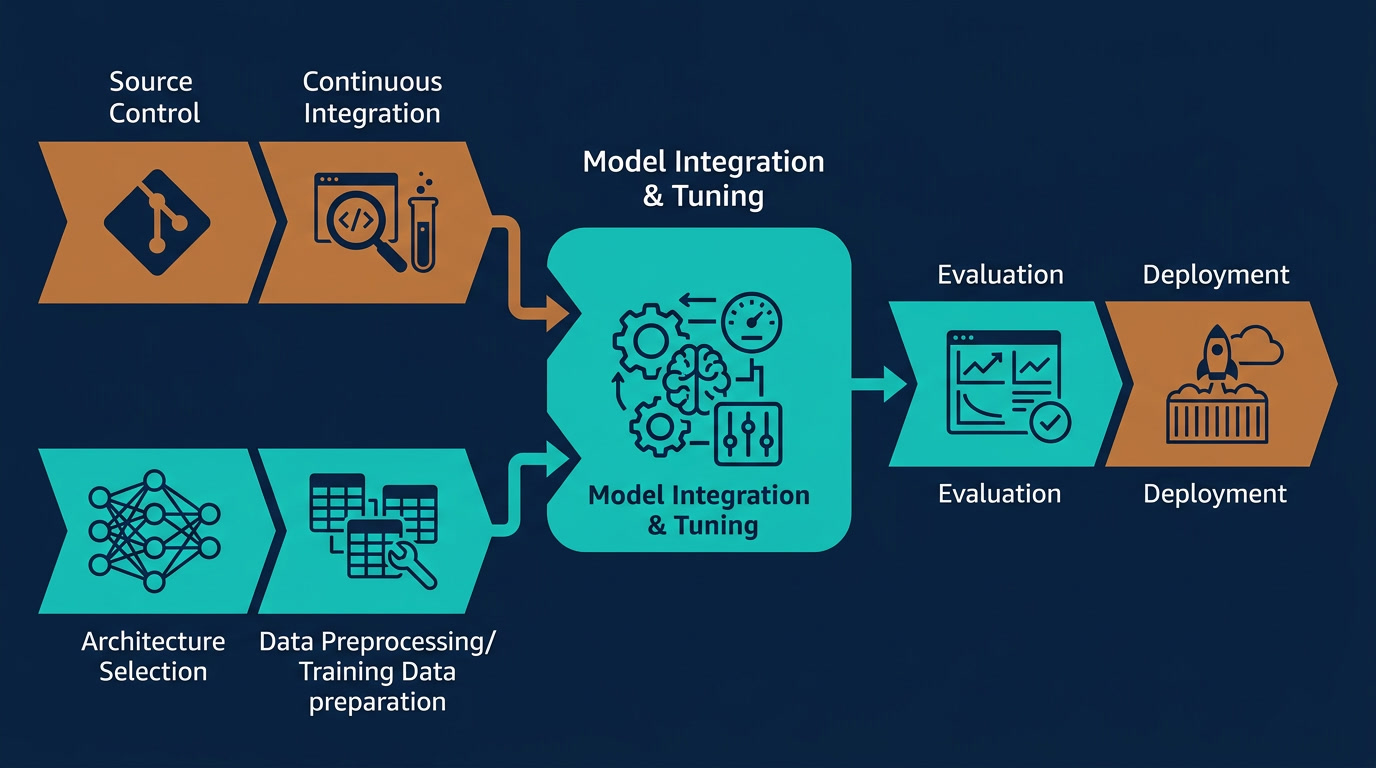
A realistic phase-by-phase allocation for a mid-sized AI implementation cost:
- Discovery & data audit (10–15%): Assessing data quality, defining success metrics, and scoping model feasibility before any code is written.
- Architecture & model selection (10%): Choosing between API-based, open-source self-hosted, or custom-trained approaches.
- Design (5–10%): UX for AI-specific interaction patterns — confidence indicators, fallback states, human-in-the-loop review.
- Core development (25–30%): Application logic, APIs, and the surrounding product surface.
- Model integration and tuning (15–20%): Prompt engineering, fine-tuning, or retraining cycles based on real feedback.
- Testing and evaluation (10–15%): Accuracy benchmarking, adversarial testing, bias and safety review — a phase conventional software testing plans often underestimate.
- Deployment and support (10%): Rollout, monitoring setup, and the first stabilization period.
Infrastructure Costs Beyond Development
Development cost is a one-time investment. Infrastructure is recurring, and it’s the line item most buyers underestimate when comparing vendor quotes, because a lower initial development quote can hide a higher long-term AI infrastructure cost.
| Infrastructure Component | Typical Monthly Range | Notes |
|---|---|---|
| LLM API usage (token-based) | $500 – $20,000+ | Scales directly with usage volume and model tier |
| GPU compute (self-hosted models) | $2,000 – $30,000+ | Required only for custom-trained or self-hosted models |
| Cloud hosting & orchestration | $500 – $10,000 | Application layer, not model-specific |
| Vector database | $200 – $5,000 | Scales with embedding volume and retrieval frequency |
| Observability & monitoring | $300 – $3,000 | Model drift detection, latency, and cost tracking |
| Security & access controls | $500 – $5,000 | Higher for regulated industries |
Companies weighing cloud and DevOps consulting alongside their AI roadmap tend to right-size this layer earlier, which avoids the common pattern of an efficient application layer sitting on top of an oversized, underutilized compute reservation.
Team Composition and Its Impact on Budget
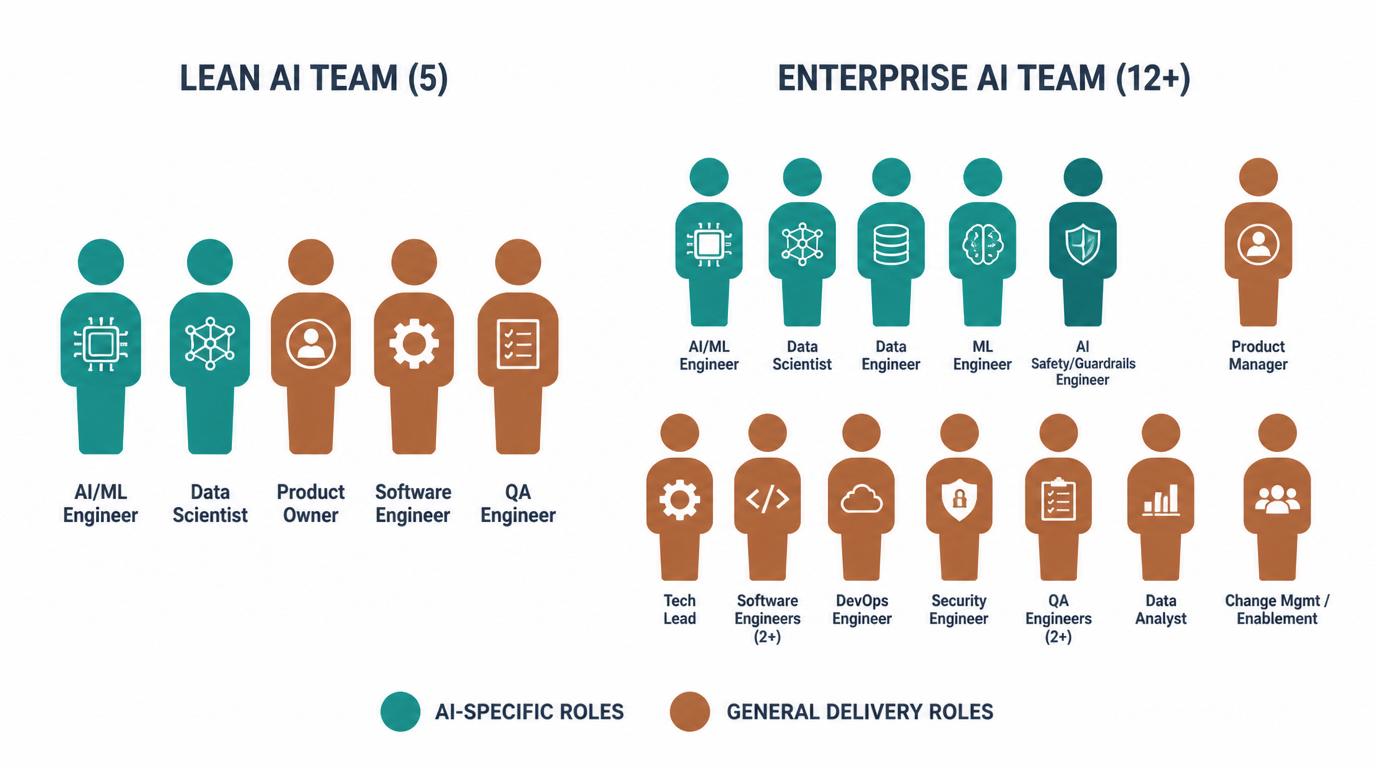
Team shape has as much influence on the final number as any technical decision. A lean team moves faster on narrow scope; a full delivery team is what regulated or high-availability systems require.
| Role | Lean Startup Team | Full Enterprise Team |
|---|---|---|
| AI/ML Engineer | 1 | 2–3 |
| MLOps Engineer | Shared/part-time | 1–2 dedicated |
| Backend Developer | 1 | 2–3 |
| Frontend Developer | 1 | 2 |
| QA Engineer | Part-time | 1–2 dedicated |
| UI/UX Designer | Part-time | 1 dedicated |
| Project Manager | Shared | 1 dedicated |
| Estimated team size | 3–5 | 10–14 |
Teams that engage dedicated development center resources for AI initiatives generally land between these two models — enough specialization to cover MLOps and QA properly, without the overhead of a full in-house enterprise bench built for a single project.
Hidden Costs Companies Often Miss
The line items above a proposal are rarely where budgets actually break. The costs that derail forecasts tend to be:
- Data engineering and cleaning — often 20–30% of total project time on projects with legacy or fragmented data sources, and almost never scoped accurately at the proposal stage.
- Compliance certifications — SOC 2, HIPAA, or financial-sector audits add both calendar time and specialized engineering hours that general-purpose AI vendors may not have in-house.
- Model retraining cadence — a model’s accuracy degrades as real-world data drifts from training data; retraining isn’t optional maintenance, it’s a recurring line item.
- Technical debt from rapid prototyping — MVP-stage shortcuts (hardcoded prompts, unvalidated data assumptions) that need to be re-engineered before a system can scale reliably.
- Continuous monitoring — tracking for model drift, hallucination rate, and cost-per-query at production volume, which is a different discipline from conventional application monitoring.
These are the primary contributors to AI operational costs that surface six to twelve months after launch, well past the point where the original budget conversation happened.
How to Optimize AI Development Costs
Cost optimization in AI projects isn’t primarily about negotiating a lower hourly rate — it’s about sequencing decisions so that the most expensive commitments happen after the cheapest ones have de-risked them.
- Start with an MVP scoped to one measurable outcome, not a platform. A narrow, well-instrumented MVP produces the usage data needed to justify (or reject) further investment.
- Default to fine-tuning or API-based models before building from scratch. Custom model training is justified when the use case has no viable off-the-shelf equivalent — not as a default starting point.
- Prioritize the highest-value feature first, and resist scope expansion until that feature is validated in production.
- Scale infrastructure in phases, matching GPU and hosting commitments to actual usage rather than provisioning for a hypothetical peak.
- Select vendors based on delivery track record with comparable complexity, not lowest bid — a change explored further in this comparison of AI software development companies.
ROI Planning Framework:
- Define the metric the AI system is expected to move (cost-per-ticket, conversion rate, cycle time) before development starts.
- Establish a baseline measurement pre-launch so post-launch impact is attributable, not assumed.
- Set a review checkpoint at 90 days post-launch to compare actual infrastructure spend against the original projection.
- Reassess build-vs-buy at each major scaling decision, since the calculus that justified an MVP approach often shifts once usage volume changes the unit economics.
Budget Planning Checklist
- Business goal and success metric defined before technical scoping begins
- Data readiness assessed (quality, volume, accessibility, labeling status)
- Model approach decided (API-based, open-source self-hosted, or custom-trained)
- Integration surface mapped (CRM, ERP, legacy systems, payment or identity providers)
- Compliance and security requirements identified early, not retrofitted
- Infrastructure costs modeled at expected production volume, not pilot volume
- Team composition matched to project complexity, not organizational default
- Maintenance and retraining cadence budgeted as a recurring line, not a one-time cost
- ROI checkpoint scheduled for 90 days post-launch
Final Thoughts
The cheapest AI development quote is rarely the cheapest AI system over its lifetime. A low upfront number that skips data engineering, understates infrastructure, or defers compliance work doesn’t remove that cost — it moves it downstream, usually at a point where it’s more expensive to fix. The organizations that get the most durable value from AI investment are the ones that treat architecture, governance, and maintenance as part of the original budget conversation, not as line items to revisit later. Firms that have already gone through AI integration planning with a technical partner tend to build that discipline in from the start, which is ultimately what separates a working prototype from a system the business can depend on.
Frequently Asked Questions
How much does AI software development cost? Most projects fall between $15,000 for a narrow, API-based chatbot and $1M+ for a full enterprise AI platform. The right figure depends far more on data readiness, integration depth, and compliance needs than on the AI model itself.
What affects AI project pricing? Scope, data quality, model choice (API-based vs. custom-trained), integration complexity, compliance requirements, and scalability expectations are the primary drivers — model licensing is usually a smaller line item than teams expect.
How much does it cost to build an AI chatbot? A rule-based or API-integrated chatbot typically runs $15,000–$50,000. Costs rise significantly if the chatbot needs to reason across multiple systems, maintain long conversational context, or meet regulatory requirements around data handling.
Why are enterprise AI platforms more expensive? Enterprise platforms require custom architecture, dedicated MLOps infrastructure, compliance certifications, and teams sized for high availability — costs that don’t apply to a single-purpose pilot project but are non-negotiable at production scale.
How much do AI APIs cost? API-based model usage is typically token-based and can range from a few hundred to tens of thousands of dollars monthly depending on query volume, model tier, and context length — a cost that scales with adoption rather than staying fixed.
Can startups afford custom AI software? Most startups are better served by API-based or fine-tuned approaches rather than fully custom-trained models, which require data volume and infrastructure investment that rarely make sense before product-market fit is established.
How can companies reduce AI development costs? Sequencing matters more than negotiating: start with a scoped MVP, default to existing models before building custom ones, phase infrastructure to match real usage, and choose a delivery partner with a track record in comparable-complexity projects.
Compliance & Estimate Disclaimer: All figures in this guide are directional planning ranges based on typical market engagements, not binding quotes. Actual costs depend on scope, data maturity, compliance jurisdiction, and vendor selection, and should be confirmed through a scoped discovery process before budget is finalized.