

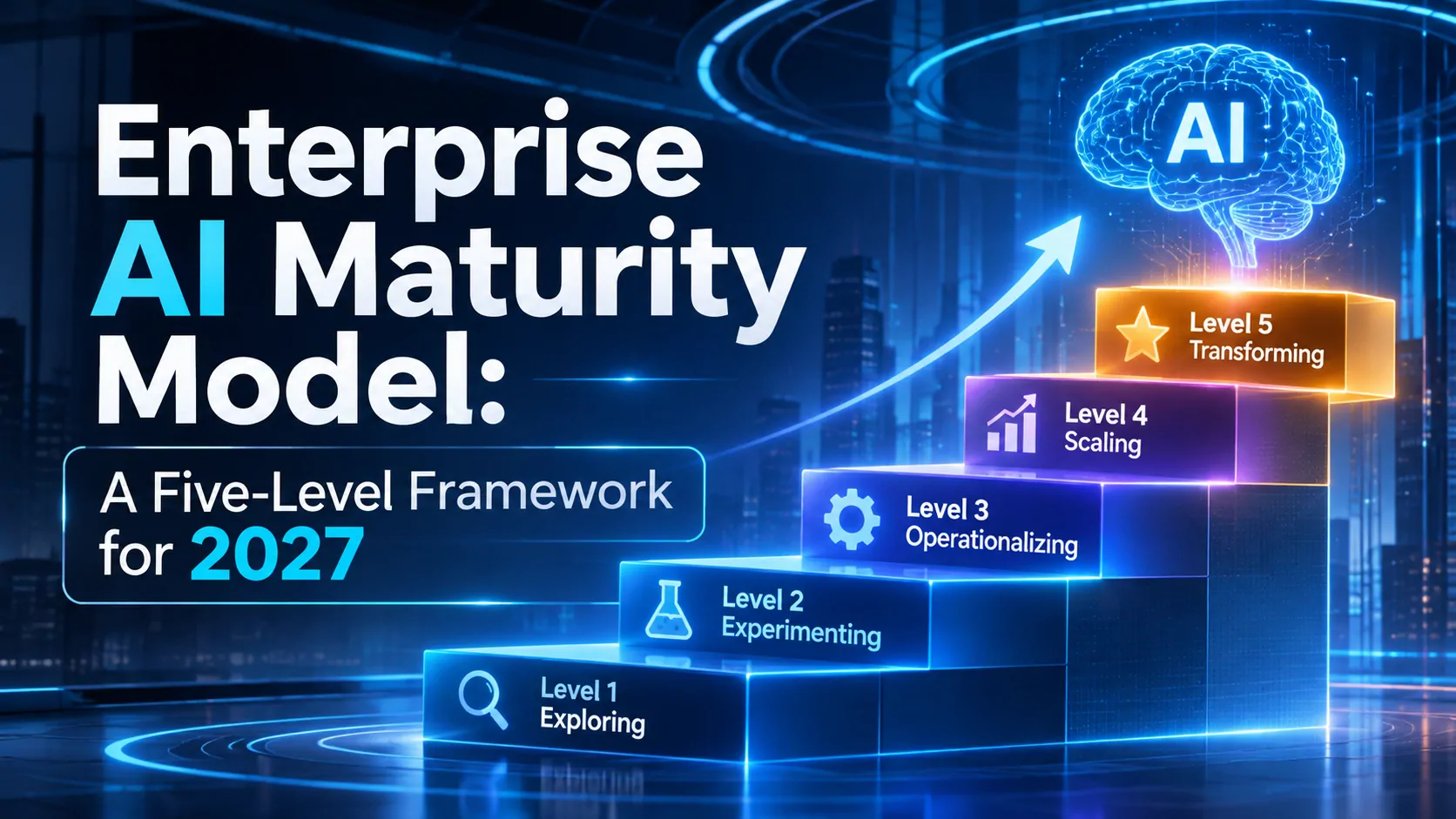
By 2027, enterprise AI will no longer be defined by how many models an organisation has deployed, but by how reliably those models are governed, operated and improved at scale. The Genius Software Enterprise AI Maturity Framework provides a practical, five-level model to assess where your organisation stands today and what capabilities are required to move from isolated experiments to adaptive, portfolio-level AI operations.
Executive Summary — What Enterprise AI Maturity Means in 2027
Our work with enterprise technology leaders and platform teams across regulated and high-transaction industries reveals six findings that should shape every AI investment decision in 2027.
Finding 1: Most enterprises overestimate their AI maturity because they conflate pilot deployment with production-grade operations. A proof-of-concept that lacks monitoring, rollback procedures or cost accountability is not evidence of maturity; it is evidence of risk.
Finding 2: Governance, not model count, is the primary constraint on scalable AI. Organisations with three well-governed production models often outperform peers with twenty shadow deployments because they can explain, reproduce and retire their systems safely.
Finding 3: Organisational capabilities lag behind technical implementation by an average of 18 to 24 months. Engineering teams frequently deliver pipelines before the business has defined decision rights, risk appetite or outcome ownership.
Finding 4: Data infrastructure readiness is the silent bottleneck in the majority of scaling attempts. Without lineage, quality SLAs and domain-oriented access patterns, models decay faster than teams can retrain them.
Finding 5: Maturity is inherently multi-dimensional. High scores in AI engineering can mask critical gaps in risk management and business alignment. A single weak dimension can prevent an organisation from advancing to the next level.
Finding 6: A reproducible scorecard enables objective investment decisions and reduces reliance on vendor self-assessment. Maturity should be measured against demonstrated capability, not roadmap promises.
What Executives Should Assess Before Approving Further AI Investment
There are several option to consider:
| Assessment Criteria | Questions to Answer | Evidence Required |
|---|---|---|
| Production Reliability | Are models monitored for drift, bias and latency in production? | Incident logs, monitoring dashboards, runbooks |
| Governance Coverage | Is there a named owner for AI risk in every major business unit? | RACI charts, policy documents, committee minutes |
| Data Provenance | Can we trace training data lineage back to source systems? | Data catalog, lineage tools, schema registries |
| Business Metric Linkage | Do AI initiatives have defined P&L, efficiency or growth targets? | Business case documentation, ROI dashboards |
| Operational Run Cost | Do we know the fully loaded cost per inference, retraining cycle and data label? | Cost allocation reports, FinOps dashboards |
| Talent & Change Management | Do business teams have embedded AI liaisons or translators? | Organisational charts, training records, role definitions |
What Is Enterprise AI Maturity?
Enterprise AI maturity is the organisation’s demonstrated capability to develop, integrate, govern, operate and improve AI systems in continuous alignment with business objectives. It is not a statement of intent, a budget line or a vendor contract. It is the observable ability to treat AI as a durable, scalable and accountable layer of the enterprise technology stack.
Mature organisations can answer three questions without heroic effort: What models are running in production? How do we know they are still fit for purpose? And what will it cost to replace or retrain them?
AI Adoption vs. AI Readiness vs. AI Maturity
Three options are clearly shown:
| Dimension | AI Adoption | AI Readiness | AI Maturity |
|---|---|---|---|
| Purpose | Measure usage, deployment volume and user penetration | Assess preconditions for safe and effective implementation | Evaluate sustained operational capability and improvement |
| Measurement Approach | Count of tools, pilots, active users and departments | Checklist of data, skills, infrastructure and policy prerequisites | Scored capability across strategy, engineering, governance and people |
| Typical Business Question | “How many departments are already using AI?” | “Can we deploy a model without technical or compliance failure?” | “Can we govern, improve and scale AI as a managed portfolio?” |
| Time Orientation | Past and present state of deployment | Future potential and immediate blockers | Current demonstrated ability and rate of capability growth |
| Primary Risk | Vanity metrics that hide technical debt | Static snapshot that ignores operational complexity | Over-engineering maturity beyond actual business need |
Why AI Maturity Cannot Be Measured by Adoption Alone
Measuring maturity through AI tool counts, pilot counts or employee usage creates a dangerous illusion of progress. Adoption metrics reward activity without requiring reliability, accountability or return.
Consider a hypothetical retail bank that has launched twelve AI pilots across marketing, fraud and operations. Four models are running in production. However, each project uses a separate data pipeline, there is no unified model inventory, logging standards differ by team, and no executive owns AI risk at the enterprise level. When a credit-risk model degrades, the response depends on which data scientist is available. When regulators ask for an explanation of a declined loan, the bank cannot reproduce the decision path without manual effort.
This organisation has high adoption and low maturity. It has proven that AI is technically feasible, but not that it is operationally sustainable. Maturity requires evidence that the organisation can manage AI systems under real-world conditions of drift, demand spikes, staff turnover and regulatory scrutiny.
The Five Levels of Enterprise AI Maturity
The Genius Software Enterprise AI Maturity Framework defines five levels of demonstrated capability. This is a proprietary editorial model designed for practical self-assessment. It is not an official Gartner, NIST or ISO maturity scale, although it is informed by standards-based concepts from those sources.

The appropriate target maturity depends on your risk exposure, business strategy and expected return. Not every organisation needs to reach Level 5. A specialised industrial manufacturer with low customer-facing AI risk may operate sustainably at Level 3, while a global financial services firm may require Level 4 or 5 to meet regulatory and competitive demands.
Level 1 — Exploratory
Defining Characteristics:
AI activity consists of isolated experiments led by individual data scientists or small teams. There is limited executive ownership, no enterprise budget and no formal governance. Business cases are often aspirational and disconnected from corporate strategy.
Technical Capabilities:
Development occurs primarily in local notebooks with manual data pulls. There is no continuous integration or delivery for machine learning. Models are rarely versioned, and reproducibility depends on individual memory.
Governance Practices:
Reviews are informal and ad-hoc. There is no enterprise risk taxonomy for AI. Ethics and security assessments happen only when a business unit insists on them.
Measurable Evidence:
Zero to one model in limited or shadow production. No defined SLAs. No incident response history.
Conditions for Progression to Level 2:
At least one use case must move to controlled production with defined acceptance criteria, rollback procedures and a named business owner.
Level 2 — Emerging
Defining Characteristics:
Initial production use cases exist, but processes are inconsistent. Ownership is fragmented between data science, IT and business units. Issue management is reactive rather than systematic.
Technical Capabilities:
Models are deployed via basic APIs or batch scoring jobs. Testing is manual and project-specific. Logging exists but is not standardised, making cross-project comparison difficult.
Governance Practices:
Policies are defined at the project level. Security reviews are conducted during implementation, but there is no central model registry or enterprise AI policy. AI agent readiness assessment efforts may begin here, but they remain separate from broader operational maturity.
Measurable Evidence:
One to three production models with basic performance tracking. Known failure points are documented, though not systematically addressed.
Conditions for Progression to Level 3:
A repeatable deployment process must be established, including automated testing, monitoring and a shared model inventory.
Level 3 — Operational
Defining Characteristics:
The organisation can repeatably deploy, evaluate and monitor AI systems. A dedicated AI operations or MLOps function exists. LLMOps practices are standardised for language models where relevant.
Technical Capabilities:
Automated retraining pipelines are in place. Feature stores or shared feature layers are available. A/B testing and shadow deployments are used to validate changes before full rollout.
Governance Practices:
A centralised model registry is enforced. Risk tiers are defined and applied during intake. Regular audits review model performance, fairness and security controls.
Measurable Evidence:
Five or more governed models in production. Drift detection is active. Mean time to resolution for AI incidents is under 48 hours.
Conditions for Progression to Level 4:
AI capabilities must move beyond a single department or platform to become a shared enterprise service with cross-functional governance.
Level 4 — Integrated
Defining Characteristics:
Shared AI platforms and reusable components reduce duplication. A cross-functional governance committee aligns AI investments with business strategy. Outcomes are measurable and tied to enterprise KPIs.
Technical Capabilities:
Microservices and reusable model APIs dominate the architecture. A unified feature platform supports multiple business units. Infrastructure abstracts across cloud and on-premise environments where required.
Governance Practices:
Enterprise AI policy is enforced through workflow automation. Compliance checks are embedded in deployment pipelines. Human-in-the-loop review is mandatory by default for high-risk decisions.
Measurable Evidence:
A portfolio dashboard shows ROI, risk exposure and model count by business unit. Fewer than 5 percent of critical incidents remain unexplained after root-cause analysis.
Conditions for Progression to Level 5:
The organisation must demonstrate continuous optimisation, strategic portfolio governance and the ability to adapt AI strategy as market conditions change.
Level 5 — Adaptive
Defining Characteristics:
AI is treated as a core competitive capability. The organisation continuously optimises its AI portfolio, retires low-value systems automatically and aligns AI strategy with corporate strategy in real time.
Technical Capabilities:
Adaptive experimentation, automated model selection and cost-aware inference routing are standard. Technology consulting engagements at this stage focus on ecosystem integration and emerging architecture patterns rather than foundational delivery.
Governance Practices:
Dynamic risk assessment updates controls as models and data evolve. Real-time audit trails satisfy both internal and external scrutiny. Regulatory engagement is proactive, not reactive.
Measurable Evidence:
More than 80 percent of AI initiatives meet target ROI within two quarters. Time from business concept to production deployment is under 30 days for standard use cases.
The Six Dimensions of Enterprise AI Maturity
Maturity cannot be reduced to a single score or a simple count of deployed models. The framework evaluates six distinct dimensions that together determine whether an organisation can build, run and improve AI safely and profitably. Each dimension captures a different layer of the AI operating model, from executive strategy to frontline execution.
Strategy and Business Alignment
Mature AI strategy is indistinguishable from business strategy. It defines where AI will create value, how success is measured and who is accountable for outcomes.
| Capability Level | Evidence |
|---|---|
| Weak | No enterprise portfolio view; AI projects are disconnected experiments funded by individual departments. |
| Intermediate | Business cases include defined KPIs; prioritisation considers both value and feasibility; enterprise digital transformation goals are linked to AI roadmaps. |
| Advanced | AI strategy is integrated into corporate planning; re-prioritisation occurs dynamically based on market signals and performance data. |
Data Infrastructure and Readiness
Data is the substrate of every AI system. Without quality, lineage and accessibility, models cannot be maintained at scale.
| Capability Level | Evidence |
|---|---|
| Weak | Data access depends on manual requests; no quality SLAs; lineage is unknown. |
| Intermediate | A data catalog is available; quality rules are defined for major sources; data engineering capabilities are aligned to AI consumption patterns. |
| Advanced | Real-time lineage, automated quality gates and domain-oriented data products support self-service AI development. |
AI Engineering and Architecture
Engineering maturity determines whether AI systems can evolve without breaking downstream dependencies.
| Capability Level | Evidence |
|---|---|
| Weak | Notebook-based development; manual deployment; no standard integration patterns. |
| Intermediate | Automated training pipelines; containerised deployment; basic API management. |
| Advanced | Modular MLOps platform; reusable model services; scalable feature engineering and low-latency inference patterns. |
AI Operations and Observability
Operational maturity separates experimental AI from production AI. Observability must cover data, model and system behaviour.
| Capability Level | Evidence |
|---|---|
| Weak | No production monitoring; issues are reported by business users after impact has occurred. |
| Intermediate | Automated alerting for latency, errors and throughput; periodic model evaluation schedules exist. |
| Advanced | Full observability including data drift, concept drift, bias metrics and cost per prediction; automated rollback and incident response are in place. |
AI Governance and Risk Management
Governance is the envelope that makes scaling safe. It includes accountability, risk classification, human oversight and auditability.
| Capability Level | Evidence |
|---|---|
| Weak | No enterprise risk taxonomy; approvals rely on personal relationships rather than policy. |
| Intermediate | Risk classification by use case; documented approval workflows; periodic human review. |
| Advanced | Automated policy enforcement; continuous auditability; independent ethics review; integration with enterprise GRC platforms. |
Talent and Operating Model
People and process maturity determines whether capabilities survive leadership changes and team turnover.
| Capability Level | Evidence |
|---|---|
| Weak | Data science is the only recognised AI role; business and IT remain siloed. |
| Intermediate | Cross-functional pods deliver AI products; ML engineering and AI product roles are defined; training programs exist. |
| Advanced | Federated AI centres of excellence support business units; product-oriented AI teams own outcomes; upskilling is embedded in HR cycles. |
How to Calculate Your Enterprise AI Maturity Score
The framework uses a reproducible assessment methodology. Each of the six dimensions is scored on a scale of 1 to 5 using the following anchors:
| Score | Anchor |
|---|---|
| 1 | Ad-hoc or absent |
| 2 | Developing and partial |
| 3 | Defined and repeatable |
| 4 | Managed and integrated |
| 5 | Optimising and adaptive |
The descriptive average is calculated as:
M = ( Σ Si ) / 6
Where Si represents the score for each of the six dimensions.
Illustrative Organisation Assessment
| Dimension | Score |
|---|---|
| Strategy and Business Alignment | 4 |
| Data Infrastructure and Readiness | 3 |
| AI Engineering and Architecture | 3 |
| AI Operations and Observability | 2 |
| AI Governance and Risk Management | 2 |
| Talent and Operating Model | 3 |
| Average | 2.83 / 5 |
The average of 2.83 is a descriptive summary, not automatically the maturity level. A weak governance or operations score may prevent an organisation from qualifying for a higher level even when its average is elevated.
Level-Assignment Rules
The Genius Software framework applies the following rules to convert dimension scores into an overall maturity level:
- Foundation Rule: The overall maturity level cannot exceed the lowest score among Governance, Strategy and Operations. These dimensions form the operational foundation.
- Minimum Threshold Rule: If any dimension scores 1, the maximum overall level is 2 (Emerging), regardless of the average.
- Integrated Qualification: To qualify for Level 4 (Integrated), at least four dimensions must score 4 or higher, and no dimension may score below 3.
- Adaptive Qualification: To qualify for Level 5 (Adaptive), all dimensions must score 4 or higher, and at least four dimensions must score 5.
- Default Calculation: If none of the above rules apply, the level is the average rounded down to the nearest integer.
In the illustrative example above, Governance and Operations both score 2. Under the Foundation Rule, the organisation is capped at Level 2 (Emerging) despite the higher average. This reflects the reality that strong engineering cannot compensate for an inability to manage risk or respond to production incidents.
Building an Enterprise AI Maturity Roadmap for 2027
Moving from one maturity level to the next requires more than technology investment. It demands coordinated changes in governance, talent, data architecture and operational process. The following 90-day roadmap provides a practical sequence for building foundational AI capabilities and preparing for longer-term scaling.
First 30 Days — Establish the Baseline
Owners: Chief AI Officer, Enterprise Architect
Deliverables: Completed self-assessment, inventory of production and shadow models, stakeholder responsibility map
Success Measures: Known maturity score for each of the six dimensions; no unowned models in production
Dependencies: Executive sponsorship and access to model metadata, incident logs and data catalogs
Days 31–60 — Prioritise Capability Gaps
Owners: COO, CISO, AI Product Lead
Deliverables: Prioritised capability backlog, quick-win plan, business case for foundational investments
Success Measures: Three priority capabilities selected based on risk and value; funding allocated for Phase 3
Dependencies: Baseline assessment complete; business unit leaders available for prioritisation workshops
Days 61–90 — Implement Foundational Controls
Owners: AI Engineering, Governance and Risk
Deliverables: Central model registry, baseline monitoring for all production models, AI policy version 1.0
Success Measures: 100 percent of production models registered; incident response runbooks tested; all high-risk use cases documented
Dependencies: Budget released; platform team capacity reserved; legal and compliance review completed
Beyond 90 Days — Scale and Reassess
Owners: Business Unit Leaders, Platform Team, HR Business Partners
Deliverables: Reusable AI components, enterprise training program, quarterly reassessment cycle
Success Measures: Increase of at least one full maturity level within 12 months; 80 percent of new projects reuse standard components
Dependencies: Cultural readiness for cross-functional ownership; continuous improvement mindset embedded in performance goals
Common AI Maturity Assessment Mistakes
Even experienced technology leaders make predictable errors when evaluating AI maturity. Recognising these mistakes early can prevent costly misinvestment and false confidence.
Overestimating maturity from pilot success
A successful proof-of-concept proves feasibility, not operational readiness. Pilots often run on cleansed data, with top-tier engineers and without compliance scrutiny.
Ignoring operational costs
Inference, retraining, data labelling, monitoring and incident response create a long-term cost profile that can exceed initial development spend by a factor of three to five.
Relying on self-reported capability
Vendor assessments and internal surveys suffer from optimism bias. Maturity should be verified through documentation, system demos and incident history.
Measuring technology without business outcomes
Pipeline count, model registrations and deployment frequency are useful engineering metrics, but they are not substitutes for ROI, risk reduction or customer outcome evidence.
Treating maturity as a one-time exercise
AI maturity decays without maintenance. New regulations, model drift and organisational change require quarterly reassessment, not annual checkbox exercises.
Strategic Recommendations for Enterprise Leaders
Maturity-based strategy must be segmented. Advice that helps a Level 2 organisation can harm a Level 4 organisation, and vice versa. The following recommendations are tailored to three maturity bands.
Organisations at Levels 1–2
Stop acquiring new AI tools until you have established governance for the ones already in use. Focus on one production pipeline that includes monitoring, rollback and a named business owner. Prioritise data access and quality for that single use case before expanding. Resist the temptation to measure progress by pilot count.
Organisations at Level 3
Your immediate goal is standardisation. Invest in a unified AI platform, observability tooling and FinOps discipline so that you understand the true cost of every model. Build business outcome tracking into every active use case. This is the stage where many organisations stall because they confuse repeatable delivery with strategic integration.
Organisations at Levels 4–5
Shift from project delivery to portfolio optimisation. Retire low-value models actively. Invest in adaptive experimentation, automated compliance and ecosystem integration. Ensure that your AI strategy co-evolves with corporate strategy, not behind it. At this level, competitive advantage comes from how quickly you can reallocate AI investment when market conditions change.
Methodology, Limitations and References
It is useful to pay attention to those:
Model Construction
The Genius Software Enterprise AI Maturity Framework was constructed through practitioner synthesis of enterprise AI delivery patterns, platform architecture reviews and governance implementation across regulated and high-scale industries. Dimension selection was guided by the need to cover the full AI lifecycle from strategy through retirement, not only model development.
Scoring Assumptions
The 1–5 scale is ordinal. Equal weighting across dimensions is applied in the descriptive average, but the level-assignment rules recognise that governance, strategy and operations are foundational. Organisations in specialised sectors may adjust dimension weights after initial baseline assessment.
Limitations
This framework is based on expert judgement and structured observation. It has not been empirically validated through a global survey or longitudinal study. Scores are subject to rater bias; we recommend conducting assessments with mixed teams from business, engineering and risk functions. Industry-specific adjustments may be required for sectors with unique regulatory or safety constraints, such as pharmaceuticals, defence or critical infrastructure.
Difference Between Expert Judgement and Validated Benchmarks
Standards such as NIST AI RMF, ISO/IEC 42001 and OECD AI Principles provide normative guidance on risk management, management systems and trustworthy AI. This framework translates those concepts into a practical maturity scale for internal self-assessment. It does not claim to certify compliance or replicate the empirical validation processes used in psychometric or large-scale benchmarking research.