


Enterprise AI spending has crossed the point where it’s a line item every board asks about, yet the graveyard of stalled proof-of-concepts keeps growing. Most of those POCs don’t die because the model was wrong — they die because the underlying architecture couldn’t survive contact with production data, production traffic, or a production compliance review. A chatbot demo that works beautifully on curated test prompts often collapses within weeks of real users, real edge cases, and real security audits.
This guide promises something most vendor-comparison content doesn’t: an objective framework for auditing potential AI partners across three dimensions that actually predict project survival — data governance, infrastructure scaling, and technical capability. Not a vendor’s own scorecard dressed up as “objective,” but the same diligence questions a technical due-diligence team would bring to an acquisition.
What follows is the evaluation scorecard, the technical benchmarks worth interrogating (RAG architecture, MLOps maturity, agentic orchestration), the red flags that precede failed engagements, and the engagement models that map to different levels of internal AI maturity.
Why Choosing the Right AI Partner Matters
Traditional software engineering is deterministic. Given the same inputs, a well-tested function returns the same output every time, and QA can verify correctness with a fixed test suite. AI systems — particularly those built on large language models — are probabilistic. The same prompt can return different phrasing, different reasoning paths, and occasionally different conclusions on two separate runs. That single shift changes almost everything about how a project should be scoped, tested, and governed.
Teams that don’t internalize this distinction end up with what looks like technical debt but is actually architectural debt: pipelines built for a deterministic world, bolted onto a probabilistic system. Common symptoms include prompt logic hardcoded into application code with no versioning, no evaluation harness to catch regressions when a model provider updates weights, and no fallback path when a model call times out or hallucinates a malformed response.
Vendor lock-in compounds the problem. An agency that builds an entire product around a single model provider’s proprietary tooling — with no abstraction layer between the application and the inference layer — leaves the client unable to switch providers when pricing changes, rate limits tighten, or a newer model outperforms the incumbent on the client’s specific task. A partner worth hiring designs for model portability from day one, even while defaulting to a single provider for the initial release. Organizations exploring what this looks like in practice can review how a dedicated AI development team structures orchestration layers to stay provider-agnostic.
Defining Business Intent & Technical Scope
Before any vendor conversation starts, the buying team needs internal clarity on which category of AI problem it’s actually solving, because the two dominant categories require different skill sets, different data pipelines, and different risk controls.
Generative AI covers LLM-powered applications: conversational agents, document synthesis, code generation, and increasingly, agentic workflows where a model plans and executes multi-step tasks with limited human intervention. Predictive AI covers classical machine learning: churn models, demand forecasting, fraud scoring, and other systems trained on structured historical data to predict a specific numeric or categorical outcome.
The two often get conflated in vendor pitches, and that conflation is itself a warning sign. A team strong in predictive modeling — gradient boosting, time-series forecasting, feature engineering — doesn’t automatically transfer that strength to prompt orchestration and retrieval architecture, and vice versa. Buyers should map their actual use case to the right technical lineage before evaluating anyone’s portfolio.
Two more scoping questions determine everything downstream:
- Data compliance boundary — does the use case involve regulated data (health records, financial transactions, PII) that constrains where inference can run and what can be logged for evaluation?
- ROI metric — is success measured in hours saved, error rate reduction, revenue lift, or risk exposure reduced? Vague success criteria produce vague architecture, because the team has no target to engineer against.
Core Technical Architecture Audit
This is where most vendor evaluations go shallow, and where the actual differentiation lives. An AI development partner capable of shipping production systems — not demos — needs fluency across a specific stack, and the buying team should ask for evidence, not assurances, on each layer.
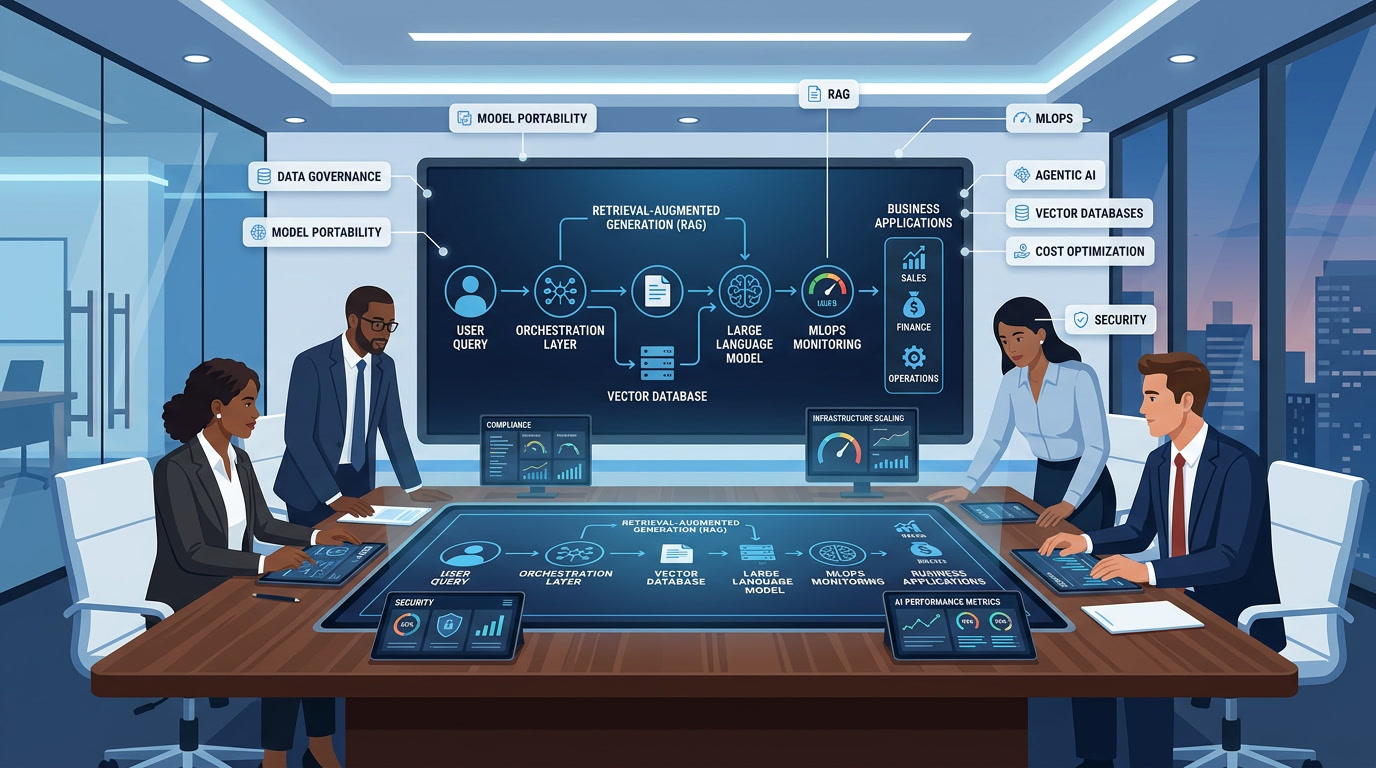
User Query
│
▼
Orchestration Layer (LangChain / LlamaIndex / custom agent runtime)
│
├──► Retrieval Layer ──► Vector DB (Pinecone / Milvus / pgvector)
│ │
│ ▼
│ Reranking + Context Assembly
│
▼
LLM Inference (with fallback + guardrails)
│
▼
Evaluation & Drift Monitoring (MLOps loop)
│
▼
Response to User
Orchestration frameworks. Tools like LangChain and LlamaIndex handle the plumbing between retrieval, tool calls, and model inference. The question isn’t whether a vendor has touched these frameworks — most have — but whether they understand when not to use them. Heavy framework abstraction adds latency and debugging overhead that a lean custom orchestration layer often avoids for well-defined workflows.
Retrieval-Augmented Generation (RAG). A partner should be able to speak fluently about chunking strategy, embedding model selection, hybrid search (combining dense vector search with keyword/BM25 retrieval), and reranking — not just “we connect it to a vector database.” Poor chunking is the single most common cause of RAG systems that retrieve technically relevant but practically useless context.
Vector databases. Pinecone, Milvus, and pgvector each carry different tradeoffs around latency, cost at scale, and operational complexity for teams already running PostgreSQL. A partner defaulting to the same vector store regardless of the client’s existing infrastructure is optimizing for their own familiarity, not the client’s total cost of ownership.
MLOps and drift detection. Once a model ships, its performance degrades as the world changes, and LLM behavior can shift silently when an upstream provider updates a model version. Serious partners implement evaluation harnesses that run continuously against a labeled test set and alert on regression — not manual spot-checks after user complaints roll in.
Cloud infrastructure scaling. Inference costs scale differently than traditional compute; a system that’s economical at 100 daily active users can become financially unworkable at 10,000 without caching, batching, and model-tiering strategies (routing simple queries to smaller, cheaper models and reserving frontier models for genuinely complex reasoning). Teams building on top of existing enterprise software architecture should confirm the AI layer integrates with, rather than bypasses, existing scaling and observability tooling.
Industry Competency Filters
Generic AI competence doesn’t automatically translate into sector-ready delivery. Compliance requirements, data sensitivity, and domain-specific failure modes vary enormously across industries, and a partner without direct experience in the buyer’s sector will spend the client’s budget relearning lessons that specialized teams already know.
In FinTech, this means understanding transaction-level audit trails, model explainability requirements for credit decisioning, and the security posture regulators expect around real-time payment data. Teams evaluating vendors for financial use cases can review how sector-specific engagements are scoped through FinTech and financial software development services, and how AI integration specifically applies to banking workflows in this breakdown of why financial institutions invest in AI integration.
In healthcare, HIPAA-driven data isolation isn’t optional and it isn’t retrofittable — it has to be designed into the pipeline from the first data flow diagram, including how PHI is masked or excluded from any logs used for model evaluation.
In SaaS, the constraint shifts toward multi-tenant scalability: an AI feature that works cleanly for one tenant’s data volume needs isolation guarantees so that one tenant’s usage spike or malformed input doesn’t degrade performance for every other tenant on the platform. This is a recurring design challenge covered in more depth in this look at AI implementation across SaaS platforms.
In HR technology, AI-driven candidate screening carries its own bias-auditing and explainability obligations, which is why teams building recruitment or workforce-management tools tend to work with partners who have direct HR tech development experience rather than general-purpose AI generalists.
Red Flags to Watch For
Some warning signs are visible before a single line of code gets written — during the sales conversation itself.
- Wrapper-only agencies. Teams that pitch “we integrate ChatGPT into your product” as their core capability, with no engineering depth beyond calling a hosted API, can’t troubleshoot latency issues, can’t optimize token spend, and can’t build the evaluation infrastructure that separates a demo from a production system.
- No fine-tuning or model-customization track record. If every past project used an off-the-shelf model with no customization, ask directly how they’d approach a use case that genuinely needs it — the answer reveals whether the gap is a deliberate choice or a capability ceiling.
- Vague data security answers. A partner who can’t specify where embeddings are stored, how prompts are logged, and what happens to client data used in fine-tuning has not thought seriously about the client’s compliance exposure.
- Rapid timelines with no discovery phase. AI projects that skip a structured data audit before quoting a delivery date are quoting a fiction. Data quality issues discovered mid-build are the single largest source of AI project overruns.
- No mention of evaluation or monitoring in the proposal. If the Statement of Work stops at “deploy the model,” the partner has scoped a demo, not a product.
Delivery Models and Engagement Frameworks
The right engagement structure depends less on budget and more on how much AI maturity already exists inside the organization.
| Engagement Model | Best Fit | Typical Duration | Internal Oversight Needed |
|---|---|---|---|
| Team Augmentation | Organizations with an existing engineering org and internal AI/ML leadership that need specialized capacity | Ongoing, flexible | High — internal leads set architecture direction |
| Dedicated AI Squad | Companies scaling multiple AI initiatives without a large internal AI team yet | 6+ months | Moderate — joint governance, external architectural ownership |
| Project-Based Delivery | A single, well-scoped use case with a defined end state (e.g., one RAG-powered internal tool) | 8–16 weeks | Low — clear handoff and documentation required |
Organizations still building internal AI capability often start with a dedicated development team model to get sustained architectural ownership without the overhead of a full internal hire, while companies validating a single use case tend to favor scoped, team augmentation arrangements that plug directly into an existing sprint cadence.
Calculating Total Cost of Ownership (TCO) vs. Long-Term Value
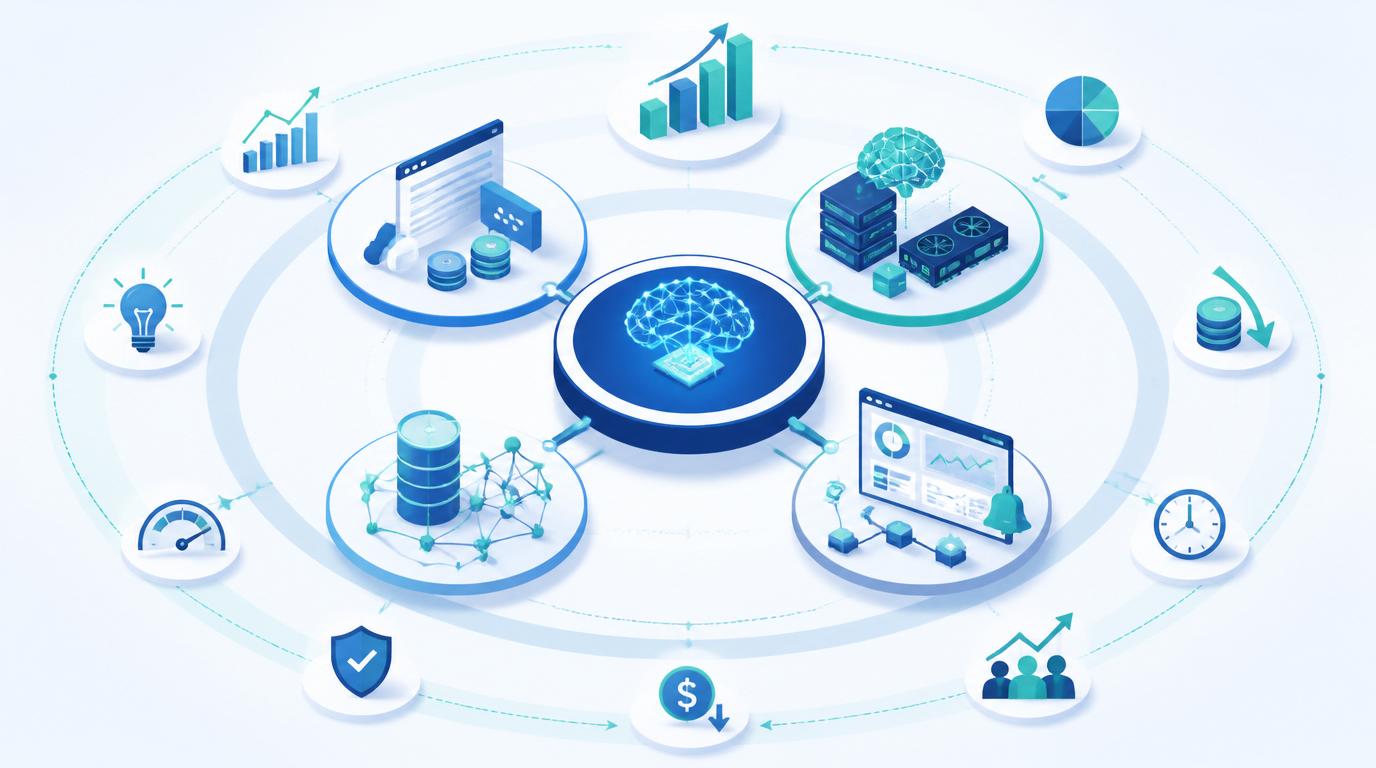
The sticker price on an AI build almost never reflects the real cost of running it. Four categories consistently get underestimated in vendor quotes:
- Token consumption at scale. A system priced against pilot-phase usage volumes can see inference costs multiply well beyond the original estimate once usage scales, particularly with unoptimized prompt lengths and no caching layer for repeated queries.
- Fine-tuning and retraining compute. Any use case requiring custom model training carries ongoing compute costs for retraining as data drifts, not just a one-time setup cost.
- Vector database infrastructure. Hosted vector DB costs scale with both storage volume and query throughput, and can become a meaningful line item once retrieval corpora grow past the pilot dataset.
- Post-launch monitoring and maintenance. Evaluation pipelines, drift alerts, and periodic re-benchmarking against new model versions require ongoing engineering time that rarely appears in an initial project quote.
Evaluating a vendor’s TCO transparency — whether they proactively model these four categories or leave them for the client to discover post-launch — is itself a useful signal of engineering maturity.
AI Project Readiness Checklist
Before approaching any vendor, internal teams should be able to check off the following:
- A named executive sponsor with authority to make data-access decisions
- A defined, measurable success metric (not “improve efficiency” — an actual number)
- An inventory of the data sources the AI system would need access to, including sensitivity classification
- Clarity on regulatory constraints (HIPAA, GDPR, SOC 2, industry-specific requirements)
- A realistic budget range that includes post-launch monitoring, not just initial build
- Internal stakeholders identified for ongoing model evaluation and feedback
Architecture Capability Checklist
When auditing a vendor’s technical stack directly, confirm they can speak concretely — not generically — about:
- Orchestration framework choice and the reasoning behind it for the specific use case
- Chunking and embedding strategy for any RAG component
- Vector database selection criteria relative to the client’s existing infrastructure
- Evaluation harness design and how regressions get caught before reaching users
- Fallback behavior when a model call fails, times out, or returns malformed output
- Logging and observability approach that respects data sensitivity constraints
- Model-tiering or cost-optimization strategy for inference at scale
Discovery Call Questions Framework
These are the direct questions worth asking on a first vendor call — the answers separate engineering depth from sales polish:
- “Walk me through a project where your initial architecture didn’t survive production traffic. What did you change?”
- “How do you version and test prompts the same way you’d version and test code?”
- “What’s your approach when a model provider deprecates or changes the model you built around?”
- “Show me an evaluation dashboard from a past project — not a mockup, an actual one.”
- “What happens to our data if we end the engagement — is anything retained in fine-tuned weights or logs?”
- “What’s the largest cost overrun you’ve seen on an AI project, and what caused it?”
Decision Matrix for Vendor Selection
| Organizational Priority | Weight This Toward | Deprioritize |
|---|---|---|
| Regulatory-heavy industry (finance, healthcare) | Compliance track record, data isolation design | Fastest delivery timeline |
| Rapid market validation of a new AI feature | Project-based delivery, fast discovery phase | Deep MLOps investment upfront |
| Multiple AI initiatives planned over 12+ months | Dedicated squad model, architectural ownership | Lowest hourly rate |
| Limited internal AI/ML expertise | Partner willingness to document and transfer knowledge | Vendors offering “black box” delivery |
| High-scale consumer-facing product | Cost-optimization and model-tiering experience | Boutique labs with no production-scale references |
Vendor Evaluation Scorecard
| Criteria | Evaluation Metric | Weighting |
|---|---|---|
| Technical architecture depth | RAG, orchestration, and MLOps fluency demonstrated with specifics | 25% |
| Industry/domain experience | Direct references in the buyer’s regulatory or business context | 20% |
| Data security & compliance posture | Documented data handling, isolation, and audit practices | 20% |
| Delivery track record | Verifiable production deployments, not just pilots | 15% |
| Cost transparency | Proactive TCO modeling across build and run phases | 10% |
| Communication & governance fit | Reporting cadence, escalation paths, documentation standards | 10% |
AI Partner Comparison Table
| Attribute | Tier-1 Enterprise Partners | Boutique AI Labs | Traditional Outsourcers |
|---|---|---|---|
| Architectural depth (RAG, MLOps, agents) | Very high, often bespoke research-grade | High, narrow specialization | Variable, often surface-level |
| Industry compliance experience | Broad, cross-sector | Deep in 1–2 verticals | Inconsistent |
| Typical engagement size | Large, multi-year programs | Focused, single-use-case | Broad staffing, less AI-specific ownership |
| Cost structure | Premium, enterprise overhead | Mid-to-premium, lean teams | Lower hourly rates, higher hidden costs |
| Speed to production | Slower, heavier governance layers | Fast, high technical ownership | Fast quotes, frequently unrealistic |
| Best fit | Large regulated enterprises with complex, multi-system AI programs | Companies needing deep expertise on one well-defined use case | Commodity staffing needs, not core AI architecture |
For companies sitting between the boutique-lab and traditional-outsourcer categories — needing enterprise-grade architectural rigor without enterprise-scale overhead — a specialized AI development team structured around dedicated squads tends to close that gap most efficiently, particularly for organizations that have already validated a use case internally and need production-grade execution.
Frequently Asked Questions
How do I choose an AI software development company? Start by classifying the use case as generative or predictive AI, then audit candidate vendors against the four pillars that predict project survival: architectural depth (RAG, orchestration, MLOps), industry compliance experience, data security posture, and cost transparency across build and run phases — not just the initial quote.
What questions should I ask an AI vendor? Ask for specifics, not assurances: a past architecture that failed and what changed, how prompts get versioned and tested, what happens when a model provider changes versions, and what data gets retained after the engagement ends. Vague answers to any of these are the clearest disqualifying signal.
What experience should an AI development company have? Direct, verifiable production deployments — not pilots — in the buyer’s regulatory context, plus fluency across the full stack: orchestration frameworks, RAG pipeline design, vector database selection, and drift monitoring. A portfolio heavy on demos and light on production references is a gap worth probing directly.
How much do AI development services cost? Costs vary widely by scope, but the bigger risk is underestimating total cost of ownership rather than the initial build price. Token consumption at scale, fine-tuning compute, vector database infrastructure, and post-launch monitoring routinely add 30–50% beyond initial build estimates when not modeled upfront.
What are common AI project risks? The most frequent failure points are architectural debt from deterministic-style pipelines applied to probabilistic systems, vendor lock-in from single-provider tooling with no abstraction layer, data quality issues discovered mid-build rather than during discovery, and no evaluation harness to catch silent model drift after launch.
Should I hire an AI agency or build an in-house team? It depends on how many AI initiatives are planned and how mature the internal engineering org already is. A single, well-scoped use case often fits a project-based external engagement; multiple ongoing initiatives without existing internal AI leadership tend to benefit from a dedicated external squad that can transfer architectural ownership over time rather than a from-scratch internal build.
What makes a good long-term AI partner? Proactive cost and risk transparency, willingness to document and transfer architectural knowledge rather than build a black box, a track record of production — not pilot — deployments, and evaluation infrastructure that catches problems before users do rather than after complaints arrive.